I have sometimes wondered whether my attention to detail is a strength, a burden, or simply a habit I never learned to turn … [Read More...]
Essay — Long Form
May 2026
Human Nature · Hubris · The Performance of Knowing
The Last Demonstration:
On Proof, Pride, and the Fatal Theatre of Expertise
A man who had thrown himself against glass a hundred times died the hundred-and-first time. The glass didn’t change. Something else did. And in that terrible gap between knowing and doing, an entire human condition waits to be examined.
On a sweltering July afternoon in 1993, a 38-year-old Toronto lawyer named Garry Hoy walked to the edge of a window on the 24th floor of the Toronto-Dominion Centre, faced a group of articling students, and launched himself into the glass. It held. Buoyed by the confirmation of what he already knew, he did it again. This time the glass didn’t shatter. It popped, clean and whole, from its frame — and Garry Hoy fell 24 stories to his death.
The coroner’s verdict was death by misadventure. The newspapers, inevitably, couldn’t resist. He won a Darwin Award posthumously, that peculiar internet-era garland reserved for people who remove themselves from the gene pool through spectacular self-defeat. Late-night hosts chuckled. Office workers forwarded it around on early email. A man died, and the world found it funny.
I have been thinking about Garry Hoy for a long time. Not about the tragedy of his death — though it was tragic — but about something far more unsettling: the possibility that he was completely right, right up until the moment he wasn’t.
“The glass held every single time before. His confidence was not irrational. It was, in the language of probability, perfectly well-calibrated — until it wasn’t.”
— On the nature of inductive certaintyThis is the story I want to tell. Not about foolishness, but about the seduction of proof. About what happens when expertise becomes performance. About the razor-thin line between knowing something and needing others to know that you know it. About what philosophers, behavioural scientists, and the great humanists of literature have understood for centuries: that the most dangerous moment in any person’s life is not when they are ignorant — it is when they are certain.
· · ·
I.
The Architecture of Certainty
To understand what happened on that July afternoon, you have to understand how human beings build the edifice of certainty in the first place. We do not reason from first principles every morning when we walk down stairs or turn on a tap. We rely on pattern. We rely on memory. We rely on the accumulated evidence of ten thousand unremarkable confirmations that the world is the way it appears to be.
The philosopher David Hume called this the problem of induction — the famous chicken-and-sunrise problem. A chicken has seen the sun rise every morning of its life. It expects the sun to rise tomorrow. Then comes the day it doesn’t, or the day the farmer comes instead. The chicken’s confidence was not irrational; it was simply built on an insufficient sample of an unpredictable universe. Garry Hoy was Hume’s chicken in a three-piece suit, on the 24th floor.
Context
The Toronto-Dominion Centre, where Hoy worked, was designed by Mies van der Rohe — the architect who gave modernism its famous dictum: “God is in the details.” The building’s glass panels were, by any engineering standard, extremely strong. Strong enough to withstand the force of a grown man throwing himself against them. Every single time before. What they were not designed to withstand was lateral force on the frame itself — the invisible variable that Hoy’s confidence never accounted for.
The structural engineer Bob Greer, commenting on the incident, reportedly remarked that he knew of no building code in the world that would allow a 160-pound man to run against a glass and withstand it. But here is what that statement obscures: the glass had withstood it. Many times. The failure was not in the glass. The failure was in the frame — in the hidden system that held the glass in place, a system that had been weakening, millimetre by millimetre, with each of Hoy’s previous demonstrations. He wasn’t testing the glass. He was eroding its foundation.
The metaphor is almost too elegant to bear.
· · ·
II.
When Knowledge Becomes Theatre
There are two kinds of knowing. There is the private kind — the quiet confidence that comes from genuine understanding, held internally, consulted when needed, and never requiring an audience. And there is the performed kind — the knowledge that only becomes real when witnessed, validated, and applauded. The first kind is wisdom. The second kind is a vulnerability dressed up as strength.
Garry Hoy was, by all accounts, a brilliant lawyer. Senior partner at Holden Day Wilson. A man known for his intellectual rigour, his fascination with engineering, his precise and disciplined mind. In a different context, his demonstrations of the window’s strength might have been charming — a party trick that delighted and impressed. But on that particular afternoon, something shifted. He was performing for articling students. Young lawyers at the beginning of their careers, looking up at a man at the top of his. The asymmetry of that audience matters enormously.
“We do not perform our competence for equals. We perform it for those who might doubt us — or for ourselves, when our own doubt grows too loud to ignore.”
The sociologist Erving Goffman, in his landmark 1959 work The Presentation of Self in Everyday Life, described human social interaction as an elaborate theatrical performance — “dramaturgy,” he called it. Every person, in every social encounter, is simultaneously actor and audience, performing a version of themselves calibrated to the expectations of the room. The expert performs expertise. The leader performs authority. The confident person performs certainty — and in performing it, often comes to believe it more completely than the evidence warrants.
This is the mechanism that I believe was operating on the 24th floor of the Toronto-Dominion Centre. Not recklessness. Not stupidity. Dramaturgy. The performance of a self — the self that knows, the self that is not afraid, the self that can be trusted — in front of precisely the audience most likely to amplify the seduction of that performance.
· · ·
III.
The Hubris Problem: A Very Old Story
The ancient Greeks had a word for it, of course. They always did. Hubris — the overweening pride that invites the punishment of the gods. But the Greeks were too sophisticated to make hubris simply about arrogance. The truly terrifying Greek insight, the one that runs through Oedipus and Agamemnon and Icarus alike, is that hubris is most dangerous in the person who has actually earned the right to be confident. It is not the fool who flies too close to the sun. It is the brilliant craftsman’s son, the one who genuinely has wings, the one who has every reason to trust them.
Icarus did not fall because he was careless. He fell because he had flown so well, for so long, that the experience of competence overwhelmed the instruction of caution. The wax was real. The wings were real. The sun was real. And the gap between those realities — the failure to account for the interaction between a known success and an unexamined variable — is the entire story of human overreach, in every domain, in every age.
In our own time, the annals of professional catastrophe are full of Garry Hoys. Not people who didn’t know what they were doing, but people who knew exactly what they were doing — and therefore stopped asking whether they should be doing it. The engineers at Morton Thiokol who knew the O-rings on the Challenger were vulnerable to cold but struggled to communicate the weight of their knowledge against the momentum of institutional confidence. The traders at Long-Term Capital Management — two Nobel laureates among them — who built models of such breathtaking elegance that they forgot the models were models. The surgeons whose complication rates rise, rather than fall, after a run of successes. Competence can be a drug. And its most addictive form is competence witnessed.
A parallel worth sitting with
In Daniel Kahneman’s Thinking, Fast and Slow, he describes the “illusion of validity” — the well-documented tendency of experts to grow more confident in their predictions even when their track records don’t warrant it. The more fluently a story comes to mind, the truer it feels. Garry Hoy’s story — the strong glass, the reliable frame, the intact lawyer — was the most fluent story in the room. It had been confirmed a hundred times. What chance did caution have against that kind of narrative momentum?
· · ·
IV.
The Audience We Perform For
I want to stay with the question of audience for a moment, because I think it is the part of this story that most of us are most reluctant to examine in ourselves.
When we perform our expertise — when we throw ourselves against the glass — who are we really doing it for? The young articling students standing in that Toronto boardroom had everything to gain from seeing Hoy’s trick succeed. Their admiration was the most obvious reward on offer. But I suspect Hoy was also performing for a more demanding audience: the part of himself that needed the knowledge to be confirmed again, publicly, in front of witnesses. Because private knowledge, unwitnessed knowledge, is somehow never quite enough. We want our knowing to be seen. We want our confidence to be legible. We want the room to understand, beyond all doubt, that we are the person who knows.
There is something deeply human in that want. And something deeply perilous.
The poet Rainer Maria Rilke, in his Letters to a Young Poet, wrote one of literature’s most quietly radical pieces of advice: “I would like to beg you, dear Sir, as well as I can, to have patience with everything unresolved in your heart and to try to love the questions themselves.” Rilke was writing about the interior life, about the spiritual practice of sitting with uncertainty. But his words carry a professional and intellectual weight that I have been returning to for years. The willingness to love the questions — to not rush toward answers, demonstrations, proofs — is one of the rarest and most valuable forms of professional courage.
Garry Hoy did not love the question. He had already answered it. The window was strong. He knew. He had always known. And the knowing had become, over time, something he could not bear to leave private.
· · ·
V.
What Leaders Get Wrong About Confidence
I work with leaders. I have spent a significant portion of my professional life helping people navigate complexity — inside organisations, inside communities, inside the fog of their own expertise and experience. And the pattern I return to most often, the one that sits at the centre of my work, is this: the leaders who cause the most damage are rarely the ignorant ones. They are the competent ones who have confused their competence for completeness.
True authority — the kind that actually moves people, builds institutions, and earns lasting trust — is not performed. It is practised. It lives in the quiet, unglamorous discipline of continuing to test your assumptions even when you’ve confirmed them a hundred times. It lives in the recognition that confidence shared too loudly becomes a cage rather than a gift. It lives in what the Japanese call shoshin — beginner’s mind — the Zen concept that holds that the expert who approaches their field with the openness of a beginner will always outperform the expert who has closed their mind with the weight of what they already know.
“The most dangerous four words in leadership are not ‘I don’t know this.’ They are ‘I already know this.’”
Margaret Heffernan, in her remarkable book Wilful Blindness, argues that the failure to see what is inconvenient — what challenges our existing model of the world — is not a cognitive error so much as a social one. We surround ourselves with people who confirm what we believe. We build careers on the foundations of ideas that once worked. We reward confidence and punish uncertainty. And then we express horror when the confident and unreflective fail spectacularly.
But the horror is misplaced. We built the system that produced the failure. Every time we promoted the certain over the careful, the decisive over the deliberate, the performer over the practitioner, we moved another millimetre of erosion into the frame that holds the glass.
· · ·
VI.
The Frame, Not the Glass
I keep coming back to what the structural engineer said. The glass was not the problem. The frame was the problem. The invisible infrastructure. The system of small, unremarked connections that held everything in place — until it didn’t.
In every domain of human endeavour, there is a version of the frame problem. In medicine, it shows up as the invisible cumulative wear of diagnostic overconfidence — the senior physician whose pattern recognition is so finely honed that it stops generating hypotheses and starts generating verdicts. In finance, it shows up as the slowly eroding risk culture inside institutions that have not had a crisis in a generation. In relationships, it shows up as the assumption that what has held together for years will continue to hold together without attention, without renewal, without the patient work of maintenance.
We test the glass. We forget the frame. We test the part that is visible, dramatic, and confirmable. We ignore the slow accumulation of stress in the connections we cannot see. And when the frame gives way, we call it an accident. A misadventure. A freak event. We do not call it what it actually is: the predictable consequence of confident neglect.
The philosopher Nassim Nicholas Taleb, in The Black Swan, describes the phenomenon of “silent evidence” — the data we never see because the events that would have generated it did not survive. We see the swimming champion; we do not see the thousand equally talented swimmers who trained with equal dedication and simply did not make it. We see Garry Hoy’s last demonstration. We do not see the hundred previous ones, and we have no way to factor their success into an accurate model of what was actually happening to the frame each time.
Every success conceals a hidden cost. The question is whether we are building systems — personal and professional — that can see those costs before they become irreversible.
· · ·
VII.
The Humanity of It All
I want to be careful, here at the turning point of this essay, not to reduce Garry Hoy to a lesson. He was not a lesson. He was a person — a brilliant, passionate, physically and intellectually courageous person who wanted to share something he loved with a group of young people at the beginning of their careers. There is something genuinely beautiful in that impulse, even as there is something genuinely tragic in its consequence.
The humanist in me recoils from the Darwin Award, from the sneering laughter that greeted his death. It is easy, and deeply unsatisfying, to explain human tragedy through the lens of stupidity. It is harder, and far more honest, to look at what Garry Hoy did and recognize in it something we all carry: the need to be believed. The need to prove. The need to perform, for others and for ourselves, the person we have worked so hard to become.
Albert Camus, in The Myth of Sisyphus, argues that the fundamental question of human existence is not whether life is fair, but whether it is worth living in full knowledge of its absurdity — its tendency to offer up the wrong window frame at precisely the wrong moment. His answer, famously, is that we must imagine Sisyphus happy. That the willingness to push the boulder, knowing it will roll back, is itself a form of heroism. That meaning is made in the act, not the arrival.
I am not sure Camus would have approved of my use of his philosophy here. But what strikes me is this: Garry Hoy pushed the boulder. He pushed it because he believed in it. And the tragedy is not that he pushed — the tragedy is that no one in the room, not even he himself, had the presence of mind to ask: but what is happening to the frame?
· · ·
VIII.
What We Owe Each Other
The articling students who witnessed Garry Hoy’s death that afternoon were not bystanders. None of us are, when we stand in the presence of performed certainty. When we watch the senior partner throw himself against the glass, we become part of the event. Our silence is a form of participation. Our admiration is a vote for continuation.
This is, I think, the most practically important thread in this entire story. We have built professional cultures — legal, medical, financial, political — in which the expression of doubt is a form of social risk. To say “I’m not sure that’s safe” in the presence of the expert performing their expertise is to commit a kind of social transgression. It reads as insubordination. As naivety. As a failure to understand how things are done around here.
James Reason, the British psychologist who spent his career studying human error, introduced the concept of “organizational accidents” — failures that are not caused by a single bad actor or a single bad decision, but by an accumulation of small, unremarkable choices, each individually defensible, that together create the conditions for catastrophe. Every choice to not ask the question. Every choice to laugh at the trick instead of examine the frame. Every choice to reward the performance instead of the practice.
We produce Garry Hoys in our organizations. We promote them. We celebrate them. And then, when they fall, we write the obituary in the passive voice and call it a misadventure.
“Psychological safety — the freedom to speak up without fear of humiliation — is not a soft culture initiative. It is the frame that holds the glass.”
Amy Edmondson of Harvard Business School has spent three decades documenting what she calls “psychological safety” — the team culture variable that most consistently predicts organizational performance, resilience, and the capacity to avoid catastrophic failure. It is the freedom to say, without social cost, “I think we should check the frame.” It is the freedom of the articling student to put up a hand and ask: “Garry, have you considered what’s happening to the window mounting over time?”
No one in that room exercised that freedom. And we cannot know whether, if they had, it would have made any difference. But we can build the systems — in our organizations, our relationships, our professional cultures — where that question is not only possible but welcomed. Where the person who asks it is not seen as undercutting the expert, but as doing the expert the highest honour: treating them as someone who can handle the truth.
· · ·
Coda
A Final Word on Peter Pan
The passage that opens the story I began with — “To die will be an awfully big adventure” — comes from J.M. Barrie’s Peter and Wendy, spoken by a boy who cannot die, in a world where consequences are always one step removed from reality. Peter Pan is the great literary monument to the seduction of invincibility. He never grows up not because he refuses to — it is because growing up, in Barrie’s vision, is inseparable from the experience of failure, loss, and the revision of certainty that comes from being genuinely hurt by the world.
Garry Hoy was not Peter Pan. He had grown up. He had built a real career, earned real expertise, accumulated real knowledge. But in the moment of that second demonstration — the one with the students watching, the one with everything already proven once — something in him reached for the Neverland logic: the glass held before, so the glass will hold again, and holding it will feel magnificent, and the students will remember it, and I will be the person who knew.
Growing up — really growing up, not just ageing — means accepting that the glass held last time and may not hold this time. That each demonstration is a new event, not a confirmation of an old one. That the appropriate response to a hundred successes is not a hundred-and-first performance, but a quiet question: what have I not checked?
Peter Pan thought death would be an awfully big adventure. Garry Hoy, I suspect, thought the window would hold. Both were wrong about the physics of the world they lived in. One was a fictional boy in a story about the price of permanence. The other was a real man in a building in Toronto, on an afternoon in July, with students watching.
We remember him with laughter. I think we owe him more than that. I think we owe him the harder tribute: to look at the frame we are all leaning against, and ask, quietly, sincerely, without an audience — how strong, really, is this?
· · ·
About the Writing
What you’ll find here is my voice, my lens, and my learning. The thoughts, stories, opinions, and models I share are entirely my own. They don’t speak for any employer, partner, or organization I’ve worked with or currently work with. This is personal — my space to explore, to reflect, and to build on what I see and experience.
I help people and organizations navigate complexity to make tough decisions. I write at the intersection of leadership, technology, and human agency — where values meet decisions, and intention drives impact. My work explores how we lead consciously, act deliberately, and shape systems that serve people, not just progress.
Live in Ottawa. Passionate Canadian. Serial Ideator. Aspiring Social Innovator. Bits and pieces Cricket Player. Lifelong Cricket Fan. Solution Addict.
Manu Sharma
Ottawa, Canada · May 2026

I don’t think we notice the people who hold us up until something gently forces us to look.
There is a moment from yesterday that has stayed with me. Nothing dramatic. Just a long day in the garden, soil under our nails, the quiet satisfaction of preparing for something that will only reveal itself months from now. I was putting the tools away when I heard a small sound behind me. I turned, and there she was. My mother. A glass of water in her hand. A soft smile. A look that said she had already seen what I had not yet registered in myself.
I hadn’t asked. I hadn’t even thought of it. She simply noticed.
I think about this ability of hers often. Not just as an act of care, but as a way of being. The ability to read a moment without making a statement out of it. To respond without needing recognition. To show up in ways that feel almost invisible in real time, but stay with you long after.
Later that evening, as I sat down to eat my dinner, I was scrolling through Netflix and came across Nonnas. I was looking for something light. What I found instead was something that asked a little more of me.
The film circles around a loss many of us spend our lives quietly avoiding in our thinking. The loss of a mother. There is a line that lands with a kind of finality that is hard to argue with. You cannot say goodbye to someone after sixty years. It is not possible. Another truth follows close behind. It does not matter how old you are. There is nothing harder than losing your mom.
I paused. Not because the idea was new, but because of how directly it was presented.
What stayed with me was not only the grief, but the recognition that sits underneath it. The realization that the most important people in our lives rarely announce their importance. They do not arrive with titles or declarations. They are simply present. Consistent. Steady. And we move through that presence as if it is permanent.
Until we are asked to imagine a world where it is not.
My mother’s life has not been defined by ease. She grew up as the only daughter among five brothers in a deeply loving family, but in a time that did not always extend the same fairness or opportunity to women as it did to others. Financial hardship added its own particular weight. To say life asked a great deal of her early on would be to state it quietly. What she faced would have defined many people, and not generously. Across her life, there were moments that could have shaped her in very different ways. What she did was something more deliberate than surviving it.
What stands out to me is not what she faced, but how she chose to respond to it.
She chose, again and again, to meet life on her own terms, with a kind of dignity that does not arrive from comfort but is forged slowly through everything that is not comfortable. She moved through difficult circumstances with a grace that never performed itself, a confidence that never needed an audience, a patience that I think most people spend their entire lives trying to acquire. Again and again, she met life with a quiet resolve. Not the kind that seeks attention, but the kind that builds over time. A steady dignity. A patience that does not rush to prove itself. A confidence that does not depend on anyone else’s acknowledgement.
I have said this in many settings, and I believe it more with each passing year. My mother is my favourite leader and my most important teacher. Not as a gesture, but as a conclusion I have arrived at through observation. When I think about what leadership actually requires, clarity, care, consistency, the ability to hold steady when things are uncertain, I realize that I learned most of it long before I had the language to describe it.
She did not teach through instruction. She taught through presence. Through stories shared at the right moment. Through choices made quietly but consistently. The lessons were not delivered. They were lived. And over time, they settled in.
I sometimes think we underestimate that kind of influence because it does not present itself in obvious ways. It does not demand attention. But in my experience, it is the most enduring form of leadership there is.
There is also something deeper here that I have come to appreciate more with time. In Hindu thought, the forces we revere most are often expressed in feminine form. The earth is not just land beneath our feet. She is Mother Earth. Knowledge is embodied as Saraswati. Wealth as Lakshmi. Strength and protection as Durga.
I have always found that meaningful. Not as symbolism alone, but as an understanding of what sustains us. That what nurtures, what enables growth, what holds things together without asking for recognition, is worthy of the highest regard. That care is not separate from strength. It is a form of it.
When I think about my mother in that context, it feels less like metaphor and more like precision.
In Nonnas, the son struggles to open a letter his mother left behind. He is not ready for her final words. There is something honest in that hesitation. It speaks to the depth of the relationship. Even when everything is prepared, even when nothing is left unsaid on paper, the moment itself can feel too heavy to carry.
He turns instead to what he can hold. Food. Recipes. The small rituals that keep her presence close. The film suggests, quietly, that as long as he has her food, he has her.
I understand that instinct. Memory does not live only in words. It lives in habits, in gestures, in the way someone shows up in your life so consistently that you begin to carry it forward without realizing.
But what the film also left me with was a more immediate question. Not about how we cope with loss, but about how we live before it arrives. Whether we are present enough now that when that day eventually comes, it does not carry the added weight of things left unsaid, moments left unattended.
I am not prepared for that day. I don’t think anyone is. But I do think we have more agency than we sometimes acknowledge in how we use the time before it.
Last night, after a full day beside her, after that small moment at the garage door, while eating an awesome meal prepared by her with love, I felt a kind of clarity settle in. Not dramatic. Just steady. A recognition that the most important parts of our lives are often built quietly, through repetition, through care that does not call attention to itself.
My mother has been a constant in that way. A source of grounding when things felt uncertain. A reference point for what matters when decisions were not simple. She has never made a show of it, but you always knew where you stood with her. You always knew what was right.
I believe that much of what I have been able to do in my life rests on a foundation she helped build long before I understood its value.
This Mother’s Day, I am not writing out of obligation. I am writing because it feels necessary to say these things while there is still time to say them. Because the people who shape us most deeply are often the ones we acknowledge the least in public.
If traditions have taught us anything, it is that the most powerful forces are not always the most visible ones. Sometimes they are the ones that sustain everything quietly, without asking for anything in return.
Thank you, Mom. For another glass of water. For the stories. For the way you have lived your life. For being my favourite and most powerful leader.
Happy Mother’s Day.
Happy Mother’s Day to every mother who has ever been someone’s lighthouse.
Distrust is often mistaken for intelligence.
We reward it in subtle ways. The quick skepticism, the raised eyebrow, the instinct to question motive before action. It feels sharp, even responsible. As if we are protecting ourselves from being misled, from being taken advantage of, from looking naive. And yet, I have come to believe that this reflex, when left unchecked, costs us more than it protects.
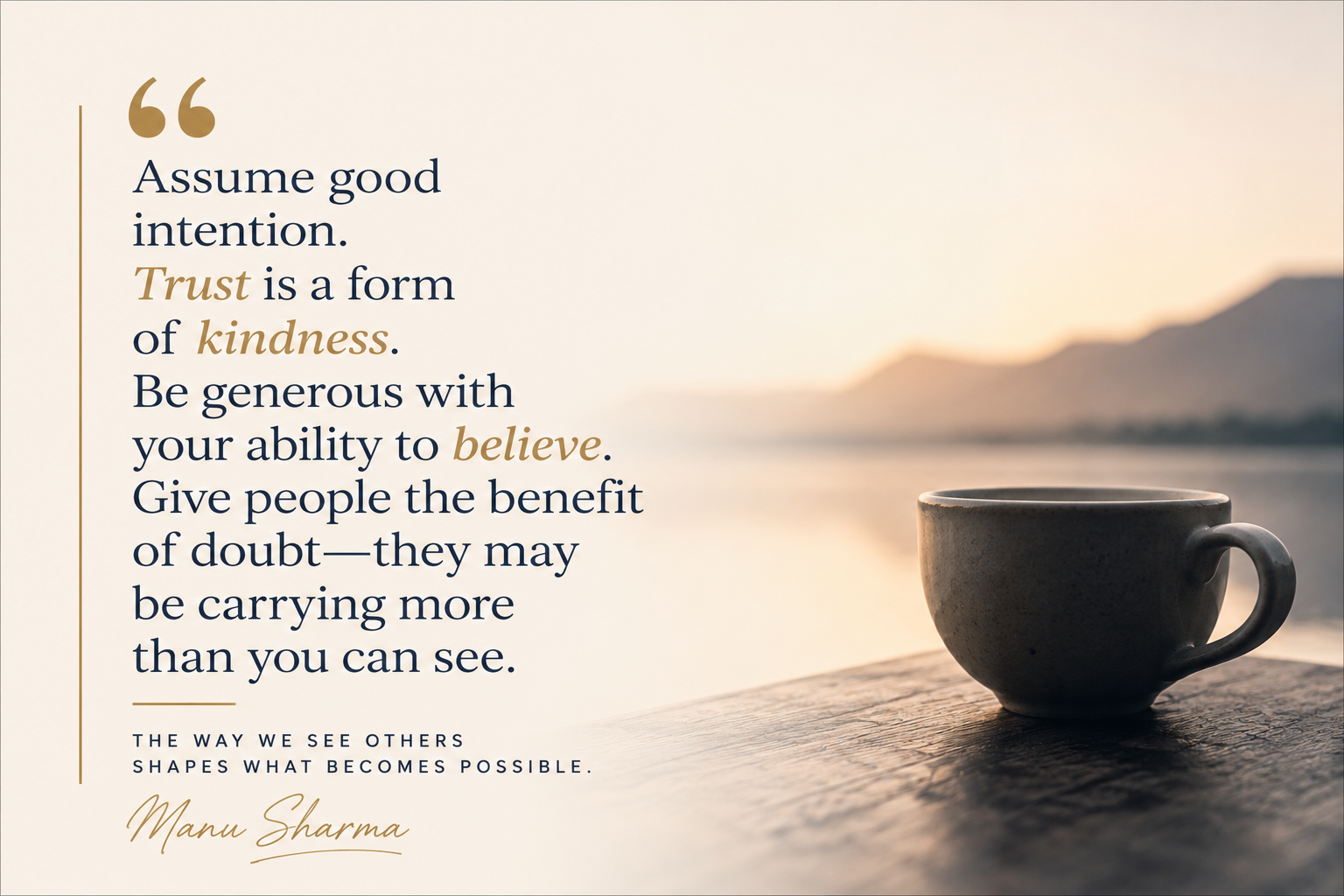
There is a quieter, less celebrated form of strength that sits on the other side of this instinct. It is the decision to assume good intention, not blindly, but deliberately. It is the choice to extend trust as an act of kindness, even when certainty is unavailable.
That choice is not about being right. It is about who we become in the presence of uncertainty.
I think about the many moments in life where people are not at their best. Not because they lack character, but because they are tired, unsure, or carrying something unseen. In those moments, what they are often asking for is not judgment. It is space. It is the chance to be seen without being immediately evaluated.
And this is where generosity shows up in a form that is rarely acknowledged. Not in what we give materially, but in how we interpret others.
To give someone the benefit of doubt is to momentarily suspend the need to be right about them. It is to say, “There may be more here than what I can see right now.” That simple shift can change the entire texture of an interaction.
In my experience, the most effective leaders and the most grounded individuals I have encountered carry this posture with intention. They are not blind to risk. They are not unaware of human complexity. They simply understand that default suspicion narrows possibility, while thoughtful trust expands it.
This does not mean accepting everything at face value. It means starting from a place that allows truth to emerge, rather than forcing it into a predetermined frame.
I have seen conversations soften because one person chose to believe first and question later. I have seen people regain confidence because someone refused to reduce them to a single moment or a single mistake. And I have seen teams move forward, not because everyone agreed, but because they felt respected enough to stay engaged.
Trust, in this sense, becomes a form of emotional infrastructure. It holds relationships steady when circumstances are unclear. It creates the conditions where honesty feels safer than performance.
I wonder sometimes how many opportunities we lose because we close the door too quickly on someone’s intent. How many relationships remain transactional because we hesitate to extend that first layer of belief. How many moments of growth are missed because we chose certainty over curiosity.
There is also a deeper layer to this. When we lead with trust, we are not only shaping how others feel, we are shaping our own internal state. Suspicion is heavy. It demands constant vigilance. It narrows our field of view. Trust, when applied with awareness, allows for a different kind of presence. One that is open, attentive, and less burdened by the need to control every outcome.
This is not a call for blind optimism. It is a call for disciplined generosity.
To assume good intention does not mean ignoring patterns or dismissing evidence. It means starting from a place that gives people the opportunity to show who they are, rather than deciding it for them too early. And when the evidence suggests otherwise, we adjust. Calmly. Clearly. Without resentment.
But we begin with belief.
Because in many cases, people rise or retreat based on how they are first received. When someone is met with trust, even a small amount, it often invites them to meet that trust with responsibility. Not always, but often enough that it matters.
From what I see, this is where leadership quietly differentiates itself. Not in the visible decisions alone, but in the invisible assumptions that precede them. The internal posture that shapes how we interpret behavior, how we respond under ambiguity, how we hold space for others when things are not fully clear.
Assuming good intention is not about others deserving it. It is about us choosing the kind of environment we want to create.
And perhaps more importantly, the kind of person we want to be within it.
There is a line I keep returning to in my own reflections. Be generous with your ability to believe. Not because the world will always justify it, but because without it, we shrink the very space where trust, confidence, and growth are meant to live.
In a time where doubt travels faster than understanding, choosing to believe well might be one of the most understated forms of leadership we have left.
There is a quiet kind of exhaustion that does not come from effort, but from resisting what will not yield.
It shows up in subtle ways. A conversation replayed long after it has ended. A decision you wish had gone differently. A situation that refuses to bend despite your best thinking. The mind circles it, not because there is something left to do, but because it struggles to accept that there is nothing left to change.
I have come to believe that much of what drains us is not the weight of our responsibilities, but the misplacement of our agency.
We spend time, emotion, and attention in places where our influence is either gone or was never real to begin with. And in doing so, we quietly withdraw from the few places where our presence might have actually mattered.
That trade is rarely visible in the moment. It feels like care. It feels like diligence. Sometimes it even feels like accountability. But over time, it becomes something else. It becomes noise. It becomes fatigue. It becomes a slow erosion of clarity.
Let’s be honest about something that is uncomfortable to admit. Not everything is ours to fix. Not every outcome is ours to shape. Not every moment calls for our intervention.
And yet, doing nothing can feel like failure.
So we fill the gap. We overthink. We revisit. We replay. We pray for movement where none is coming. We hold on, not because it is useful, but because letting go feels like giving up.
I do not see it that way anymore.
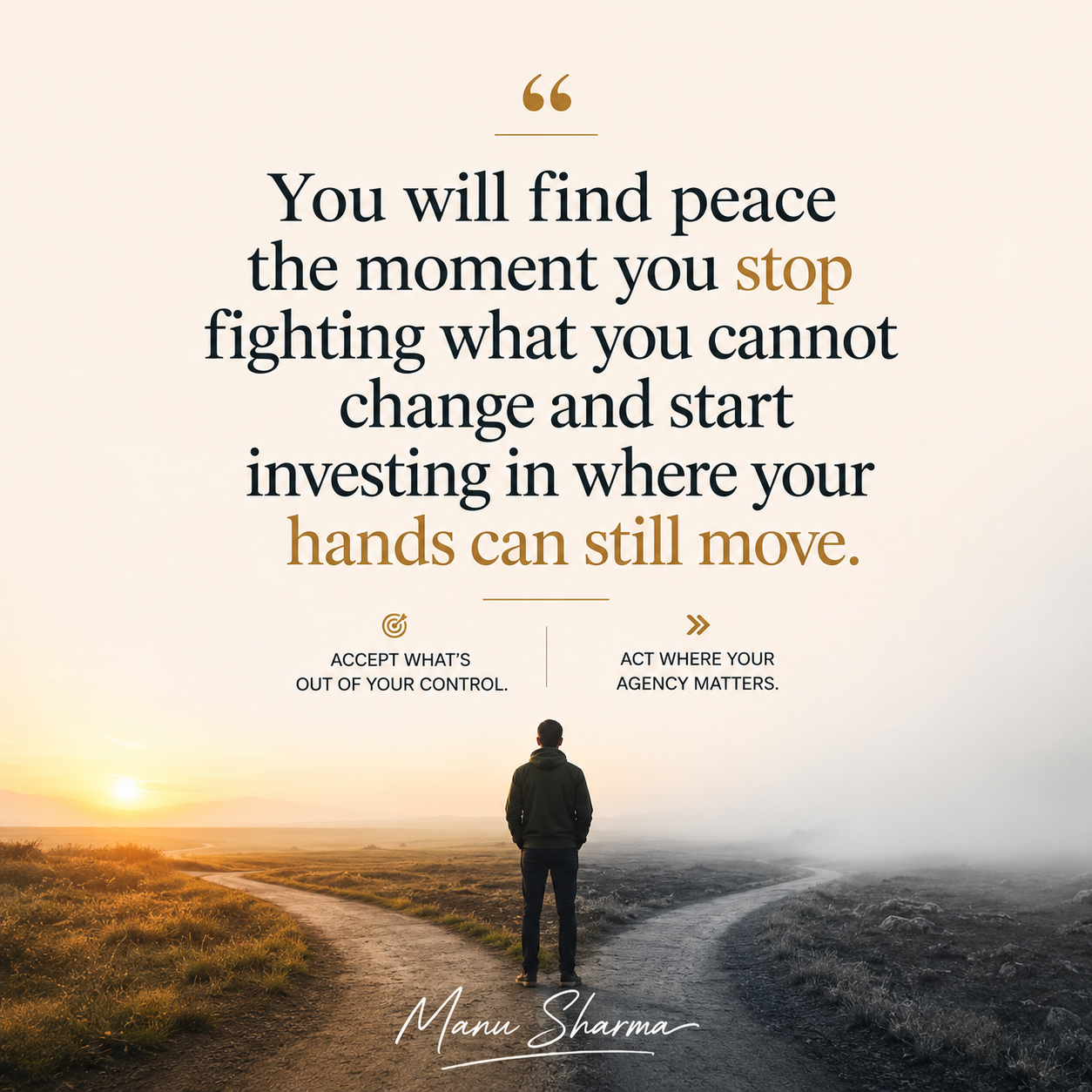
Accepting what you cannot control is not surrender. It is discernment.
It is the discipline to step back and ask a harder question than “What went wrong?” It is asking, “Where, exactly, do I still have the ability to influence this?”
That question changes everything.
Because it forces a shift from emotion to clarity. From reaction to intention. From scattered effort to directed action.
In my experience, the difference between those who feel stuck and those who move forward is not intelligence, capability, or even resilience. It is their relationship with agency.
They know when to lean in and when to step away. They recognize when their involvement creates movement and when it simply creates more friction. They do not confuse presence with impact.
This is not about becoming detached or indifferent. If anything, it requires a deeper level of engagement. You have to pay closer attention. You have to be more honest with yourself. You have to care enough to choose your involvement carefully.
There are moments when your voice matters. When your action changes the direction of something. When your decision opens or closes a path. In those moments, hesitation carries a cost. That is where you show up fully.
But there are also moments when the outcome is no longer in your hands. When the variables extend beyond your reach. When continuing to push does not create progress, it only creates strain.
The difficulty is that both moments can feel the same from the inside.
That is where reflection becomes a discipline, not a luxury.
I think about times when I held on too long. Not because it was the right thing to do, but because I had convinced myself that persistence alone would change the outcome. It rarely did. What it did instead was narrow my field of vision. I became so focused on one immovable point that I missed other paths that were quietly opening.
I wonder how often we do this without realizing it.
We anchor ourselves to a single version of how something should unfold. And when it does not, we interpret that as a problem to solve rather than a signal to reassess.
But not every closed door is a puzzle. Some are simply closed.
The work, then, is not to force them open. It is to turn around and ask where else your effort might actually matter.
This is where the idea of responsibility needs to be reframed.
Responsibility is not about carrying everything. It is about carrying what is truly yours.
Your actions. Your choices. Your response to what unfolds. The way you show up in the next moment, not the one that has already passed.
That is where your hands can still move.
And when you redirect your energy there, something shifts. The noise quiets. The regret softens. The sense of paralysis begins to lift, not because the situation has changed, but because your relationship to it has.
You stop negotiating with the past. You stop arguing with reality. You stop waiting for something external to give you permission to move forward.
You begin again, but this time with clarity.
I would contend that this is one of the most underdeveloped forms of discipline in leadership and in life. The ability to locate your agency with precision. To know where your effort will create movement and where it will only create exhaustion.
It is not a grand gesture. It is a series of small, quiet decisions made consistently.
Where do I step in?
Where do I step back?
Where do I let go?
Where do I commit fully?
These are not questions you answer once. They are questions you return to, especially when things feel uncertain.
Because uncertainty has a way of pulling us toward reaction. Toward urgency without direction. Toward doing something, anything, just to feel a sense of control.
But control is often the illusion. Agency is the reality.
And the sooner we learn to distinguish between the two, the more effective, and at peace, we become.
There is a certain calm that comes from this understanding. Not because life becomes easier, but because your energy is no longer scattered.
You are no longer sitting in your corner, replaying what cannot be changed, while the parts of your life that could move forward wait quietly for your attention.
You are present. You are intentional. You are engaged where it counts.
And that, I think, is where meaningful progress begins.
There is a strange irony in how much information we have access to and how little of it truly stays with us.
I notice it in myself at times. I can move through a dozen ideas in a single hour, watch, listen, absorb, react. It feels productive. It feels like learning. But if I pause and ask a simple question a few days later, what did I really take with me, the answer is often thinner than I would like.
I think this is where something older, quieter, and far less celebrated still holds its ground.
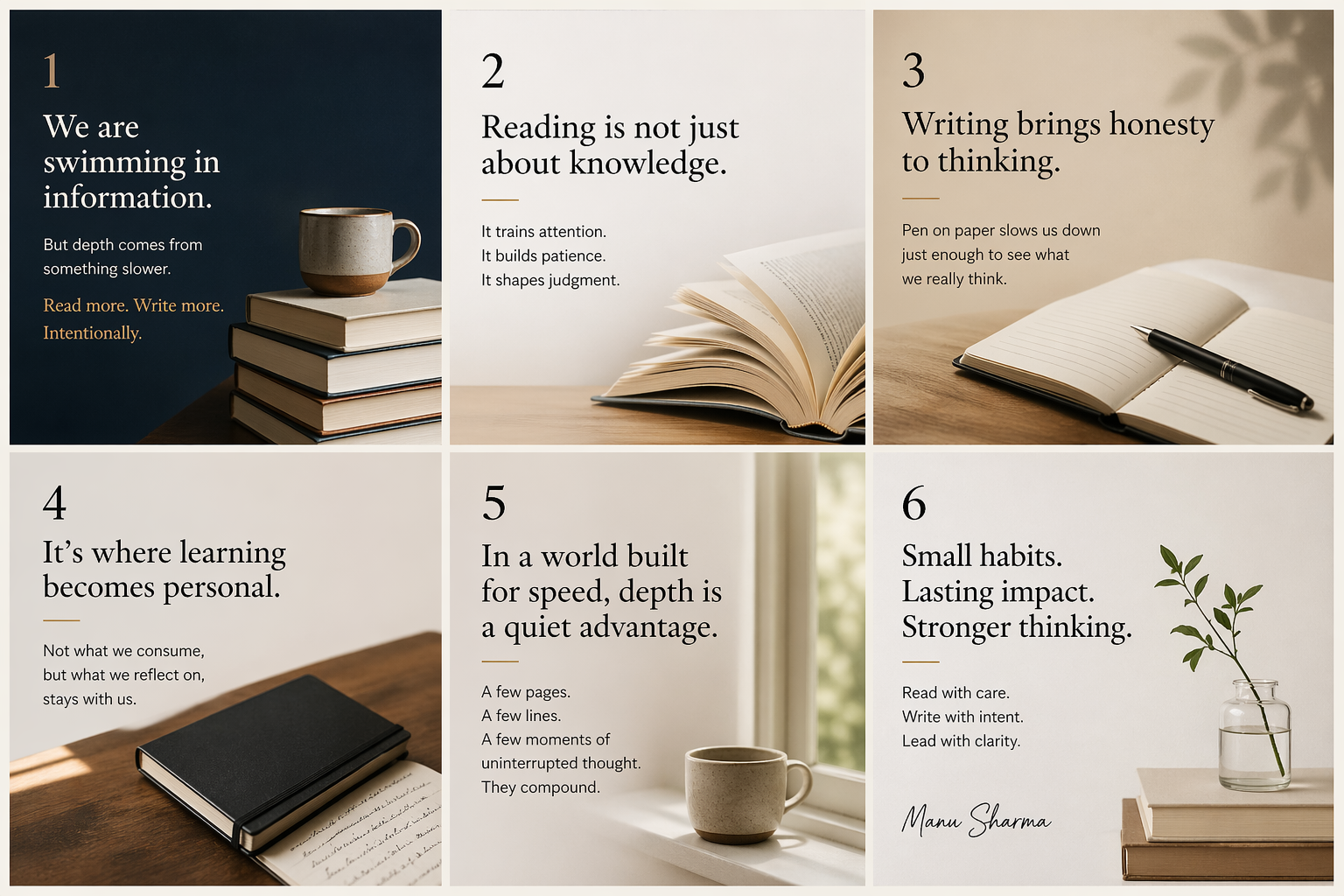
Reading slowly. Writing deliberately.
Not as an alternative to everything else, but as a counterbalance to the pace we have come to accept as normal.
I have spent much of my time working with students, early founders, and teams trying to make sense of complexity. There is always a moment, subtle but unmistakable, when the shift happens. It is not when they consume more information. It is when they begin to sit with it. When they start to write it out in their own words. When they stop chasing the next idea long enough to wrestle with the current one.
That is when clarity begins to form.
From what I see, the act of reading in a focused, uninterrupted way is not just about gathering knowledge. It is about training attention. It asks us to stay with something beyond the point of initial interest. It forces us to engage with ideas that do not immediately conform to our existing views. Over time, that does something deeper than learning. It shapes judgment.
And writing, especially by hand, brings a different kind of honesty into the process.
When you write with a keyboard, it is easy to keep moving, to edit as you go, to polish in real time. When you write with a pen, there is a certain friction. You cannot outrun your own thinking. You see the gaps. You feel the hesitation. You notice when a thought is not fully formed.
I would contend that this friction is not a limitation. It is the work.
Some of the most meaningful conversations I have had with students did not come from what they read. They came from what they wrote after reading. A half page of reflection. A question they could not answer. A connection they had not expected to make. That is where learning becomes personal. That is where it becomes durable.
There is also something grounding about the physicality of it. A notebook that travels with you. A page that carries your own handwriting. It may seem small, almost nostalgic, but I believe it creates a different relationship with ideas. They are no longer abstract. They are held, revisited, built upon.
I am not suggesting we step away from digital platforms. That would be unrealistic and, frankly, unnecessary. There is immense value in the access we now have. But I do think we need to be more intentional about how we balance consumption with reflection.
Without that balance, we risk becoming very good at recognizing ideas and not very good at developing them.
The truth is, thinking is not a passive activity. It requires effort. It requires time. It requires a willingness to stay with something even when it is not immediately clear.
Reading and writing, in their simplest forms, create the conditions for that to happen.
I often encourage my students to carry a notebook. Not because it is a technique or a productivity hack, but because it signals a different posture toward learning. It says, I am here to engage, not just to observe. I am here to form my own view, not just to borrow someone else’s.
Over time, that posture compounds.
It shows up in how they ask questions. It shows up in how they make decisions. It shows up in how they lead.
And perhaps that is the deeper point.
In a world that rewards speed and visibility, there is still immense value in practices that build depth and clarity, even if they are quiet and largely unseen.
A few pages read with care.
A few lines written with intent.
Not dramatic shifts. Not sweeping changes. Just small, consistent acts that slowly sharpen how we think and how we understand the world around us.
I believe those habits still matter. Maybe now more than ever.

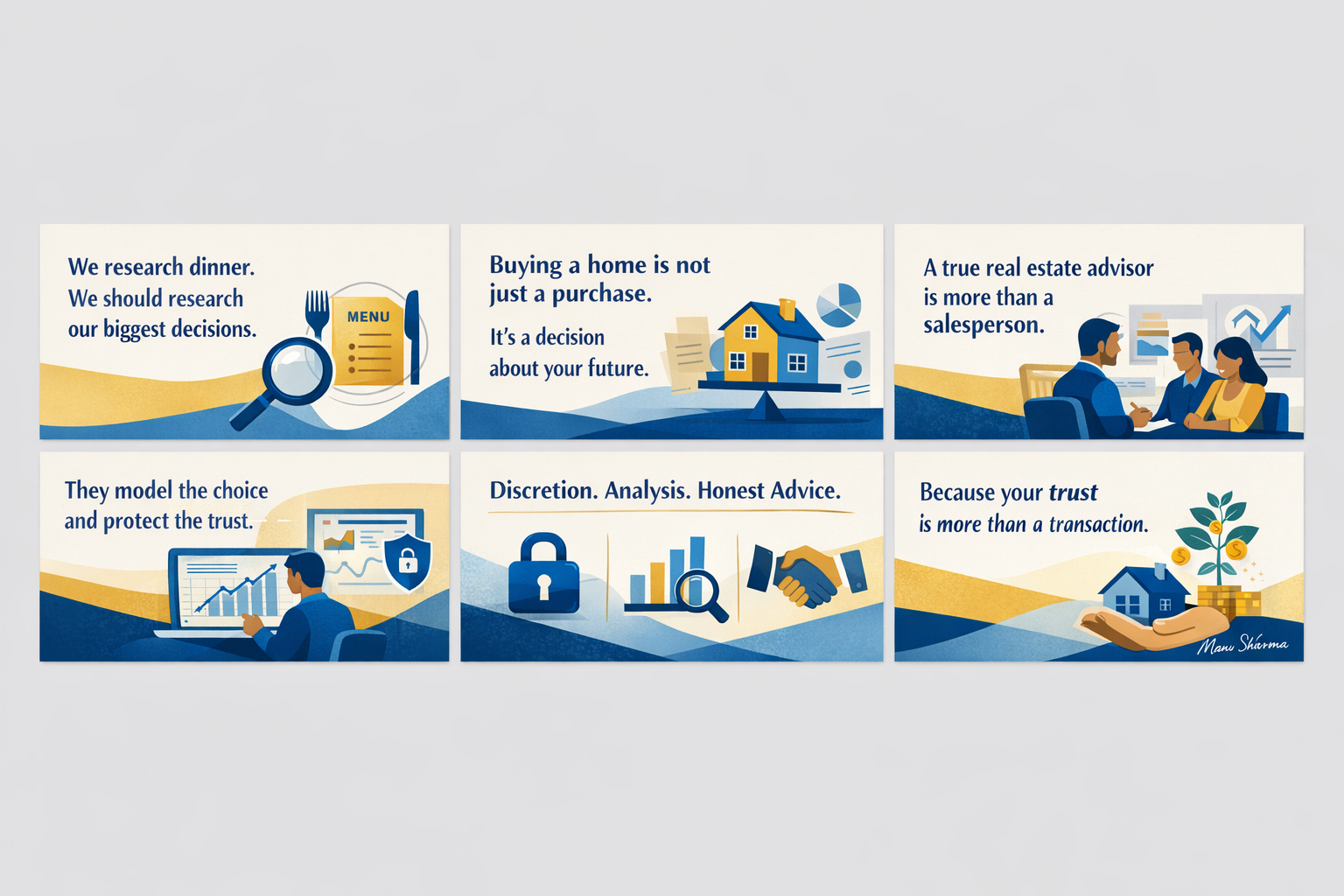
Most people will spend more time researching a restaurant than they do choosing the person who will guide them through the largest financial decision of their lives.
I have always found that curious.
Before we spend fifty dollars on dinner, we read reviews, compare menus, ask friends what they think. We study the experience in advance. We want reassurance that the choice will be worthwhile.
Yet when it comes to buying or selling a home – a decision that often represents the largest financial commitment a family will ever make – many people rely on chance introductions, casual referrals, or the first friendly face who happens to hold a license.
I think we underestimate what a real estate decision actually represents in the arc of a life.
A property is never just a property.
It is a financial structure that will influence how your capital behaves for years, sometimes decades. It shapes the rhythm of your monthly life. It quietly determines what options remain open to you later. It affects how easily you can absorb uncertainty, how comfortably you can retire, and how securely you can pass stability to the next generation.
Real estate sits at the intersection of life, finance, and time.
Which is why the person advising you through that decision should be more than someone who unlocks doors and describes kitchens.
A real estate professional, at their best, functions closer to a financial modeler, an analyst, and a strategic advisor than a simple facilitator of transactions.
They should be able to sit with you and truly understand the architecture of your life. Not just what kind of home you want today, but where you are headed, what you value, what risks you are comfortable carrying, and what kind of future you are trying to build.
In my experience, that conversation often goes deeper than people expect.
What does your financial life look like today? How does this purchase sit alongside your savings, your retirement planning, your obligations to family? What will this decision mean five years from now if your circumstances change? What happens if interest rates move? What happens if your career path shifts? How will this asset behave within the broader mix of your RRSP, TFSA, RESP, and other investments?
These are not abstract questions. They shape whether a property becomes a quiet source of stability or an ongoing source of pressure.
A strong advisor helps you see both sides of the equation.
They should be just as comfortable helping you walk away from a deal as they are helping you pursue one. In fact, I believe the moments that build the deepest trust are often the ones where an advisor calmly says, “This one may not be right for you.”
That kind of counsel requires discipline and integrity. It requires someone who sees their responsibility not as closing a transaction but protecting the decision.
It also requires something that is often overlooked in this profession: discretion.
When people search for a home, they reveal parts of their lives that are rarely shared openly. Their financial realities. Their ambitions. Their fears. Their long term plans for family and security.
Handled properly, that information is treated with the same confidentiality one expects from a lawyer, a physician, or a financial advisor. The relationship carries an implicit promise of trust.
I believe it should be held to that standard.
Because when someone works with you in real estate, they are not just showing you houses. They are being given a window into the structure of your life.
They should treat that access with care.
And they should bring real analytical rigor to the table.
A thoughtful real estate professional looks beyond square footage and finishes. They study the financial and structural implications of the property. They evaluate the long term costs of ownership. They think about resale liquidity. They examine the tax implications. They model potential outcomes across time.
They ask questions that may not initially feel comfortable but ultimately protect the client.
Is this purchase aligned with your financial capacity? Does it strengthen or weaken your long term position? What assumptions are we making that may not hold true? Where does intuition help, and where does data need to guide the decision?
These are not casual conversations, but they are necessary ones.
Over time, I have come to see real estate as one of the quiet pillars of personal financial architecture. For many families, it becomes the largest single component of their balance sheet. That reality deserves careful thought.
Done well, a real estate portfolio can grow slowly in the background, providing stability and optionality across decades. Done poorly, it can create operational stress, financial strain, and long shadows over future choices.
The difference often lies in the quality of the thinking applied at the beginning.
I sometimes wonder why this dimension of the profession is not discussed more openly, especially at a time when housing access and affordability are central topics across society.
We debate policy. We analyze interest rates. We talk about supply and demand.
But we rarely talk about the quality of guidance individuals receive when making these deeply consequential decisions.
From what I see, that guidance matters more than most people realize.
Years ago, one of the reasons I chose to obtain a real estate license myself was precisely this concern. I had spent much of my professional life helping individuals and organizations make sense of complex decisions. Strategy, modeling, and disciplined thinking had become part of how I approached most problems.
It felt natural to extend that mindset to real estate as well.
Not because I wanted to sell houses, but because I wanted the people around me – friends, colleagues, students, and those who sometimes seek counsel – to have access to clear frameworks when facing a decision that can shape the trajectory of their lives.
I believe people deserve that level of support.
When someone buys or sells a property, they are moving a meaningful portion of their hard earned resources into a structure that will influence their quality of life and their long term financial resilience.
That decision should be guided with care.
Which brings us back to the beginning.
We are remarkably diligent when the stakes are small. We research thoroughly before buying a piece of electronics or choosing a restaurant for dinner. We read reviews. We compare options. We ask questions.
Yet when the stakes rise dramatically, many people relax their standards.
They work with someone they met casually. A distant acquaintance. A friendly referral without deeper inquiry.
I think we can do better.
When selecting a real estate professional, the standard should resemble the one we apply to other trusted advisors in our lives. We look carefully for the right doctor. We evaluate lawyers thoughtfully. We spend time choosing financial advisors.
The same care should apply here.
Find someone who brings discipline to the work. Someone who respects privacy. Someone who can analyze the financial implications of the decision and explain them clearly. Someone who is comfortable telling you what you need to hear, not simply what you want to hear.
Most importantly, find someone who understands that when you place your trust in them, you are not just asking for help with a transaction.
You are asking for help with one of the most important decisions of your life.
That trust deserves to be earned.

We say it all the time. Don’t judge a book by its cover.
And yet most of us still do.
Not always out of arrogance. Often out of efficiency. Life moves quickly, decisions pile up, and our minds try to protect our time by forming impressions early. A quick glance. A short conversation. A first meeting. Sometimes even a single sentence. From there we build quiet conclusions about whether something – or someone – is worth further attention.
I understand the instinct. Time is limited. Energy even more so. But I have come to believe that some of the most consequential decisions in our lives cannot be made from the cover.
You have to open the book.
And more importantly, you have to read enough pages to know what kind of book you are holding.
The cover is marketing. The introduction is positioning. The early pages are where truth begins to reveal itself.
Opportunities work the same way. So do projects. So do people. And very often, so do the challenges that arrive uninvited into our lives.
The real signal rarely appears in the first few moments. It appears after a little exposure, a little friction, and a little time spent paying attention.
I think many of us underestimate how often our lives are shaped by things that initially looked ordinary, inconvenient, or even unappealing.
In my experience, some of the most meaningful chapters of my own life began quietly. A conversation that almost did not happen. A project that felt ambiguous in the beginning. A professional path that did not present itself with clarity on day one. If I am honest, several of the opportunities that later became deeply meaningful did not look extraordinary at first glance. They looked unfinished. Uncertain. Occasionally even uncomfortable.
But once I spent time with them – once I stayed in the room long enough to understand what was really there – something different emerged.
I suspect this happens more often than we admit.
Human beings are remarkably good at making fast judgments. Evolution rewarded that ability. But modern life asks us to make a different kind of decision. Not just fast judgments, but thoughtful ones.
And thoughtful decisions require exposure.
They require curiosity.
They require a willingness to spend a little time before forming a conclusion.
When I work with teams, young leaders, or founders building something new, I often see a similar pattern. People want clarity very early. They want to know immediately if an idea is worth pursuing, if a collaboration will work, if a challenge is worth the effort.
The desire is understandable. None of us want to waste our time.
But I sometimes wonder if we confuse early uncertainty with lack of potential.
A good book does not reveal its depth on the cover. It reveals itself page by page.
The same is true for complex work. The same is true for relationships. And certainly the same is true for problems that at first appear inconvenient but later become formative.
I believe intentional exposure is one of the most underrated disciplines in professional and personal life. Spending time with something deliberately. Observing it carefully. Giving it just enough room to show its true character before deciding whether it deserves a place in your life.
Not endless patience. Not blind commitment.
Just thoughtful engagement.
Enough time to move past the surface.
I sometimes think about how many potentially meaningful paths people abandon too early because the opening chapter did not feel exciting enough. Or how many potentially damaging relationships continue simply because the cover looked impressive.
Neither direction serves us well. The art lies somewhere in the middle.
Open the book.
Read enough pages to understand the author’s voice.
Pay attention to how the story unfolds when the initial excitement fades and the real substance begins to show itself.
In leadership, this discipline becomes even more important because decisions rarely affect only us. They shape teams, communities, and institutions. Leaders who rush to judgment often create environments where surface impressions dominate deeper understanding.
Leaders who pause, observe, and allow time for reality to emerge tend to build wiser systems.
I believe this is also why humility plays such an important role in good judgment. Humility creates space for discovery. It reminds us that first impressions are often incomplete and that understanding usually arrives in layers.
The truth is that very few meaningful things in life introduce themselves with perfect clarity.
Some opportunities disguise themselves as hard work.
Some mentors arrive in unexpected forms.
Some partnerships require patience before trust becomes visible.
Even challenges, which most of us would prefer to avoid, often contain the chapters that strengthen our character the most.
From what I see, the people who grow the most over time are not necessarily the ones who make the fastest decisions. They are the ones who stay curious long enough to understand what they are dealing with.
They read deeper. They observe longer. They listen more carefully. And then they decide.
Of course, not every book deserves to be finished. Discernment matters. Life is too short to force yourself through pages that clearly offer nothing of value.
But the opposite mistake is equally costly. Closing the book before the story even begins.
I sometimes wonder how many remarkable possibilities have been quietly set aside because they did not present themselves with immediate brilliance.
And I wonder how many extraordinary people have been misunderstood because we stopped listening too early.
The older I get, the more I value thoughtful patience. Not passive waiting, but active attention. The kind that asks better questions before forming conclusions.
Because in the end, the cover rarely tells the real story.
You only discover that once you start turning the pages.

There is a quiet tension most people carry but rarely name.
The life they imagine for themselves feels expansive, almost inevitable, yet their days feel small, repetitive, and constrained. Somewhere between the two, something starts to feel off.
I have come to believe that the problem is not a lack of ambition or a lack of discipline. It is the way we position them against each other, as if one must dominate the other to win.
We romanticize big goals because they give shape to our identity. They answer the deeper question of who we are becoming. There is something deeply human about wanting to build, to contribute, to leave something behind that reflects our values and effort. I think that pull toward a future state is not just ambition. It is meaning trying to express itself.
But daily habits do not carry that same emotional weight. They are quiet. They do not announce themselves. They do not inspire applause. They ask for repetition without recognition. And yet, they are the only mechanism through which that imagined future ever becomes real.
This is where the tension begins.
Most people try to resolve it by choosing sides. They either live in the future, constantly planning, refining, and chasing what is next, or they retreat into the present, focusing on execution without lifting their head to ask where it is all going. In both cases, something breaks. Either the vision becomes detached from reality, or the routine becomes disconnected from purpose.
I would argue that the real work is not choosing between the two. It is learning how to let them inform each other.
A meaningful goal should not feel like a distant destination. It should behave more like a standard. Something that quietly shapes your decisions today. Not in a rigid or suffocating way, but as a reference point. A filter. When that happens, discipline stops feeling like restriction and starts feeling like alignment.
At the same time, habits should not feel like a checklist you grind through in the hope that one day they will pay off. That framing drains the life out of them. The better approach, at least in my experience, is to see habits as expressions of identity. Not things you do to get somewhere, but things you do because of who you are choosing to be.
This is a subtle shift, but it changes everything.
When you see your work, your routines, even the small decisions you make throughout the day as reflections of your standards, the gap between ambition and execution begins to close. You are no longer waiting for the future to arrive. You are participating in it, one decision at a time.
I have seen this play out in different ways over the years. Not in dramatic breakthroughs, but in quieter patterns. The individuals who sustain momentum are not necessarily the most driven or the most disciplined in the traditional sense. They are the ones who have made peace with the rhythm of the work. They do not expect every day to feel meaningful, but they trust that meaning accumulates through consistency.
There is also an honesty required here that we do not talk about enough.
Not every big goal we set is actually ours. Some are inherited. Some are shaped by expectation, comparison, or proximity to what others value. When that happens, no amount of discipline will feel right. The habits will feel forced because they are serving something that has not been fully owned.
So part of balancing ambition and daily execution is doing the deeper work of ensuring that the direction itself is true. Otherwise, what looks like a discipline problem is actually a clarity problem.
I think this is where many people get stuck. They try to optimize their days without questioning their direction, or they keep redefining their goals without committing to the work required to move toward them.
The balance is not mechanical. It is relational.
Your goals should challenge you, but they should also feel grounded in something that matters to you. Your habits should stretch you, but they should also feel sustainable within the life you are actually living, not the life you think you should be living.
And perhaps most importantly, there needs to be patience with the process.
We tend to overestimate what can happen in a short period of time and underestimate what consistent effort can compound into over years. That impatience creates unnecessary friction. It makes us question the path too early or abandon the habits before they have had a chance to work.
From what I see, the individuals who navigate this well are not constantly recalibrating in reaction to short-term results. They hold their direction steady while allowing their methods to evolve. There is a quiet confidence in that approach. Not certainty, but commitment.
In the end, the tension between big goals and daily habits does not go away. It is supposed to be there. It keeps you honest. It keeps you moving. It reminds you that who you want to become is always slightly ahead of who you are today.
The work is to build a relationship between the two that feels coherent.
So that when you look at your day, you can see your future in it.
And when you think about your future, it does not feel abstract.
It feels earned.

Loss rarely announces itself.
It often does not arrive with a single moment you can point to, name, and explain. It accumulates in the background, in the spaces we stop paying attention to, in the things we assume will hold without care.
I have come to believe that a lot of what we regret losing was not taken from us. It was left unattended.
We tend to think of maintenance as something mechanical. You service the car. You fix the roof. You update the system. There is a schedule, a checklist, a clear signal when something needs attention. It feels practical, contained, almost impersonal.
But the more I watch how people live and lead, myself included, the clearer it becomes that this same principle shapes everything human, only in ways that are harder to see and far more consequential.
Relationships do not break in a moment. They thin out. Conversations become shorter. Curiosity fades. Assumptions take the place of understanding. What once felt natural starts to feel like effort, and then eventually, it feels like distance.
Trust follows a similar path. It is not destroyed in one act as often as we like to believe. It weakens through small inconsistencies, through things said and not followed through, through attention given elsewhere. Each moment is easy to dismiss. Together, they become a pattern.
Even our sense of self is not immune. The discipline you once held, the standards you quietly lived by, the way you showed up when no one was watching – these do not disappear overnight. They loosen. You negotiate with yourself. You let one thing slide, then another. Over time, you find yourself further away from who you thought you were, without ever having made a conscious decision to leave.
I think this is why maintenance is so often ignored. It asks for effort when nothing appears to be broken. It requires presence without urgency. It demands that you care before the cost is visible.
And most of us are conditioned to respond to what is urgent, not what is important.
In my experience, the real work in leadership is not just in solving visible problems. It is also in noticing what is beginning to drift before it becomes a problem at all. It is in holding the line on standards that no one is actively challenging. It is in creating space for conversations that do not feel necessary yet, but will be missed later if they never happen.
I humbly accept that this is not always comfortable work. Maintenance rarely is. It can feel repetitive, even unnecessary at times. There is no immediate reward for doing it well. No recognition for preventing something that never happened.
But I would contend that this is where the substance of a life is built.
Not in the moments where we react, but in the quiet discipline of staying close to what matters.
I have seen teams that were once deeply aligned slowly lose their edge, not because of a strategic misstep, but because the small rituals that held them together were allowed to fade. The check-ins became transactional. The shared language lost its meaning. The sense of ownership softened. Nothing dramatic happened. And yet, everything changed.
I have also seen the opposite. People who stay in conversation even when it would be easier to withdraw. Leaders who revisit expectations before they become frustrations. Individuals who tend to their own growth with a kind of quiet consistency that does not seek attention.
There is a steadiness to them. Not because they avoid difficulty, but because they do not wait for difficulty to force their hand.
As I mentioned above, I wonder if part of the challenge is that maintenance asks us to take responsibility without the pressure of consequence. It asks us to act early, when we still have options, when the cost is low, when the outcome is still within our control.
Repair, on the other hand, often arrives when those options have narrowed. When something has already been compromised. When we are no longer choosing freely, but responding to what has already unfolded.
And so the question becomes less about what we are fixing, and more about what we are quietly allowing to slip.
What conversations have we postponed? What standards have we softened? What relationships have we assumed will take care of themselves? What parts of ourselves have we stopped investing in because life became busy, or complicated, or simply distracting?
From what I have experienced, the answers to these questions rarely feel urgent in the moment. But over time, they shape the trajectory of everything.
Maintenance is not a task. It is a posture.
It is a way of staying engaged with what matters before it demands your attention. It is a commitment to care that is not driven by crisis. It is the discipline of showing up consistently, even when nothing is asking you to.
And perhaps most importantly, it is an acknowledgement that the things we value do not sustain themselves.
They require us.
Not once. Not occasionally. But regularly, intentionally, and often quietly.
Because in the end, what we lose is rarely taken all at once.
It leaves in increments, in moments we barely notice, until one day we look back and realize it is no longer there.
And by then, we are no longer maintaining.
We are busy, often desperately, trying to repair.