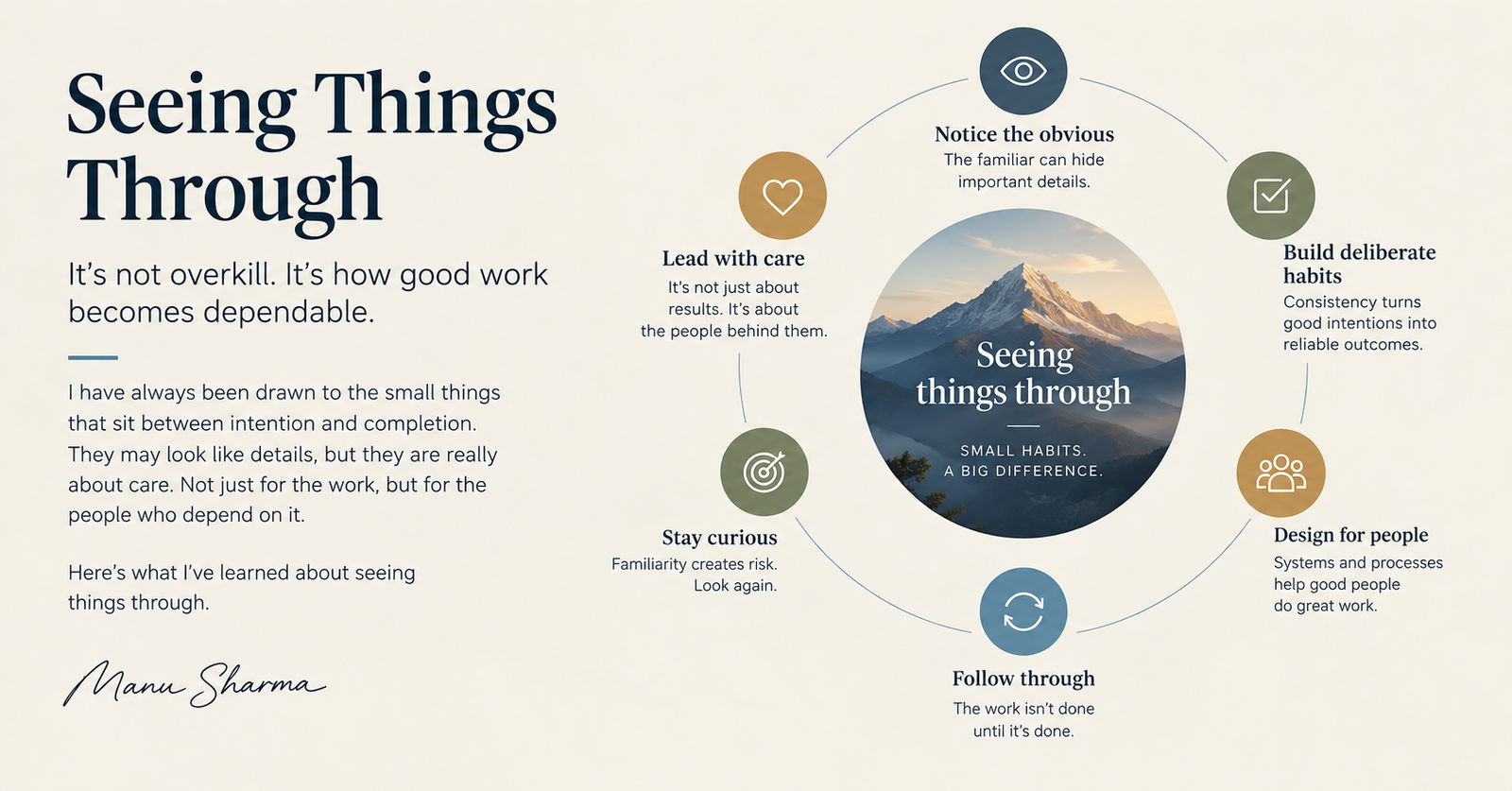
I have sometimes wondered whether my attention to detail is a strength, a burden, or simply a habit I never learned to turn off.
I notice the unfinished thing. The unanswered email. The assumption nobody checked. The small inconsistency between what we said we would do and what actually happened. I remember the conversation that was supposed to lead somewhere but quietly stopped. I am often the person who asks, “Did we actually close that loop?” when everyone else has already moved on.
For a long time, I thought this was simply a personal preference. Over the years, though, I have come to see something else in it. My insistence on details is really an insistence on intentionality, and my insistence on consistency is really an expression of care. I want things to mean what we said they would mean. I want commitments to survive the distance between intention and execution. Most of all, I want to see things through.
That last part matters to me more than it probably appears.
Seeing something through does not mean obsessing over every detail or refusing to let go of something that no longer matters. There is a difference between perfectionism and completion, between control and stewardship. Sometimes seeing something through means knowing when the work is finished. Sometimes it means changing course. Sometimes it means having the uncomfortable conversation that would be easier to avoid. The common thread is intentionality: being conscious of what you are doing, why you are doing it, and what it means to leave it unfinished.
I was reminded of this when I came across Shisa Kanko, the Japanese practice of pointing and calling used in safety-critical environments. A worker may physically point toward a signal or component, identify its status aloud, and confirm it before proceeding. It can look almost unnecessarily deliberate to someone watching from the outside. Yet that deliberate behaviour exists for a very human reason: familiarity creates its own kind of risk.
The more often we do something, the more our minds are inclined to stop seeing it.
We begin to rely on memory. We recognize the shape of the task and fill in the rest automatically. We assume the door is locked because it was locked yesterday. We assume the number is right because we entered it a hundred times before. We assume the person followed up because they usually do.
Nothing about this is a character flaw. It is simply part of being human.
Good systems understand that.
They do not build their reliability around the hope that people will always be attentive, rested, experienced and motivated. They build small acts of confirmation into the work itself. They make attention visible. They create moments where someone has to stop, look again and consciously confirm what is in front of them.
That idea has stayed with me because it applies far beyond aviation, railways or any other safety-critical environment.
It applies to the way we lead.
Much of leadership is actually about what happens after the interesting part is over. We are naturally drawn to beginnings: the new strategy, the ambitious idea, the announcement, the transformation, the launch. Those moments have energy. They give us something to talk about.
The quieter work comes afterward.
Someone has to translate the idea into a process. Someone has to make sure the process works for the people expected to use it. Someone has to notice where it breaks. Someone has to return to the decision three months later and ask whether what we intended is actually what happened.
This is where my own approach to operations has evolved over time. I have become less interested in making processes elaborate and more interested in making them dependable. When I look at a process, I tend to ask what is critical, what is essential, what is preventative and what is simply enhancing. I want to know where a little more discipline will materially reduce risk, and where we are merely adding activity because it makes us feel productive.
That distinction is important.
There is a peculiar temptation in modern work to treat speed as evidence of competence. We admire the person who responds immediately, closes a task quickly and moves on to the next thing. We sometimes make thoroughness feel like a personality quirk, something that belongs to the unusually cautious rather than to the effective.
I think we have confused efficiency with haste.
Efficiency matters. I care deeply about it. But removing unnecessary effort is very different from removing necessary care. A process should be as simple as it can be, but simplicity should never become an excuse for leaving important things to chance.
This is one reason I have become increasingly interested in the relationship between people and systems. We often say that we need better people when what we really need is a better environment in which good people can do good work. If a critical step depends entirely on someone’s memory, we have already placed too much weight on the individual. If a process only works when its most experienced person is present, we do not really have a process yet.
The same principle applies to culture.
We often talk about values as though stating them is enough. We put them on walls, repeat them in meetings and include them in presentations. But culture becomes real in the small repeated behaviours that nobody thinks are worth mentioning anymore.
How do we treat the person who made a mistake? Do we follow up when we said we would? Do we prepare as carefully for the ordinary meeting as we do for the important one? Do we make it safe for someone to say, “I don’t think this is right”? Do we do what we said we would do when nobody is checking?
These are operational questions, but they are also human questions.
That is perhaps why I resist the idea that thoroughness is “overkill.” The word suggests that care itself becomes excessive once we have crossed some invisible threshold of efficiency. I would rather ask a different question: what is the consequence of not being thorough here?
Sometimes the answer is nothing. Then simplify. Remove the step. Trust the system.
Sometimes the answer is that a person gets inconvenienced. That deserves consideration, but perhaps not a cumbersome process.
And sometimes the answer is that a small oversight compounds into something much harder to repair.
That is where intentionality earns its place.
I have seen enough organizations to know that most problems rarely arrive announcing themselves as problems. They begin as something small that nobody thought was worth stopping for. A missed handoff. An assumption. A task that was “almost done.” A conversation that was postponed. A data point that did not look quite right but was accepted because everyone was busy.
The cost often appears much later, when nobody can quite remember where the original thread was lost.
This is why I have such respect for consistency.
Consistency is not glamorous. It does not usually produce a story worth telling at the end of the year. But there is something deeply reassuring about knowing that a person, a team or a system will behave with care even when the novelty has disappeared.
Anyone can be intentional when something is new.
The real test comes when it becomes routine.
That is also why I think leadership has less to do with having extraordinary moments than we sometimes imagine. It is revealed in repetition. In whether we keep our standards when we are tired. In whether we remain curious after we think we already know the answer. In whether we continue to care about the small things once nobody is applauding us for caring about them.
For me, this connects to a broader belief about service.
To serve someone well is to take their outcome seriously. That does not require grand gestures. Often, it requires something much less visible: preparation, reliability, follow-through and the willingness to spend another few minutes making sure that what needed to happen actually happened.
Care becomes meaningful when it enters the work.
Perhaps that is what I have been trying to articulate through my own fixation on seeing things through. I do not want to be the person who simply has good intentions. I want the intention to survive contact with reality.
There is a quiet dignity in that.
You check the thing because it matters.
You follow up because someone is depending on you.
You revisit the detail because you know that familiarity can make us careless.
You finish the work because completion is part of the commitment.
And then, importantly, you move on without needing anyone to notice that you did it.
I wonder if this is what some of the best systems teach us. They remind us that human beings are imperfect, and then they respond to that imperfection with compassion rather than judgment. They give us structures that help us pay attention when attention is hardest. They turn good intentions into repeatable behaviour.
That is not overkill.
It is intentionality made visible.
And perhaps seeing things through is ultimately a very simple philosophy for work and for life: take what you have chosen seriously enough to give it your full attention, and care enough to finish what you started.
Not everything deserves that level of attention.
But the things that do deserve it should receive nothing less.