I feel that most people do not struggle with complexity.
They struggle with acceptance.
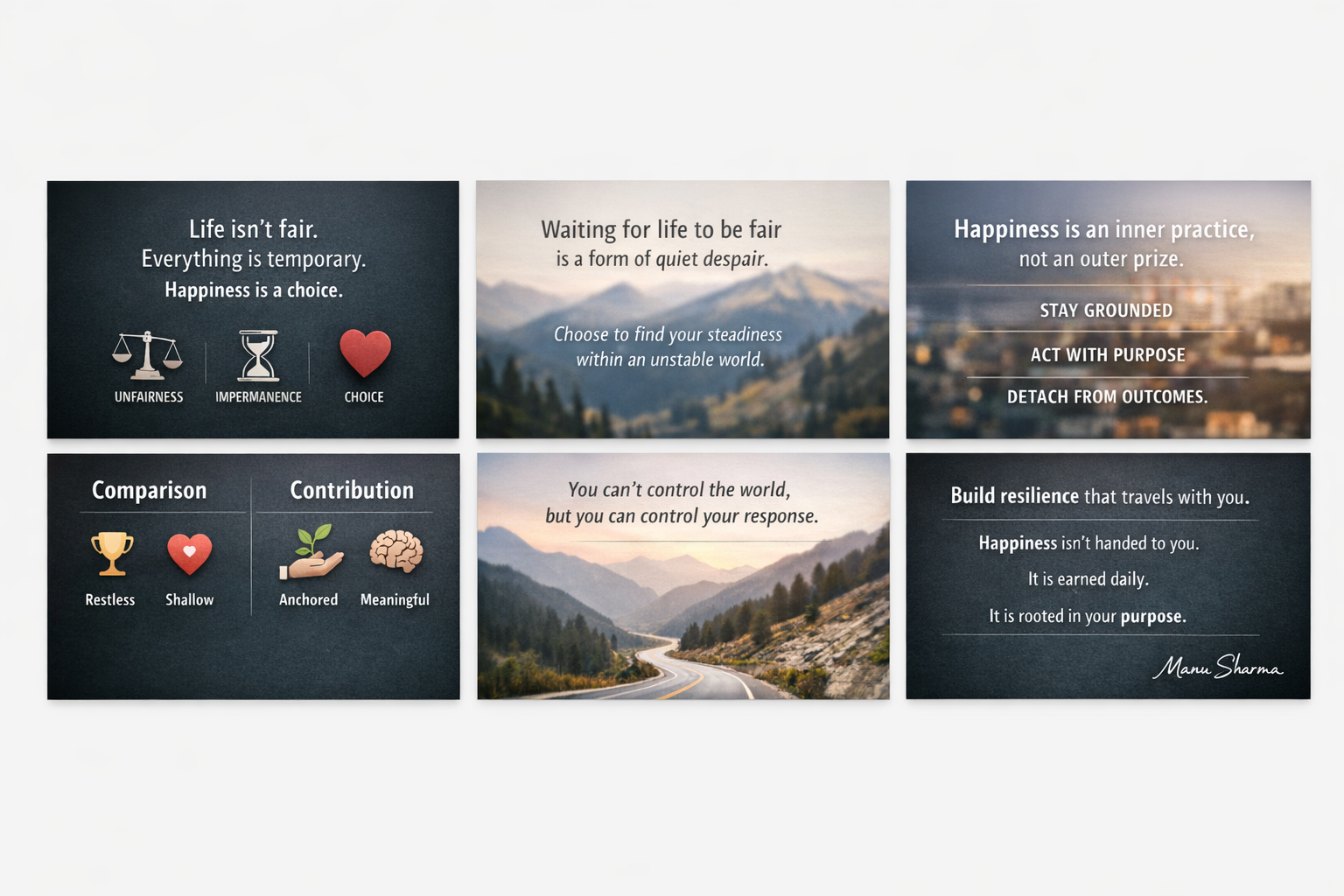
Life often is not fair. It has always been like this. It distributes talent unevenly. It allocates opportunity inconsistently. It interrupts good people and rewards questionable ones. If you wait for symmetry before you allow yourself peace, you will wait a long time.
And yet, the deeper truth is not about fairness. It is about impermanence.
Everything moves. Careers crest and recede. Influence expands and contracts. Health strengthens and weakens. Institutions that look immovable today will be restructured tomorrow. I have sat inside rooms where strategies were drawn with certainty, only to watch conditions change faster than the ink could dry. I have watched young leaders rise quickly, then confront the quiet work of staying grounded. I have seen organizations built with care struggle because the external environment shifted without permission.
Nothing stays. Everything moves. Shift is the only constant.
When you accept that reality fully, something steadies inside you. The anxiety of control begins to loosen a bit. You realize you are not owed permanence. You are not owed smooth paths. You are not owed applause. That ultimately, you are responsible for how you respond.
Happiness, then, is not a mood. It is not the absence of friction. It is a decision repeated under pressure.
This is the part people resist. We prefer the narrative that joy arrives when circumstances improve. When the promotion lands. When the balance sheet stabilizes. When recognition comes. When the market corrects. When the family tension resolves.
But if happiness, for you, is contingent on conditions, then trust me that you have outsourced it.
There is a discipline to choosing steadiness in a world that is unpredictable. It requires intellectual and emotional honesty. You must look at the asymmetry without bitterness. You must recognize temporary wins without over-identifying with them. You must face loss without building an identity around it.
That discipline is work.
In my leadership practice, I often return to a simple alignment: why, how, what. If your why is clear, your emotional state becomes less volatile. You are less shaken by temporary setbacks because your orientation is long term. You understand that value is built through consistency, not reaction. The same applies to personal happiness. If your why is rooted in contribution, growth, and service, daily fluctuations lose their power over you.
The opposite is also true. If your sense of self is anchored in comparison, visibility, or short term validation, impermanence will exhaust you. Social media amplifies this distortion. It compresses context and inflates perception. It invites you to measure your life against curated fragments of someone else’s highlight reel. That comparison erodes gratitude quietly. It convinces capable people that they are behind when, in reality, they are simply on a different path.
I say this as someone who has spent decades in systems that reward performance and visibility. I accept that I have myself benefited from those systems. I like to believe that I understand ambition. I respect it. But I have learned that ambition without internal anchoring becomes corrosive. It turns every room into a ranking exercise. It makes rest feel like weakness. It confuses busyness with meaning.
Happiness, in my humble opinion, without overgeneralizing it, requires a different metric.
It asks: Are you aligned with your values? Are you acting with integrity when no one is watching? Are you contributing in a way that reflects who you actually are, not who you think you should be?
Those questions are harder than chasing external markers. They demand self-confrontation. They require humility. You must admit when ego is driving decisions. You must notice when fear is narrowing your perspective. You must interrupt the quiet greed that whispers that more status will finally quiet the restlessness.
This is interior work. No one applauds it. No algorithm amplifies it.
But it is necessary, and it compounds.
When you train yourself to choose gratitude in ordinary moments, your baseline shifts. When you consciously detach from outcomes you cannot control, your nervous system stabilizes. When you measure your days by contribution rather than comparison, envy loses its grip.
This is not naïve optimism. It is strategic realism.
If everything is temporary, then so are your hardest seasons. The fatigue you feel today will change. The disappointment will soften. The tension in a relationship can evolve if you approach it with patience and clarity. Even grief, while never erased, transforms over time. Impermanence cuts both ways. It removes what you cherish, but it also removes what burdens you.
The question then becomes: how will you live in the middle of that motion?
You can live resentful that the distribution was uneven. Or you can accept the distribution and focus on stewardship. You can resent that others appear ahead. Or you can invest in depth rather than optics. You can chase stability that does not exist. Or you can build resilience that travels with you.
One path feels easier in the moment. The other, while taxing, builds strength.
I have come to believe that happiness is less about feeling good and more about being anchored. Anchored in purpose. Anchored in service. Anchored in the quiet confidence that you are acting in alignment with your values even when conditions fluctuate.
This anchoring does not eliminate pain. It gives pain context. It makes it bearable, even normal.
When you know why you are doing the work, you tolerate difficulty differently. When you understand that status and struggle are both temporary, you stop overreacting to either. You become steadier. More thoughtful. Less performative. More deliberate.
There is dignity in that steadiness.
I have lived enough now to know that life will not become fair because you demand it. It will not slow down because you are overwhelmed. It will not grant permanence because you crave certainty.
But I know now that it will respond to your posture.
Choose bitterness and the world confirms your suspicion. Choose responsibility and the world becomes a field for growth. Choose conscious gratitude and even difficult seasons begin to reveal instruction.
Happiness is not handed to you. It is built quietly, daily, often invisibly. It is maintained through reflection, through service, through the discipline of aligning your actions with your deepest convictions.
That is the work.
And if everything is temporary, then the opportunity to do that work is temporary too.
Which makes it precious.