I have always been slightly unsettled by the phrase, “I want to leave the world in a better place than I found it.”
It sounds noble. It photographs well. It fits cleanly into a bio.
But every time I hear it, I find myself asking a quieter question.
Better according to whom?
There is an assumption hidden inside that sentence. An assumption that we are, or know, the unit of measurement. That the world is a project awaiting our improvement. That our departure should be evaluated by the condition of something vast and complex, as though history is a room we walked into and are personally responsible for rearranging.
I understand the impulse. I work in spaces that deal directly with social impact, philanthropy, and community capital. I have spent years around leaders who genuinely want to shift outcomes, strengthen institutions, widen opportunity. I have devoted much of my professional life to helping organizations clarify their purpose, tighten their models, and align their actions with what they say matters.
But over time, I have come to see something else.
When people focus too much on “leaving the world better,” they often drift into abstraction. The world becomes a concept. An audience. A scoreboard. The work becomes externalized. Impact becomes visible, measurable, comparable.
And comparison quietly enters the room.
How big was your footprint?
How many lives did you change?
How scalable was your impact?
We begin to measure legacy the way markets measure growth.
I am not dismissing ambition. I have built things. I have scaled initiatives. I care deeply about systems and outcomes. But I have also seen how easily the idea of “improving the world” can inflate the ego while bypassing the interior work that makes any real contribution possible.
There is a different orientation that feels more honest to me.
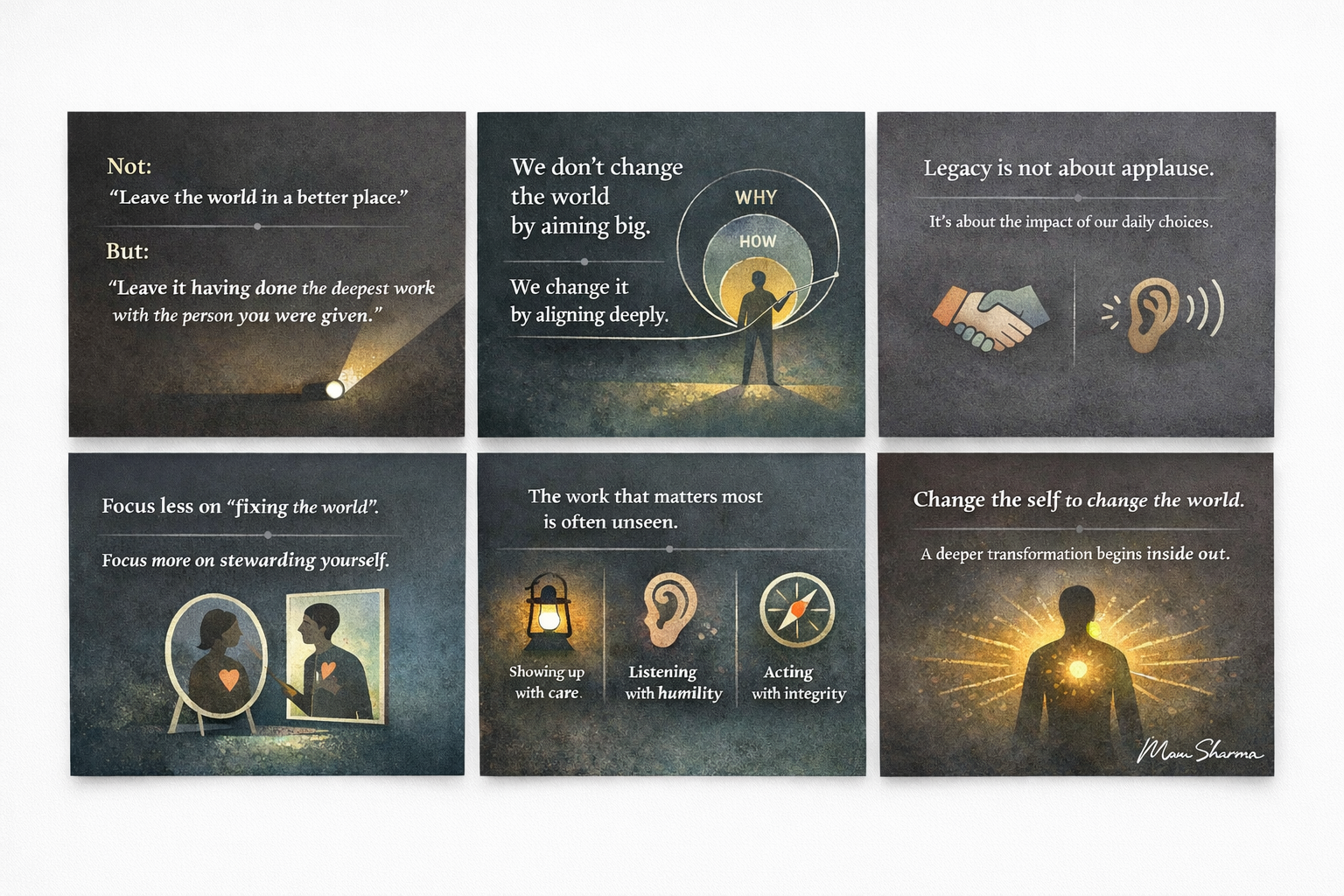
What if the work is not to leave the world better than we found it, but to leave it having done the deepest work we could with the person we were given?
That is a very different standard.
It shifts the focus from conquest to stewardship. From optics to integrity. From external validation to internal coherence.
The world does not primarily change because someone declared a grand intention. It changes because someone aligned their why, their how, and their daily behavior with unusual consistency. It changes because someone showed up with care in rooms where care was scarce. It changes because someone refused to let fear, ego, greed, or hubris dictate their choices.
Those battles are rarely public. They are fought in small decisions. In how you speak when you are tired. In whether you listen when you disagree. In whether you take responsibility when it would be easier to deflect.
In my own life, the moments that feel most consequential are not the keynote talks or the strategic plans. They are quieter. A conversation with a young founder who needed someone to believe in their capacity before they believed in it themselves. A difficult board discussion where truth needed to be spoken without aggression. A choice to simplify when complexity would have impressed.
None of those moments will show up in a global ledger of “world improvement.”
Yet they shape the texture of the world around me.
There is also a humility in accepting that the world was not waiting for us to fix it. Civilizations have risen and fallen. Ideas have clashed and evolved. Entire generations have wrestled with problems far larger than any one lifetime can resolve. To believe that our role is to improve “the world” can quietly slip into a form of self-importance.
But to believe that our role is to steward our gifts, our time, and our responsibilities with depth and consistency is different. That is not small. That is exacting.
I often tell the leaders I coach that clarity of purpose is not a branding exercise. It is a discipline. When you are clear about your why, your decisions become cleaner. When your why is service, your posture changes. You become less concerned with being seen as impactful and more concerned with being useful.
Useful is an underrated word.
If each of us left the world having been deeply useful to the people, institutions, and causes placed in our care, the aggregate effect would likely be profound. But the driver would not be scale. It would be integrity.
There is also something psychologically grounding about focusing inside out before outside in. We are quick to diagnose systems. Slower to examine ourselves. It is easier to critique policy than to confront impatience. Easier to call out injustice than to notice where we withhold generosity.
I do not mean this in a moralistic way. I mean it in a developmental one.
If we want the world to be more thoughtful, we must become more thoughtful. If we want institutions to be more responsible, we must practice responsibility in our own spheres. Systems are made of people. Culture is made of behavior. Change that bypasses character is fragile.
When I look back on nearly three decades of working across technology, community foundations, and higher education, what stays with me is not a narrative of “I made the world better.” It is a quieter accounting.
Did I get out of my own way often enough?
Did I make the invisible visible when it mattered?
Did I start with the outcome in mind, or did I chase activity?
Did I meet people where they were, rather than where I wished they would be?
Those questions feel harder than the slogan. They demand self-scrutiny. They require consistency. They leave less room for performance.
And here is the paradox.
When you focus deeply on becoming the most disciplined, aligned, service-oriented version of yourself, you often do leave the world better. But it is a byproduct, not the headline. It emerges from thousands of grounded decisions rather than a single grand declaration.
Perhaps the issue is not the desire to leave the world better. It is the direction of attention.
Outside in change is unstable if inside out work is neglected. Inside out work without any outward responsibility becomes self-absorption. The tension is real. But if forced to choose an order, I would begin with the self.
Not as indulgence.
As obligation.
We are each entrusted with a finite life. A limited span of influence. A set of capabilities that, if neglected, quietly atrophy. The question that feels most honest to me is not whether the world applauds our impact. It is whether we used what we were given with depth, care, and courage.
If we did, the world will have shifted in ways we may never fully see.
And that is enough.