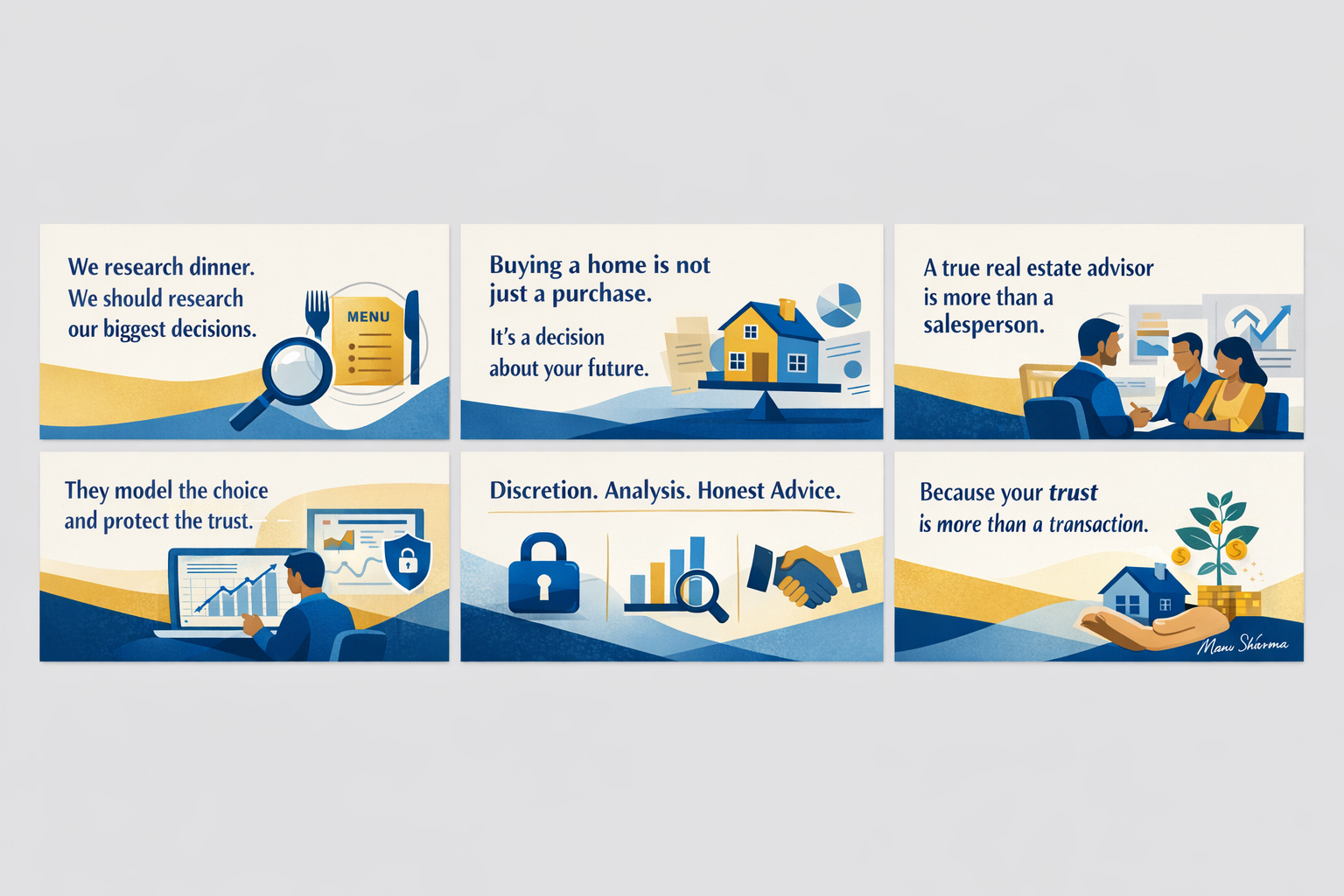
Most people will spend more time researching a restaurant than they do choosing the person who will guide them through the largest financial decision of their lives.
I have always found that curious.
Before we spend fifty dollars on dinner, we read reviews, compare menus, ask friends what they think. We study the experience in advance. We want reassurance that the choice will be worthwhile.
Yet when it comes to buying or selling a home – a decision that often represents the largest financial commitment a family will ever make – many people rely on chance introductions, casual referrals, or the first friendly face who happens to hold a license.
I think we underestimate what a real estate decision actually represents in the arc of a life.
A property is never just a property.
It is a financial structure that will influence how your capital behaves for years, sometimes decades. It shapes the rhythm of your monthly life. It quietly determines what options remain open to you later. It affects how easily you can absorb uncertainty, how comfortably you can retire, and how securely you can pass stability to the next generation.
Real estate sits at the intersection of life, finance, and time.
Which is why the person advising you through that decision should be more than someone who unlocks doors and describes kitchens.
A real estate professional, at their best, functions closer to a financial modeler, an analyst, and a strategic advisor than a simple facilitator of transactions.
They should be able to sit with you and truly understand the architecture of your life. Not just what kind of home you want today, but where you are headed, what you value, what risks you are comfortable carrying, and what kind of future you are trying to build.
In my experience, that conversation often goes deeper than people expect.
What does your financial life look like today? How does this purchase sit alongside your savings, your retirement planning, your obligations to family? What will this decision mean five years from now if your circumstances change? What happens if interest rates move? What happens if your career path shifts? How will this asset behave within the broader mix of your RRSP, TFSA, RESP, and other investments?
These are not abstract questions. They shape whether a property becomes a quiet source of stability or an ongoing source of pressure.
A strong advisor helps you see both sides of the equation.
They should be just as comfortable helping you walk away from a deal as they are helping you pursue one. In fact, I believe the moments that build the deepest trust are often the ones where an advisor calmly says, “This one may not be right for you.”
That kind of counsel requires discipline and integrity. It requires someone who sees their responsibility not as closing a transaction but protecting the decision.
It also requires something that is often overlooked in this profession: discretion.
When people search for a home, they reveal parts of their lives that are rarely shared openly. Their financial realities. Their ambitions. Their fears. Their long term plans for family and security.
Handled properly, that information is treated with the same confidentiality one expects from a lawyer, a physician, or a financial advisor. The relationship carries an implicit promise of trust.
I believe it should be held to that standard.
Because when someone works with you in real estate, they are not just showing you houses. They are being given a window into the structure of your life.
They should treat that access with care.
And they should bring real analytical rigor to the table.
A thoughtful real estate professional looks beyond square footage and finishes. They study the financial and structural implications of the property. They evaluate the long term costs of ownership. They think about resale liquidity. They examine the tax implications. They model potential outcomes across time.
They ask questions that may not initially feel comfortable but ultimately protect the client.
Is this purchase aligned with your financial capacity? Does it strengthen or weaken your long term position? What assumptions are we making that may not hold true? Where does intuition help, and where does data need to guide the decision?
These are not casual conversations, but they are necessary ones.
Over time, I have come to see real estate as one of the quiet pillars of personal financial architecture. For many families, it becomes the largest single component of their balance sheet. That reality deserves careful thought.
Done well, a real estate portfolio can grow slowly in the background, providing stability and optionality across decades. Done poorly, it can create operational stress, financial strain, and long shadows over future choices.
The difference often lies in the quality of the thinking applied at the beginning.
I sometimes wonder why this dimension of the profession is not discussed more openly, especially at a time when housing access and affordability are central topics across society.
We debate policy. We analyze interest rates. We talk about supply and demand.
But we rarely talk about the quality of guidance individuals receive when making these deeply consequential decisions.
From what I see, that guidance matters more than most people realize.
Years ago, one of the reasons I chose to obtain a real estate license myself was precisely this concern. I had spent much of my professional life helping individuals and organizations make sense of complex decisions. Strategy, modeling, and disciplined thinking had become part of how I approached most problems.
It felt natural to extend that mindset to real estate as well.
Not because I wanted to sell houses, but because I wanted the people around me – friends, colleagues, students, and those who sometimes seek counsel – to have access to clear frameworks when facing a decision that can shape the trajectory of their lives.
I believe people deserve that level of support.
When someone buys or sells a property, they are moving a meaningful portion of their hard earned resources into a structure that will influence their quality of life and their long term financial resilience.
That decision should be guided with care.
Which brings us back to the beginning.
We are remarkably diligent when the stakes are small. We research thoroughly before buying a piece of electronics or choosing a restaurant for dinner. We read reviews. We compare options. We ask questions.
Yet when the stakes rise dramatically, many people relax their standards.
They work with someone they met casually. A distant acquaintance. A friendly referral without deeper inquiry.
I think we can do better.
When selecting a real estate professional, the standard should resemble the one we apply to other trusted advisors in our lives. We look carefully for the right doctor. We evaluate lawyers thoughtfully. We spend time choosing financial advisors.
The same care should apply here.
Find someone who brings discipline to the work. Someone who respects privacy. Someone who can analyze the financial implications of the decision and explain them clearly. Someone who is comfortable telling you what you need to hear, not simply what you want to hear.
Most importantly, find someone who understands that when you place your trust in them, you are not just asking for help with a transaction.
You are asking for help with one of the most important decisions of your life.
That trust deserves to be earned.