This past Friday, after class, two students stayed back to chat with me.
For context. They were international students. Thoughtful, capable, and clearly carrying something heavier than coursework.
As we sat down, the frustration came out quickly. The job market is terrible. No one is hiring. Companies want Canadian experience. Too many applicants. Everyone is competing for the same roles.
Underneath the words I could hear something else – a deep worry.
Sir, the co-op deadline is getting closer. The clock is becoming real.
I listened for a while. When someone is carrying that kind of tension, the first responsibility is simply to hear them. I remember what that feeling is like. When uncertainty begins to mix with self-doubt, the mind starts building stories very quickly.
After a pause I told them, gently, that I did not quite see the situation the same way.
Not because the challenges they described are imaginary. They are real. Anyone who has come to a new country knows that the road is uneven. Systems favor familiarity. Networks matter. Experience compounds. None of that is new, and much of it is not fair.
But I also told them something else. This problem they were describing is not unique to Canada.
I asked them a simple question. Why did you decide to leave home and come here in the first place?
They looked at each other for a moment and then answered almost at the same time. Because finding a good job back home was proving to be very difficult.
The room went quiet for a moment after that.
It was not a trick question. It was an invitation to step outside the story they had started to believe. What I wanted them to land on was a slightly different perspective.
If the same challenge existed where everything was familiar – language, networks, culture, and confidence – then perhaps the challenge itself is not geography.
Perhaps the question is something else.
I think, in moments of pressure, we sometimes forget that the difficulty of building a life is not a Canadian story, an European story, or an Indian story. It is a human story. Every country carries its own version of the same tension between aspiration and opportunity. Social media, of course, amplifies the noise. When you live in Canada, the algorithm feeds you Canadian anxieties. People with large microphones explaining why the system is broken, why the future is bleak, why opportunities are disappearing.
Travel anywhere else in the world and you will hear the same chorus in a different accent, with a set of different variables.
The truth, I personally believe, is a bit more grounded than that.
If you sit down with immigrants who arrived here twenty or thirty years ago, you will rarely hear a story about how smooth the transition was. Most will describe the early years as uncertain. Jobs were hard to secure. Experience was questioned. Fitting in took time.
None of that made the journey meaningless.
So I asked the students another question. What are you doing differently now from what you were doing before you left home? Is it a different voice, a different narrative, a different presentation, a different offering?
That question often lands harder than people expect.
Because once we strip away the narrative of a difficult market, the conversation becomes more personal. It moves from complaint to strategy.
The idea is not to diminish the obstacles. They exist and they should be acknowledged honestly. Systems have blind spots. Institutions move slowly. Human bias is real.
But the alternative to accepting that reality is not despair. The alternative is agency.
Over the years, I have shared a simple modeling exercise with students, entrepreneurs, and newcomers trying to find their footing in the job market. I repeated it with them on Friday.
Imagine a small local provate company, in your chosen professional domain, generating twenty million dollars in annual revenue. Say, their operating costs are roughly eighteen million. So that leaves the owner(s) with two million dollars in net profit. It is safe to assume that, while being decently successful, like most businesses, they would be constantly looking for ways to grow.
Let’s say that you have identified them and you are interested in working there. But you do not see any open roles or positions. But you still spend some serious time studying their business. You learn how they make money. You understand their model. You observe their blind spots and the opportunities they may not be fully exploiting.
After doing that work carefully, you approach the owner with a proposal.
You explain how you believe the company could increase revenue by ten percent over the next three years. You present a thoughtful plan. You ask for a salary of sixty five thousand dollars and the three year runway to implement the idea.
In simple terms you are asking the owner to invest ten percent of their current yearly profit, over the next three years, in exchange for the possibility of meaningful bottomline ten percent growth.
If your thinking is credible, your understanding of their business is real, and your commitment is visible, I would contend with a fair bit of confidence that very few serious business owners will dismiss that conversation outright. I told them that they would definitely have my interest if something like that came my way.
What you have done in that moment is change the dynamic.
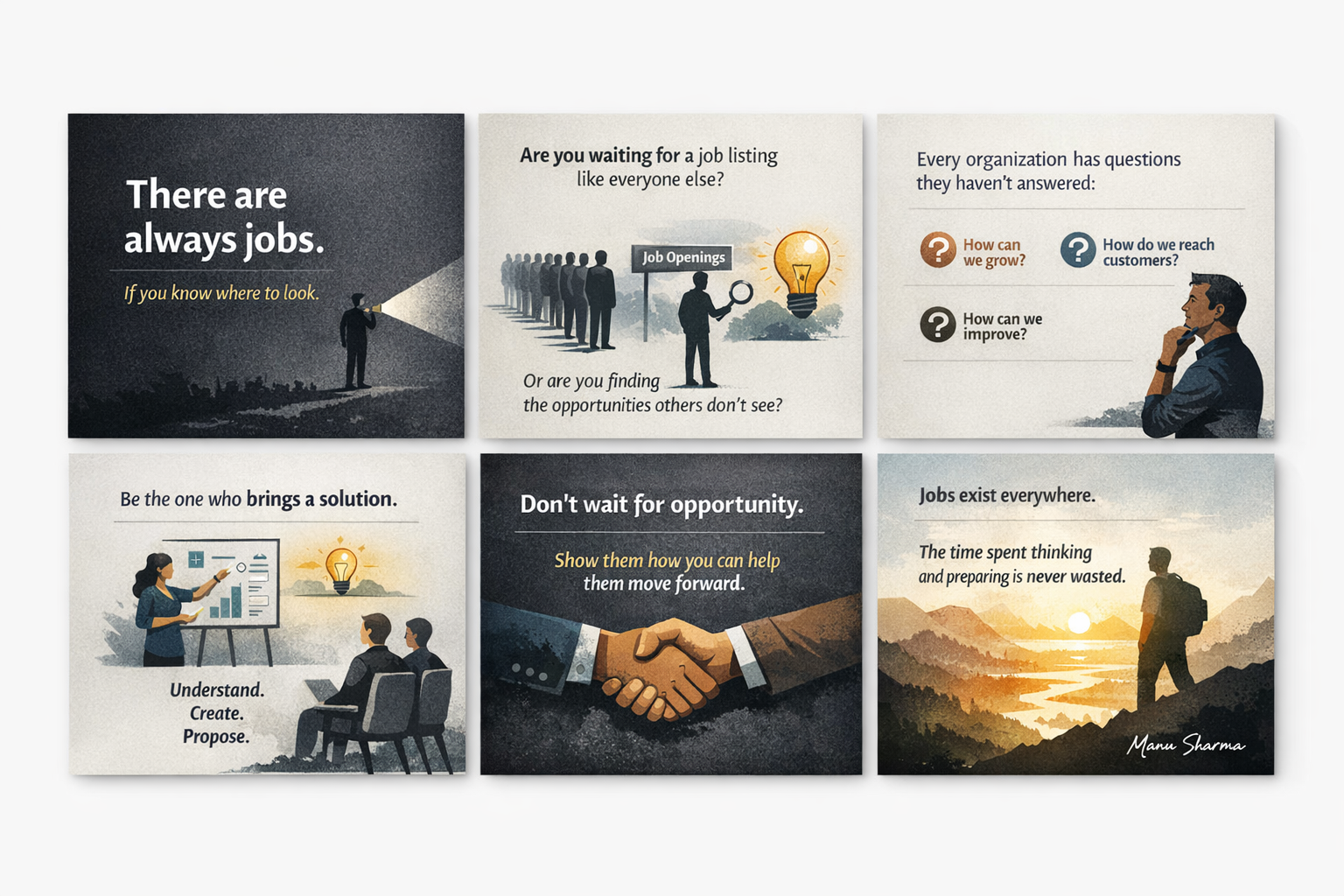
You are no longer waiting for a job description written by someone who had no idea of your profile – of who you are. You are not one of two hundred applicants pressing the same submit button. You are not bound by what they have on offer. You are exercising your agency – in a very powerful way.
You are bringing a proposition.
In other words, you are stepping into the language that business leaders actually speak.
Growth. Opportunity. Value. Intentionality. Depth.
I would contend that jobs often appear scarce when we limit ourselves to the narrow channel of existing postings. When everyone stands in the same line, the line naturally becomes long.
But the opportunity out there is not simply a list of openings. It is a network of unresolved problems.
Every organization, whether it is a small business or a large institution, wakes up each morning with questions it has not yet solved. How to grow. How to reach customers. How to reduce costs. How to improve operations. How to expand.
Those questions rarely appear neatly formatted on a job board. They sit quietly inside the business until someone brings a solution. This is where intentionality becomes powerful.
Instead of sending one hundred applications, imagine investing that time in deeply understanding ten companies. Learning how they operate. Thinking carefully about where they might grow. Preparing a thoughtful proposition about how you might contribute.
That work is slower. It requires discipline and patience. It demands curiosity and courage.
But it also builds something far more valuable than a stack of applications.
It builds and sharpens your value proposition.
When people tell me there are no jobs, I often hear something else beneath the surface. I hear someone waiting for permission. Waiting for the system to recognize them. Waiting for opportunity to appear fully formed.
In my experience, the people who eventually build stable and meaningful careers often approach the process differently. They spend less energy chasing openings and more energy understanding how value is created.
Once you begin to see the world through that lens, the landscape often changes.
Businesses do not hire because they enjoy interviewing people. They hire because they believe someone can help them move forward.
If you can articulate that belief clearly and honestly, doors tend to open. Often not instantly and not easily, but steadily.
I told the students something else before they left.
This approach works in Canada. It works in India. It works in the United States. It works anywhere people are building organizations and trying to make them better.
And perhaps most importantly, the time spent preparing this way is never wasted.
Even if the first conversation does not lead to a job, you are sharpening your understanding of business. You are learning how to see opportunity. You are building clarity about your own strengths. You are not just grabbing a business card, you are leaving an impression.
That work compounds.
So yes, the road can feel heavy at times. Especially when the deadline is approaching and uncertainty starts whispering uncomfortable questions.
But I still believe something simple.
There are always jobs.
The real question is whether we are prepared to think deeply enough to uncover one.