For a long time, we have been taught to admire the uninterrupted climb.
The flawless résumé. The steady rise. The leader who seems to move from success to success without ever losing balance.
We rarely admit this out loud, but part of us believes that real leadership looks like certainty. Like confidence without cracks. Like momentum that never stalls.
And yet, if I am honest, most of the leaders who have truly shaped me – and most of the moments that have shaped my own leadership – came from the opposite place.
They came from falling.
From misjudgments that stayed with me longer than I expected. From initiatives that did not land the way I hoped. From conversations I replayed in my head on long drives home, wishing I had listened better. From seasons where progress felt slow, invisible, or misunderstood.
No one posts those chapters on LinkedIn. But those chapters are where leadership is forged.
In my early years, I often thought competence was about having answers. About being prepared. About proving that I belonged at the table. Over time, life dismantled that illusion, gently at first, then decisively.
Over the years, I have learned that leadership is less about having answers and more about how you behave when you do not have those obvious answers.
When a strategy collapses. When a partnership disappoints. When trust wobbles. When expectations collide with reality.
That is when character steps forward. Not in speeches. Not in slogans. But in those intentional choices.
Do you pause, reflect, and recalibrate, or do you defend and deflect? Do you take responsibility, or do you look for shelter in excuses? Do you grow quieter and wiser, or louder and more rigid?
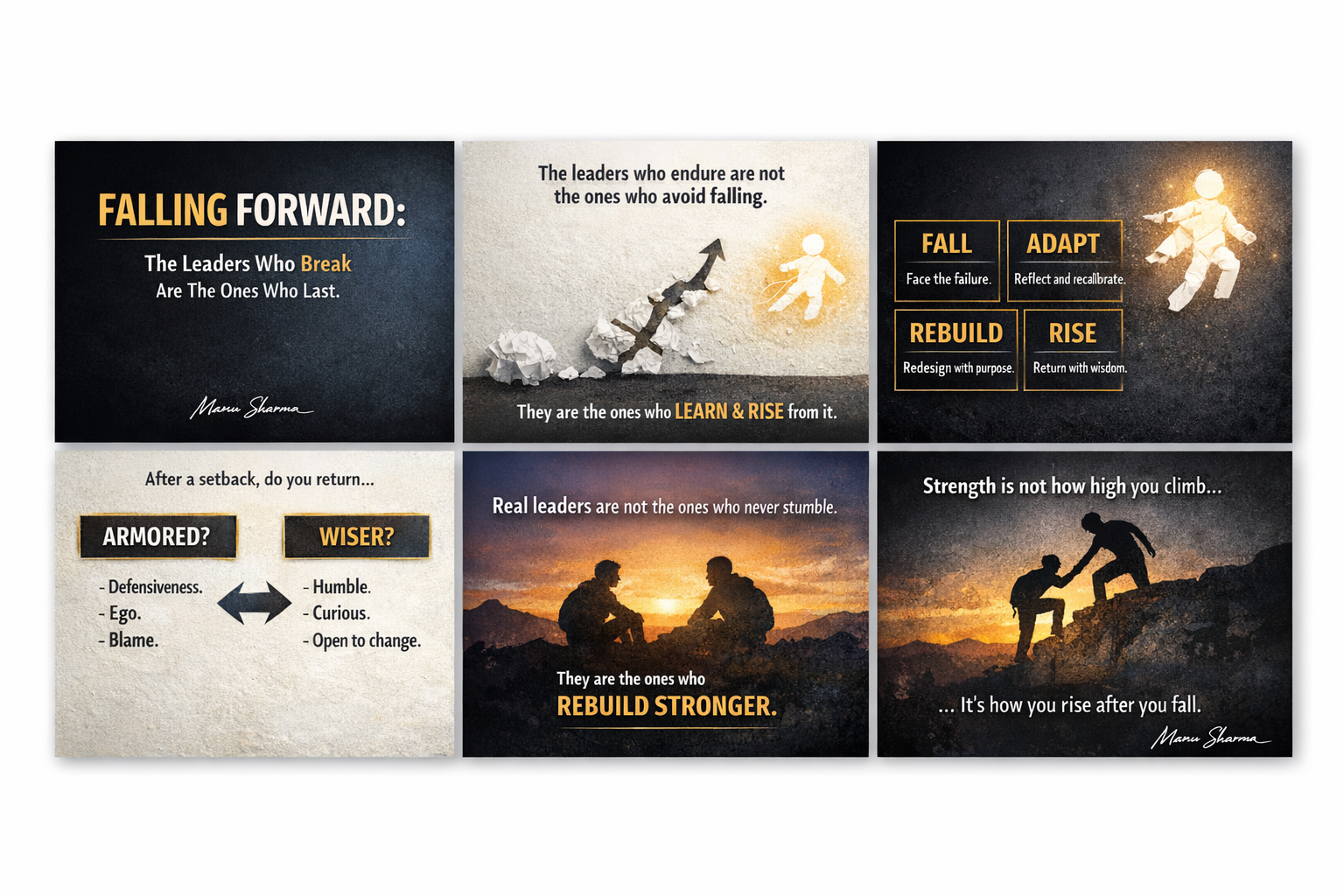
Falling, adapting, rebuilding, rising again is not a slogan. It is a lived rhythm.
And, I will the first one to accepts that it is uncomfortable.
Because falling exposes things we would rather keep hidden. Our blind spots. Our impatience. Our need for approval. Our fear of disappointing others. Our temptation to move fast when we should move deep.
In my work over the past two decades, I have watched this pattern repeat itself. The leaders who endure are not the ones who avoid mistakes. They are the ones who metabolize them. They turn failure into feedback. They turn criticism into reflection. They turn disruption into redesign. They turn disappointment into discernment.
Quietly. Without theatrics.
There is a moment, after a fall, when you feel smaller than you did before. Your voice softens. Your certainty thins. Your confidence gets rewired.
That moment matters.
You can rush past it. Or you can sit in it long enough to learn.
Most people rush. But. the best leaders linger. They ask harder questions of themselves than anyone else ever will.
Why did I miss this? What did I assume? Where did ego sneak in? Who paid the price for my blind spot? What am I being invited to unlearn?
This is where depth is born. Not just in success. But also in the constant reckoning.
Over time, I began to notice something else. Leaders who have fallen and rebuilt carry a different energy into rooms. They listen differently. They interrupt less. They speak with more care. They leave more space.
They know how fragile progress can be.
They stop performing leadership and start practicing it. They understand that resilience is not toughness. It is humility with stamina. They understand that adaptation is not about trends. It is about staying aligned with purpose while changing methods. They understand that rebuilding is not cosmetic.
It is structural. Emotional. Cultural. Relational.
And they understand that rising again is not about proving anything. It is about serving better.
In my own journey, almost every meaningful shift in how I lead has followed some version of discomfort: A project that stretched beyond its design. A partnership that required more listening than talking. A team moment that reminded me that intent is not impact. A season that forced me to simplify everything.
Each time, something had to be released.
Old assumptions. Old habits. Old narratives about who I thought I had to be.
Letting go is rarely dramatic. It is usually quiet. It happens in private. In reflection. In long walks. In handwritten notes. In conversations with people who care enough to be honest.
This is the work no one really notices or applauds. But it is the work that compounds.
Over time, it builds leaders who are grounded instead of reactive. Leaders who are steady without being rigid. Leaders who can hold complexity without losing compassion.
When I meet people who have led through crises, reinventions, setbacks, and reinventions again, I notice something subtle.
They are lighter.
Not careless. Not casual. Simply, Lighter.
They are not carrying the weight of needing to be right all the time. They are not trapped by old identities. They are not clinging to yesterday’s success.
They are free to learn.
That freedom is rare.
And it is earned through falling well.
There is a difference between failing and falling forward. Failing without reflection hardens people. Falling with reflection deepens them. One produces defensiveness. The other produces wisdom. One shrinks relationships. The other strengthens them.
Leadership, in the end, is not measured by how high you climb. It is measured by how you return after you stumble.
Do you come back more curious? More generous? More aware of others? More patient with complexity?
More committed to doing the work that does not show? Or do you come back armored?
I have learned that the leaders I trust most are the ones who can say, calmly and without drama, “I learned from that. It changed me.”
No excuses. No performance. No self-pity. Just growth.
In a world obsessed with speed, visibility, and constant motion, this kind of leadership feels almost radical. It moves slowly. It thinks deeply. It listens carefully. It acts deliberately. It builds for decades, not quarters. And it understands that falling is not a detour.
It is part of the path.
So when I think about the leaders who matter most to me, they are not the ones who always looked perfect from a distance. Many of them are the ones who were willing to be imperfect up close. Who stayed open when closing would have been easier. Who stayed reflective when reacting would have been faster. Who stayed human when hiding behind authority was an option.
They fell. They adapted. They rebuilt. They rose.
Often … again and again.
Not to impress. But, to serve better.
And perhaps that is the quiet truth about leadership we do not say often enough. That the goal is not to avoid breaking. The goal is to break in ways that make you wiser, kinder, and more useful to the people who trust you.
That is not weakness. That is strength, refined.
And it always lasts.