There are stories that stir your pride.
There are others that spark your imagination. And then, once in a while, there are stories that do both – while quietly rewriting what we believe is possible.
Reading NDTV’s recent feature on the 50-year anniversary of India’s landmark SITE experiment – “From Cow Dung to Cosmos: How India Gave The World Direct-To-Home Television” – left me deeply moved. Not just as an engineer who finds such feats exhilarating, but as an Indian who lived through that time, who saw firsthand how technology, commitment, and community could combine to transform lives.
This wasn’t just a clever deployment of satellites. It was a remarkable confluence of imagination, international collaboration, grassroots effort, and above all, belief. In a world increasingly defined by tariff wars, hardened borders, and protectionist sentiment, it feels especially timely to revisit and celebrate what happens when science works across boundaries – and when action matters more than optics.
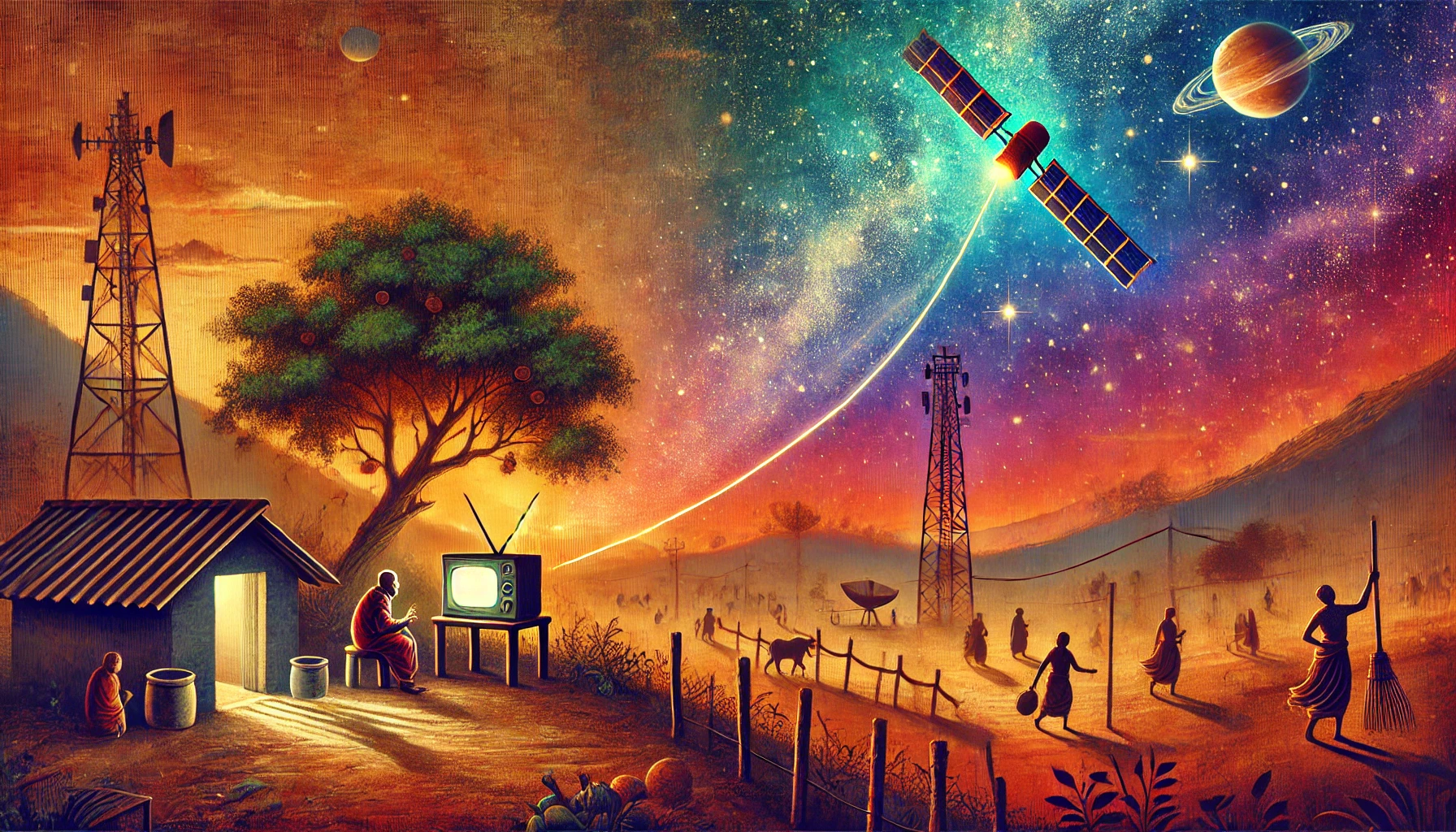
In 1975, NASA and ISRO, with support from the UN and governments in both countries, launched the Satellite Instructional Television Experiment – known as SITE. The goal was audacious. To beam educational television directly into 2,400 remote Indian villages. No cables. No middlemen. Just a satellite in the sky, local antennas on the ground, and an army of schoolteachers, engineers, and local volunteers mobilized to ensure every signal translated into learning.
And it worked. For a whole year, villages across six states gathered daily around community TV sets powered by solar panels and car batteries, watching broadcasts on farming, health, nutrition, and family planning – often in their local language. It wasn’t vanity. It wasn’t about broadcasting a signal for the sake of saying we did it. In the words of SITE’s own architects, it wasn’t “glitz or glamour” that mattered. “What mattered was action and impact.”
Over 44,000 teachers were trained. Surveys showed over half the viewers changed behaviors or adopted new practices. More than 90 percent of viewers found the content locally relevant. All of this from a nation that at the time, in many places, still relied on cow dung as fuel and lit village streets with kerosene. It’s no exaggeration to say this was one of those seminal moments India learned how to leapfrog. Not copy. Leap.
The satellite, ATS-6, was American. But everything else was Indian. The production. The local mobilization. The engineering that patched over power outages, signal failures, and cultural barriers. The sheer ingenuity that made it work in the field, not just in theory. When NASA handed the keys to the satellite, India didn’t just receive it. They activated it. And then, they built on it.
SITE gave birth to India’s space-based communication infrastructure. It laid the foundation for INSAT and EDUSAT, and opened the door for Doordarshan to become one of the world’s largest public broadcasters. The principles tested during SITE – direct-to-home broadcasting, interactive public education, decentralized information access – now power not just television, but mobile phones, e-learning platforms, and disaster response systems across India.
But more than the systems it built, SITE shaped a mindset. It showed us that you don’t need to own everything to build something valuable. That strategic collaboration – not dependence, not imitation – is the shortest path to sovereignty. That technology’s true power lies not in its sophistication, but in its ability to reach and uplift.
When I think of how education delivery is being debated today – through AI tutors, private EdTech, metaverse classrooms – I can’t help but remember that India, half a century ago, already implemented one of the world’s boldest decentralization models. It wasn’t perfect. But it was real. And it worked. In a country where decision making often stayed top-down, SITE flipped the model. Villages chose how to use the content. Teachers adapted the lessons. Communities owned the outcomes. It was education by satellite, but it was governance by the grassroots.
And this is where the story becomes deeply personal. While I was not personally a part of this amazing social, educational, and technical experiment, I do remember the first time I saw a television flicker to life in 1986. I can imagine the first time a farming tip or a health message reached people not through rumors or third-hand advice, but from a trusted, clearly articulated, professionally produced broadcast. The quiet revolution wasn’t in the signal. It was in the shift of who had access to knowledge – and who got to feel included in the future.
That’s why this story matters even today.
Not just because it’s a good throwback. But because it reminds us what can be built when the aim isn’t just visibility, but value. When partnerships are pursued not for headlines, but for hard problems. When we stop measuring development through optics and start prioritizing transformation.
NASA brought the satellite. But ISRO brought the soul. Together they created magic. And the people of India – engineers, teachers, farmers, volunteers – brought the courage to try, to build, to believe.
This was more than a broadcast. It was a signal of what was to come. And half a century later, that signal still matters.