There’s a quiet irony in how people approach their own growth.
We design strategies for organizations, markets, and systems, yet when it comes to our personal evolution, we tend to drift. We absorb advice from books, borrow wisdom from podcasts, and fill notebooks with lofty ambitions. But very few of us have a strategy for ourselves that we actually use. We build career plans that collect dust, personal goals that dissolve under pressure, and professional aspirations that sound good but never make it to execution.
Somewhere between the idea of growth and the act of growing, the bridge collapses.
That collapse, in my view, comes from confusion between direction and design. Growth isn’t a byproduct of effort alone; it’s the outcome of clarity. You can have all the ambition in the world, but if you don’t know what you’re building toward, ambition becomes noise. In the world of business, we call it misalignment. In human terms, it’s simply being lost.
For years, I’ve used and taught the “Personal Business Model” as a way to help people map their professional identity, borrowing from Tim Clark’s Business Model You. It’s a powerful tool, but what I’ve learned through coaching, teaching, and my own leadership journey is that most people don’t need a new framework. They need a new relationship with themselves – one that combines self-awareness, discipline, and direction. They need a personal strategy that doesn’t just live on paper but breathes in the choices they make every day.
I’ve built and refined one such structure over time. I call it “A Professional Growth Strategy“. Think of it as your personal operating system – a way to bring the same rigor to your development that great companies bring to theirs, but with the heart, honesty, and imperfection that make you human.
It begins, as all things should, with purpose. Ask yourself: if a 10-year-old asked what you do, could you answer in one sentence? Not your title, not your résumé, but your purpose. Mine is simple: I help people and organizations make sense of complexity so they can act with clarity, courage, and purpose. It took me two decades to get to that sentence. Strip away the jargon, and it’s about helping people see clearly so they can move forward. Clarity, after all, is the foundation of movement.
Then comes a more uncomfortable question: why does the world need you? The world doesn’t owe any of us attention. It rewards relevance. And relevance comes from contribution. The truth is, if your work disappeared tomorrow and no one noticed, it’s not because you’re invisible; it’s because your value hasn’t yet connected with a real need. When I ask myself what would break if I stopped showing up, I find my answer not in tasks but in presence. The people I work with would lose a reflective mirror – someone who helps them see themselves more clearly, and in doing so, move more intentionally. That’s my real contribution. The rest is logistics.
The next layer is what I call your personal moat – your unique advantage. Every professional should know what makes them hard to replace. It’s not your degree or your skill set; those are commodities. What makes you rare is the fusion of how you think, what you care about, and the consistency with which you show up. My moat is what I call strategic empathy – the ability to understand systems and emotions at the same time. It’s how I bridge analytical design with human depth. Most people specialize in one or the other. I’ve learned to operate in both worlds because impact often sits right at that intersection.
Another question I often ask people I mentor is: where are you already winning disproportionately? Most of us are so busy chasing what’s missing that we ignore what’s working. Doubling down on your existing strengths is often a faster route to growth than chasing new ones. For me, that area is helping others find direction, not by giving answers but by asking questions that bring clarity. That’s where my influence compounds naturally.
Find yours.
Every strategy must also confront reality. Who do you create the most value for? What’s their biggest pain? What do they struggle with emotionally or professionally that your presence helps ease? For me, it’s leaders and changemakers who sit between vision and uncertainty. They care deeply about what they do but feel pulled in too many directions. My work helps them translate care into clarity, purpose into action. That’s not a market segment; that’s a mission.
Strategy, though, isn’t just about knowing what to do. It’s about deciding what you will always do – and what you will never do. This is where personal discipline takes root. I will always tell the truth, even when it’s uncomfortable. I will always choose people over processes. I will always make time to help someone grow, even when it’s inconvenient. And I will never chase popularity over purpose, or pretend to know what I don’t. Decisions like this form the moral architecture of your career. They define your integrity long before your résumé does.
A growth strategy also demands focus. Each year, I define one priority that matters above all. This year, it’s to scale my impact through writing and teaching. Writing, for me, is not an output; it’s a practice of thinking out loud. Teaching is where that thinking turns into transformation. But no matter how clear your priorities, constraints will always appear. Mine is time. I say yes too often to meaningful things, which dilutes my ability to go deep on the most strategic ones. So my plan is simple: fewer commitments, better systems, and more reflection. Strategy is less about what you add and more about what you remove.
Execution turns vision into motion. That’s why I break my focus into three quarterly outcomes and specific monthly milestones. I’ve found that when progress is measured in months instead of years, accountability feels real. And accountability itself is a team sport. Growth doesn’t happen alone. I rely on peers, mentors, and my writing community to keep me honest and evolving. We all need mirrors that reflect both our progress and our blind spots.
Finally, there’s the narrative – the story others tell about you when you’re not in the room. That’s the true measure of your professional strategy. For me, I hope people say I made complexity simple, that I led with empathy, that I helped others believe they could lead too. Not because of authority, but because of awareness. And if I had to distill all of this into a phrase, mine would be: I grow because I keep learning how to serve better. That’s it. Growth without service is just self-improvement.
Growth in service to others is leadership.
At the heart of it, the best strategies are the ones you can remember on a Monday morning. They don’t live in binders or slides; they live in behaviors. They don’t need jargon or endless KPIs; they need conviction. And they work not because they’re clever, but because they’re lived.
So if you’re trying to design your own growth path, start with questions, not answers. Begin with why the world needs you, what breaks when you don’t show up, what makes you rare, and what you will refuse to compromise. Build your plan like you’d build a company, but run it like you’d live a life – with curiosity, humility, and a relentless commitment to keep showing up.
Because in the end, strategy is not a plan on paper. It’s a pattern of behavior. And the most powerful strategy of all is the one you actually live by.
Growth, after all, is not about how fast we move but how consciously we choose our direction. It’s about recognizing that we are each, in our own way, a living business model – shaped by what we value, what we give, and what we choose to protect. And once we understand that, we stop chasing external validation and start building from a place of internal clarity.
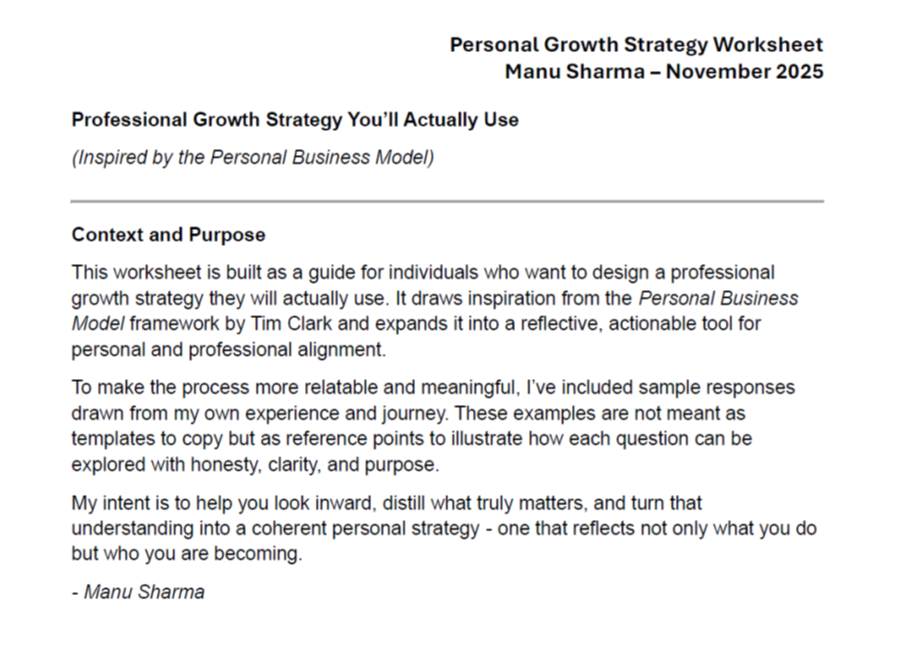
If you’d like to put this into practice, I’ve created a Personal Growth Strategy Worksheet – a simple, reflective tool that walks you through the same questions and frameworks I use with my clients and students. It’s designed to help you move from intention to action, from confusion to clarity.
You can download it below and start building a growth strategy you’ll actually use.