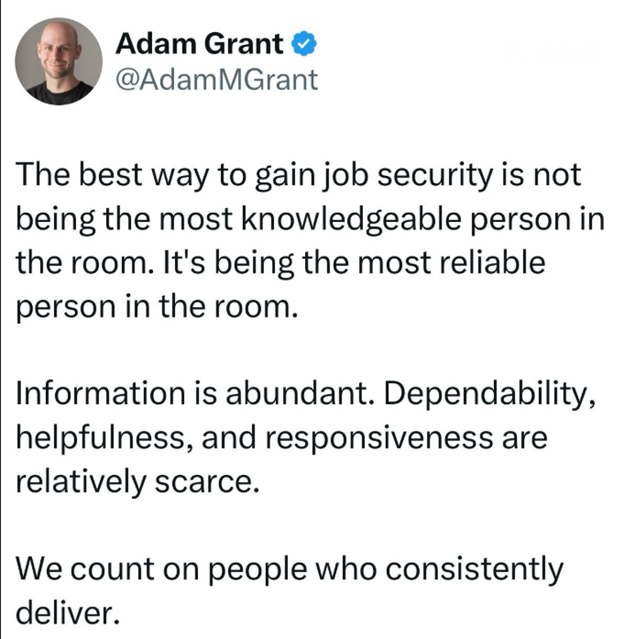
I have to shine a light on something Adam Grant posted on Linkedin recently.
He wrote that job security has less to do with being the most knowledgeable person in the room and far more to do with being the most reliable. In a world overflowing with information, he reminded us that dependability, helpfulness, and responsiveness are the true rarities. It stayed with me long enough to share with my students later in my class and inspired me to leave a comment under his post. That conscious exchange nudged me to write this piece.
I’ve spent most of my life around people who are (often) brilliant on paper but (often) unpredictable in practice. You can’t build anything meaningful on unpredictability. I learned that the hard way early in my career, during a stretch when I was myself the same way – saying yes to too many things and delivering on fewer than I wanted to admit. It wasn’t intentional. It was youth, insecurity, and a misguided belief that potential mattered more than follow through. The truth is, potential doesn’t keep anyone’s lights on. Reliability does. It took time to understand that every commitment you make is a quiet signature of your character. People remember the small promises you keep long after they forget the impressive things you knew.
Adam’s reminder stirred something again, because the world hasn’t changed as much as we pretend it has. We talk endlessly about skills, knowledge, speed, and now the tidal wave of AI. But remember, intelligence has never been the scarcest resource. The scarcest resource has always been people who consistently show up with intention, keep their word when no one is watching, and treat the responsibility to others with seriousness. It’s easy to glorify brilliance. It’s far harder to value the quiet force that actually holds teams together.
When I think about reliability, I think about the leaders who shaped me. None of them were the loudest in the room. They were the ones who made you feel safe because you knew what they stood for. They didn’t surprise you with sudden shifts in character. They didn’t hide behind jargon or posture. They brought clarity when everything around you felt muddy. They listened. They paid attention. They followed through. They created environments where people could breathe.
Somewhere along the way, I was inspired to build my own personal compass: be intentional, be consistent, be thorough. Those three behaviours became anchors that steadied me during moments when everything else felt uncertain. They helped me understand that reliability isn’t about perfection. It’s about care. It’s about treating every commitment as if it carries weight, because it does. It’s about recognizing that trust isn’t built through grand gestures. It grows through small, repeated actions strengthened over time.
And let’s not forget the world we’re currently living in. AI is rewriting how we work, what we create, and how quickly we operate. The volume of information around us has exploded. Knowledge is becoming an open resource, accessible to anyone with a keyboard and curiosity. But reliability is still deeply human. No model can replace the feeling of counting on someone. No algorithm can replicate the confidence that grows when a person says something and then does it exactly the way they said they would. In a time when technology can do almost everything faster, reliability is one of the few remaining traits that becomes more valuable as everything else accelerates.
I’ve watched high performing teams crumble because trust was thin and commitments were treated like loose suggestions. I’ve watched struggling teams transform almost overnight when one reliable person walked into the room and raised the standard for everyone else. That’s the part we underestimate. Reliability isn’t just a personal virtue. It’s contagious. It elevates the people around you. It reinforces expectations. It sharpens culture. It becomes the quiet mechanism that moves work forward even when things get messy.
There’s a moment in every leader’s journey when they realize that influence has very little to do with authority. Influence is built through the simple, unglamorous act of doing what you said you would do. People follow that. They trust that. They bet their own reputation on that. I’ve built my life around frameworks, models, and strategic thought, but nothing I teach lands if reliability isn’t the backbone of it. It’s the difference between theory and credibility.
When Adam wrote about reliability as a pathway to job security, I think he was pointing to something bigger. Reliability isn’t just a professional asset. It’s a human one. It shapes how people experience you. It shapes how teams breathe. It shapes whether others feel grounded in your presence or unsettled by your inconsistency. It even shapes how you experience yourself. Every time you keep a promise to someone else, you strengthen the promise you’ve made to yourself. Every time you deliver with care, you remind yourself that you are someone worth counting on. There’s a deeper self respect in that, a quieter confidence.
As I look at the next chapter of my own work, reliability feels less like a habit and more like a responsibility. We all leave a trail behind us. A trail of kept promises or abandoned ones. A trail of clarity or confusion. A trail of stability or volatility. And the people who cross our path feel that trail long before they hear our credentials.
Adam’s post was short, but it carried a truth that resonates across every era of work, every generation, every team. Knowledge may open doors. Reliability keeps them open. And if you ever find yourself unsure about how to stand out in a world obsessed with status and skill, remember this: the rare advantage has never been brilliance. It’s the quiet strength of doing what you say you will do.