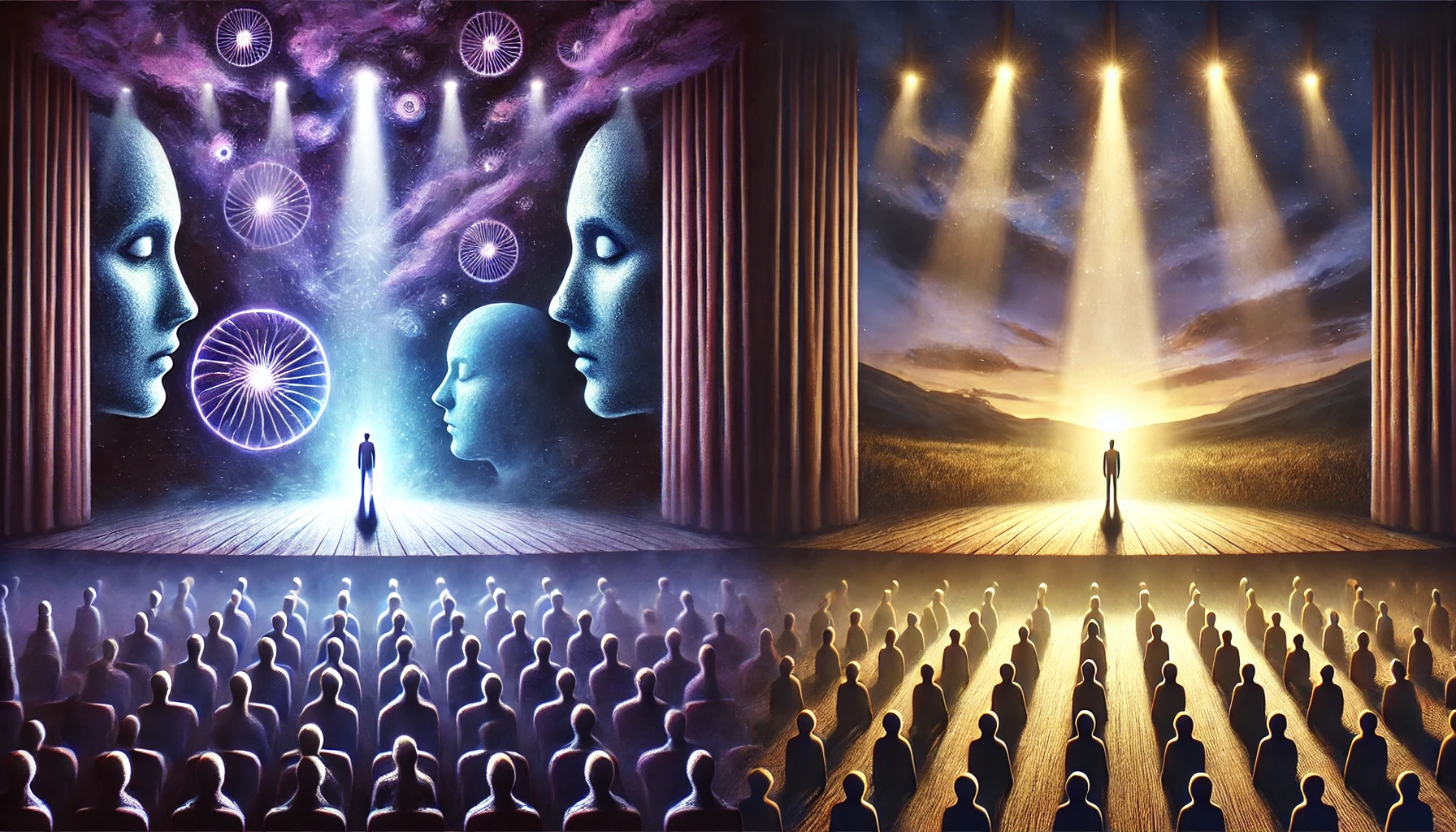
We spend a surprising portion of our lives rehearsing for an audience that isn’t really there.
Every word, every post, every awkward silence, every stumble in a meeting gets filtered through the same quiet thought: What are they thinking about me?
Psychologists call this the Spotlight Effect – the bias that convinces us people are paying far more attention to us than they actually are. The truth, as simple as it sounds, is that most people are far too busy thinking about themselves to notice us. It’s humbling, even a little funny, and strangely freeing to realize that the spotlight we fear so much exists mostly in our imagination.
The day that realization sinks in, something changes. The weight we carry lightens. The noise of self-consciousness softens. And for the first time, we begin to feel what freedom might actually mean.
But this isn’t just a psychological discovery. Beneath it lies a much older insight – one that has been at the heart of Advaita Vedanta for thousands of years. Because what psychology now calls the Spotlight Effect, Vedanta has always recognized as a symptom of self-ignorance – our mistaken belief that we are the center of everything.
Advaita teaches that most of our suffering comes from identifying too closely with our body, our personality, and our thoughts. It calls this misidentification avidya, or self-ignorance. And from it arises the ego – ahamkara – that constant, subtle voice that says “I am the one being seen, I am the one being judged.” The Spotlight Effect is the ego’s modern costume. It’s the same old illusion wearing a new psychological name.
If you look closely, you can see how universal it is. Everyone is busy playing a role in a play where they believe they’re the lead. Imagine a theatre full of actors, each convinced the spotlight is on them, each nervously performing for an audience that doesn’t exist. Nobody’s watching anyone else – everyone’s just trying to remember their lines.
Advaita invites us to walk out of that theatre altogether. To see that we are not the actor on the stage, but the awareness that witnesses the entire play.
Swami Vivekananda once said the ego is like an actor lost in a role, mistaking the stage for reality. The moment he remembers who he really is, he’s free – free to act, to speak, to play, or even to walk away. That’s what true freedom feels like. Not an escape from the world, but a quiet return to your real nature: the calm, unchanging awareness that simply watches.
In that awareness, something beautiful happens. You stop trying to manage other people’s perceptions. You stop living for applause or fearing disapproval. You move through life with a kind of lightness. You still play your part, but the performance no longer defines you.
Even modern cognitive science seems to be circling back to this truth. It teaches us to let go of imagined judgment; Advaita goes further and asks, “Who is the one that feels judged?” Follow that question deeply enough and the whole illusion begins to unravel. Because the one being judged – the “me” under the spotlight – is just a thought. The awareness observing that thought was never under any light to begin with.
You can try this in real life. The next time you feel anxious about what someone might think, pause and watch that thought. Then ask yourself, quietly, “Who is this me they’re thinking about?” Don’t rush for an answer. Just notice the awareness behind the question. That’s the part of you that was never embarrassed, never observed, never touched.
And in that moment, something dissolves. The anxiety loses its grip because you’ve seen through the illusion that gave it power. You see that nobody was thinking about you after all. Everyone else is caught in their own version of the same story, each believing they’re the one being watched. It’s almost poetic – a world full of imagined spotlights, none of them real.
Freedom, then, isn’t about shining brighter or silencing the critics. It begins when you stop performing for an audience that was never there. The spotlight fades, but what remains is peace. You laugh more easily. You forgive quicker. You become lighter, not because you’ve escaped judgment, but because you’ve stopped living for it.
In truth, both psychology and Vedanta are pointing toward the same liberation. One calls it a bias, the other an illusion. Both are trying to free us from the same mental prison – the belief that others’ opinions define who we are.
Once you see through that, life opens up.
You stop walking into rooms as the center of attention. You begin to walk in as awareness itself – quiet, unshaken, and alive. And you realize something profoundly simple: the spotlight never existed. It was never shining on you. It was always shining from you.