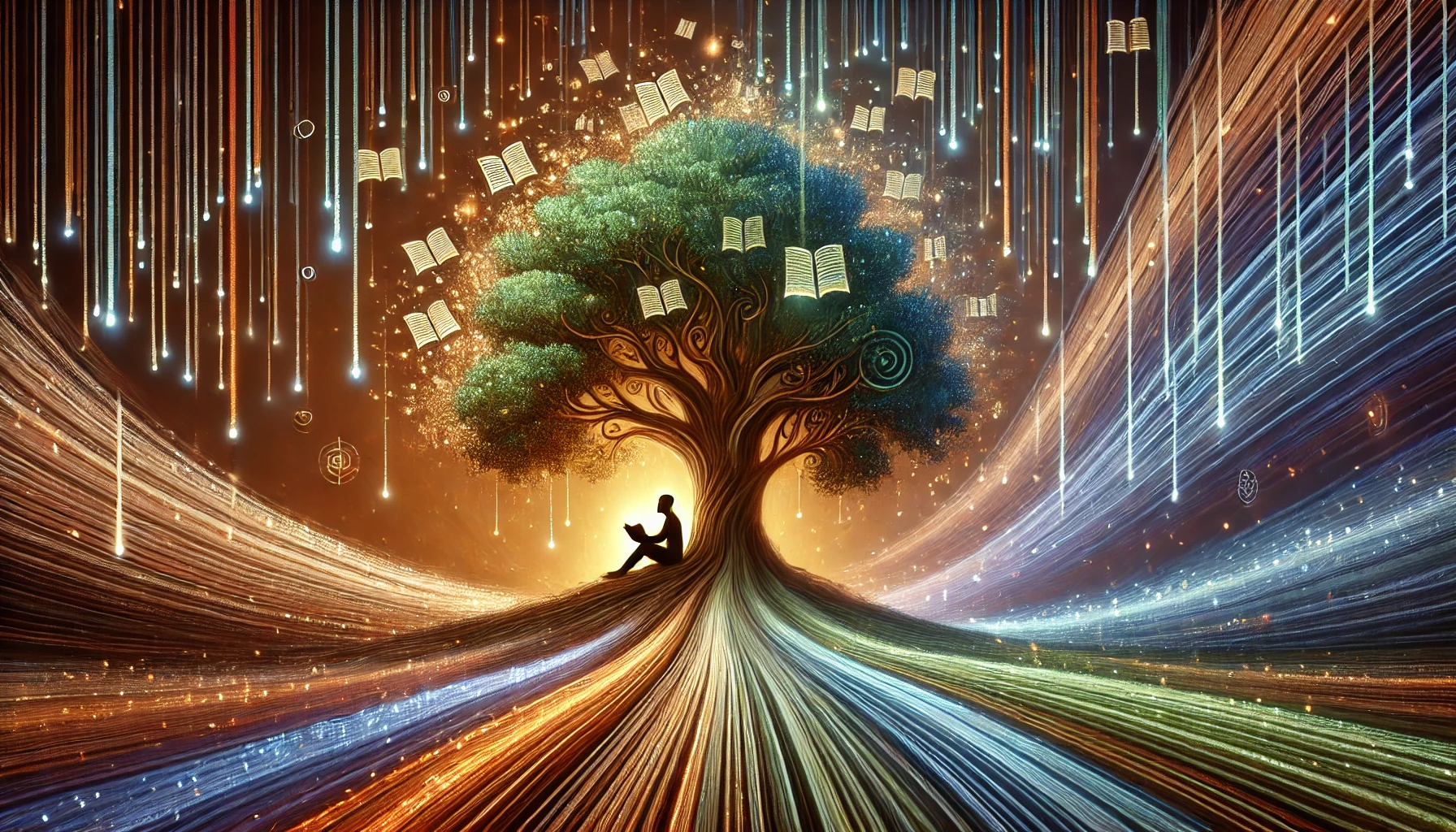
Every few years, the same conversation finds its way back into public consciousness, dressed in new logic but carrying the same old fear – that books are dying.
I’ve heard it for years, but lately, the voices seem louder, more certain, almost triumphant. A few weeks ago, someone I hold in the highest regard echoed that sentiment again, saying we might be witnessing the start of the end of books. I paused for a moment – not in disagreement, but in quiet reflection. What if they were right? And yet, deep down, I knew they weren’t.
The argument, on the surface, feels rational.
Why spend ten hours with a five hundred-page book when you can consume a crisp twenty-minute summary, or better yet, ask AI to explain the same ideas in seconds? Why take the long road when technology offers the express lane? Social media, video essays, short-form summaries, and now generative AI – they’ve all promised us the same thing: more knowledge, faster. But what they really offer is more information. And information, no matter how fast or how smartly delivered, is not to be confused with knowledge.
Books demand time, and that is exactly their power. They ask for our attention, our patience, and our willingness to think deeply. They require us to be present in the process of discovery. When you read a book, you are not just gathering information; you are immersing yourself in the way someone else has seen the world, connecting dots across time, culture, and perspective. A good book doesn’t just teach you something new – it changes how you think about what you already know.
This is my positon: what AI gives you is a shortcut, what a book gives you is a journey. And that journey is what transforms raw data into wisdom.
As someone who deeply believes in the promise of AI, and I truly say this not as a skeptic but as an enthusiast, I see what AI can do – how it can distill, connect, and extend human knowledge in extraordinary ways. I use it. I learn from it. I am often in awe of it. There is immense value in using AI to augment our learning, to support research, to help us navigate vast oceans of information. But even as I embrace that, I don’t believe that AI can, or should, replace everything we know or do. It can enhance the process, but it cannot substitute the experience. Reading a book, in its truest form, is not about consumption; it’s about communion. AI can point us to new ideas, but it cannot replicate the intimacy of discovering those ideas in our own time, at our own pace, through the quiet act of reading.
Let me try explain more.
As I see it, there is a quiet kind of alchemy that happens when you spend time with a book. You start by following the author’s thread of thought, but somewhere along the way, your own ideas start to emerge, intersecting with theirs. You pause, you underline, you reread a line that feels heavier than the rest. Sometimes, you even close the book and stare out the window, lost in a thought that wasn’t there five minutes ago. That’s the moment when knowledge begins to form – when your neurons start building bridges between what you’ve read and what you’ve lived. That, I firmly believe, cannot be automated.
To take it further, books are not designed to give us answers; they are built to help us ask better questions. They don’t shout conclusions at you; they whisper possibilities. They don’t tell you what to think; they help you understand how to think. Every page invites reflection, disagreement, even discomfort. And that friction, that subtle tension between what you know and what you’re learning, is what creates depth.
It’s easy to see why short-form content is winning the attention game. We live in an age that rewards speed and punishes stillness. Scrolling is easier than sitting with a paragraph. Instant summaries make us feel productive. AI makes us feel powerful. But none of that replaces the slow burn of understanding, the intimate act of walking with an author through their ideas, feeling their hesitations and their clarity, their structure and their struggle. Reading a book is not passive consumption; it’s active participation in a centuries-old conversation between thinkers and dreamers.
There’s a saying that I hold dear: “Every book is a conversation with a genius.” I don’t remember where I first heard it, but it has stayed with me for years. Because that’s exactly what, I believe, reading is – a dialogue between minds, sometimes across generations, often across continents. Some of the most powerful conversations you will ever have are with people you will never meet, whose words will still challenge and comfort you decades after they were written. Books bring that to our lives.
AI might be able to summarize everything humanity has ever written, but it will never replicate the feeling of discovering something for yourself. It can generate conclusions, but it cannot generate curiosity. It can predict what you might like to read next, but it cannot replicate the moment when a line in a book suddenly rearranges your understanding of the world. That feeling – of being surprised, provoked, or quietly moved – is not data. It is distinctly human.
So no, I do not believe that books are dying.
At worst, they are simply waiting for us to return to them with a little more patience, a little more humility, and a lot more curiosity. They are not relics of the past; they are compasses for the future. In a world flooded with content, they remain one of the few places where depth still matters, where silence has value, and where thought is allowed to breathe.
The world may have changed, but the need for reflection hasn’t. And that’s what books give us – the space to think without the pressure to perform, the time to wander through ideas without the fear of missing out. They are the antidote to noise. They are the architecture of thought. They are proof that slow still wins, that depth still matters, and that wisdom still takes time.
For me, books have never been about pages or print. They have been companions through doubt, through curiosity, through growth. They’ve travelled with me through airports and sleepless nights, through seasons of learning and unlearning. They have shaped how I listen, how I lead, and how I learn. And no matter what technology brings next, I know this much – I will keep turning pages, not because I must, but because somewhere in that quiet rhythm of reading, I continue to find myself.