Obaid was in Ottawa this past weekend, and of course we met. These days the core emphasis of our in-person conversations is for me to get a download from him on what is happening in the Valley.
In our chat, he described something that felt small at first. It was just a reflection on how back-to-school shopping happens in his home now. But the more I thought about it, the more I realized he had captured something much larger. A seismic shift. One that speaks volumes about how we live, how we decide, and how we buy.
We were speaking, as we often do, about AI – about the growing role it’s playing in our daily decision-making, and about the wave that’s reshaping the Valley and reverberating far beyond it. Obaid was sharing details of his work, the ecosystem around him, and how quickly things are changing in this new AI-first world. And in the middle of all that, he offered an example from home – the kind of detail that says more than a market report ever could.
Where once his family would drive from store to store, making decisions in real time – comparing notebooks, weighing options, doing the math on the fly – now the journey looks very different. The decision-making is invisible. The selection happens long before any store is entered. AI agents and digital platforms do the work upfront, not just surfacing the options but refining them, recommending them, packaging them neatly.
All that’s left is the click.
This quiet change in household shopping behavior is a mirror to what’s happening across every consumer category. From software to shoes, banking to baby strollers. The way we make decisions has changed. And with it, the very architecture of marketing is collapsing and rebuilding itself in real time.
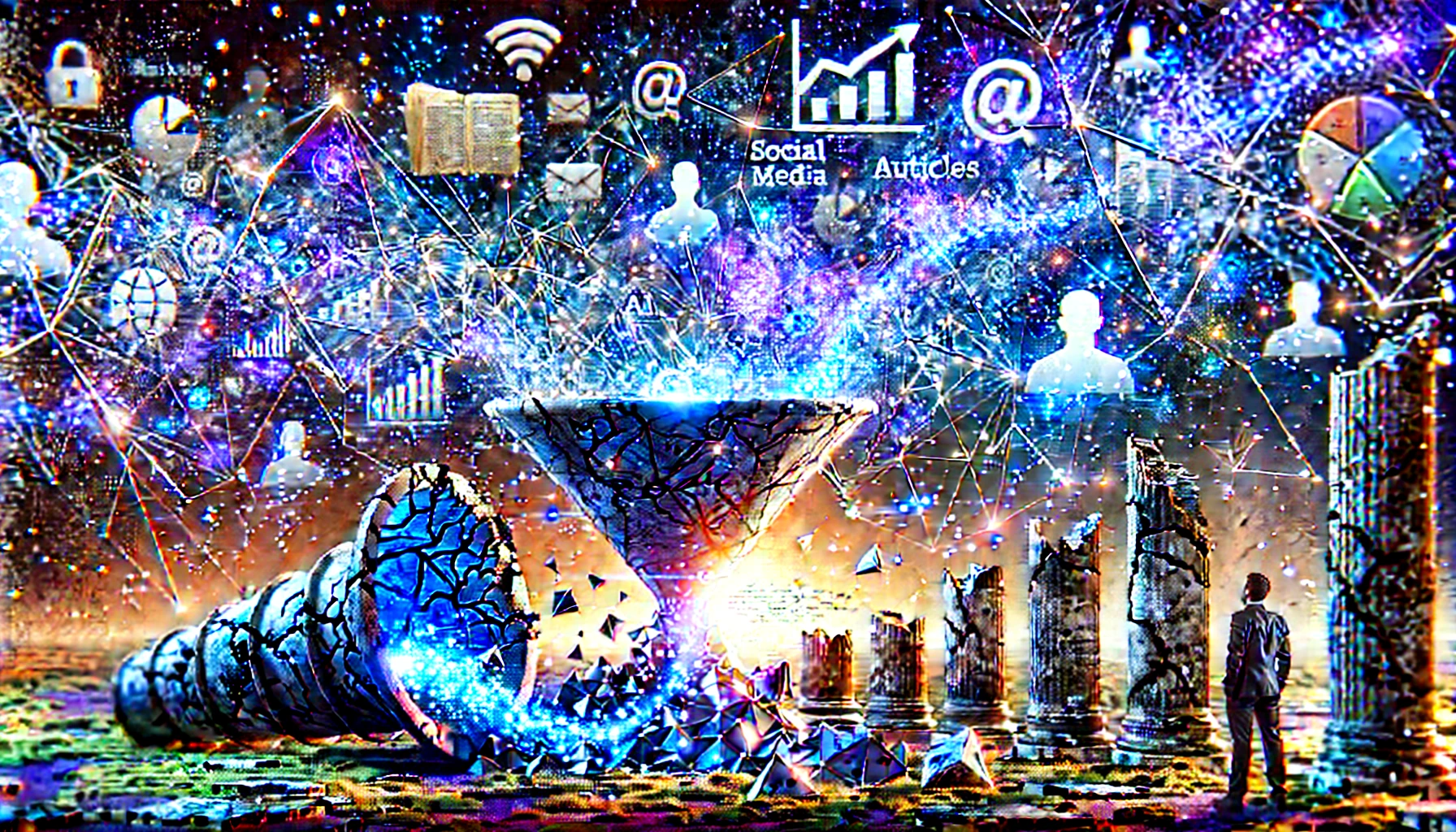
For decades, the marketing funnel was the backbone of strategy. Predictable and measurable.
Capture attention at the top, drive interest in the middle, convert at the bottom. Every touchpoint tracked. Every stage optimized. But now, the funnel has been flattened. Decentralized. And for the most part, rendered invisible.
Today, buyers arrive pre-informed. They’re not just aware of you – they’ve already run side-by-side comparisons, asked a chatbot, watched TikToks and Instagrams, checked out summaries on ChatGPT or Perplexity, scrolled through LLM-generated reviews on Google, and read Reddit threads. By the time they hit your website or your product page, they’ve already decided whether they trust you or not. Whether you’re in the running or out of the race.
This shift isn’t just disruptive – it’s disorienting for those still playing by the old rules. Because traditional attribution models can’t see the journey anymore. Your analytics dashboard will show “direct traffic” or a conversion with no prior touchpoints. But the truth is, you were discovered five days ago in an AI-generated comparison chart, mentioned in a WhatsApp group, and validated by a YouTube or Instagram creator your team has never heard of.
Which means what used to be marketing is now just noise.
And what used to be noise – casual brand mentions, subtle presence in public conversations, passive awareness – is now everything.
Let’s say it clearly: you’re no longer optimizing for traffic. You’re optimizing for presence. For relevance. For being part of the answer when someone asks a machine a question.
That’s not just a branding challenge. That’s a strategic realignment.
If you think about how AI systems are trained, the game starts to reveal itself. They’re not simply crawling your site. They’re reading everything ever written about you. Articles, reviews, testimonials, Reddit posts, employee blogs, user forums, LinkedIn commentary, conference transcripts. Every piece of content becomes signal. Every mention becomes influence.
So if you’re still chasing clicks, your competitors are already in the conversation that matters – the one you can’t see, can’t track, and can’t buy your way into overnight.
In a world where machines are filtering, framing, and front-loading buyer decisions, your job isn’t to shout louder. It’s to show up better. Not by pushing products, but by building trust, credibility, and clarity across the ecosystem of knowledge these systems rely on.
In other words, your brand has to live in the training data.
This means different things for different organizations. For some, it means rewriting the SEO playbook to focus less on keywords and more on usefulness. For others, it means building thought leadership that feels human, relevant, and hard to fake. For many, it means getting serious about reputation – not as PR spin, but as digital equity that compounds over time.
The winners in this new environment will be those who understand that marketing is no longer a campaign. It’s a constant. A living archive of who you are, what you stand for, and how clearly that shows up when you’re not in the room.
To borrow from Obaid’s metaphor, it’s not about dressing up the storefront anymore. It’s about having your story told accurately by the assistant that’s helping the buyer shop from their kitchen table.
And that story isn’t written at the checkout page. It’s written across a hundred small touchpoints that machines, and people, learn to trust.
So if you’re a business leader, a brand strategist, or a marketer trying to make sense of all this, stop asking how to drive more traffic. Start asking where your brand shows up in the modern research stack. In the LLMs. In the sidebars. In the summaries. In the snippets. In the whispers of the web.
Because in 2025, your customer isn’t searching.
They’re asking.
And the answer they get is the beginning – and the end – of your funnel.
Let’s not just keep up. Let’s get ahead.
Because you’re not selling a product.
You’re building an answer.
And the smartest agents in the world are already telling your story – whether you’re in the room or not.