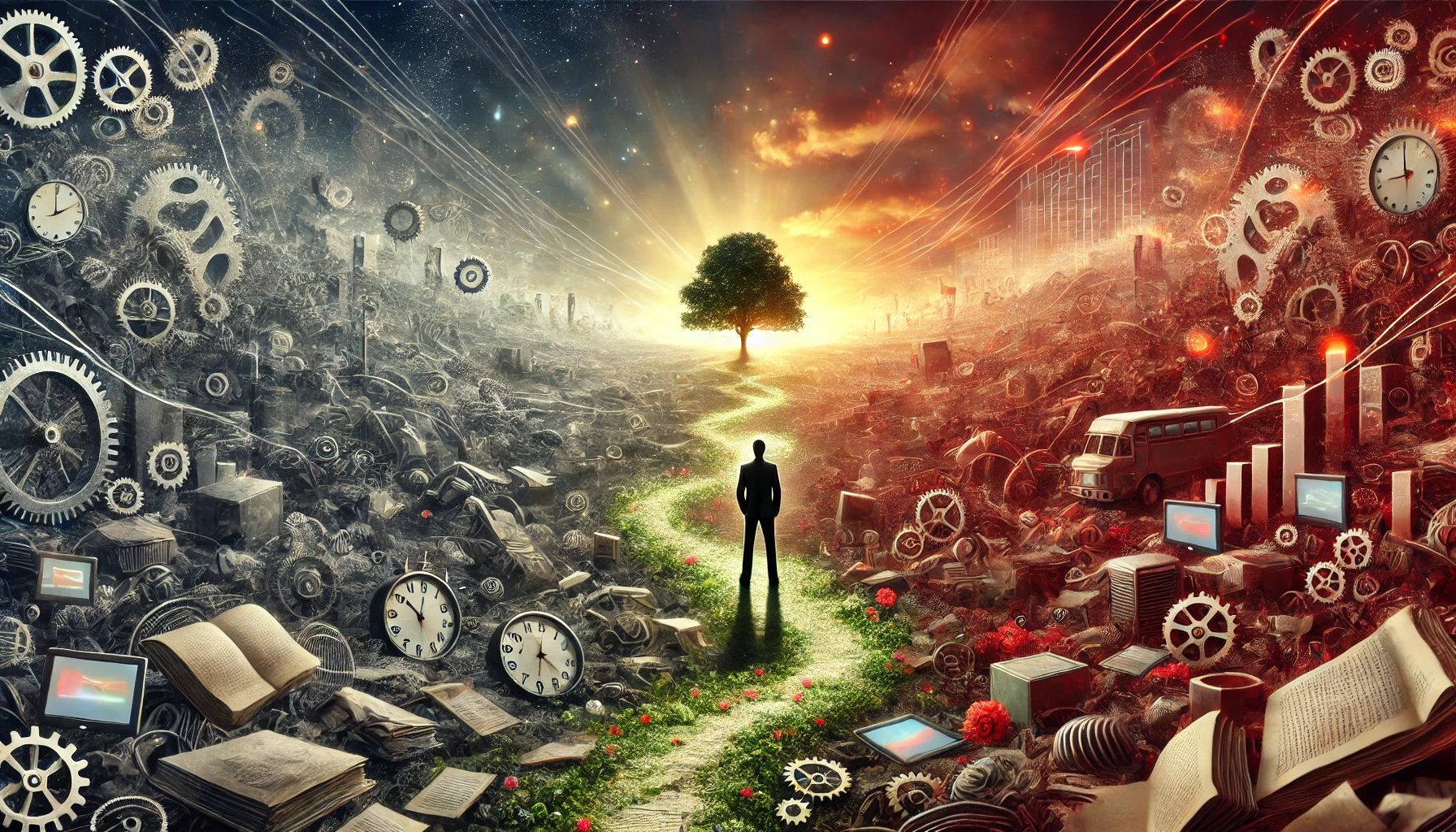
There’s no shortage of things that need fixing.
Everywhere we look, something is breaking — systems, relationships, climates, trust. The world is noisy with urgency. And yet, the more we pile onto our plates, the more we realize that doing everything is just another way of doing nothing well. When everything feels important, what truly deserves our best?
This is not just a question of productivity. It’s a question of meaning.
We often find ourselves trapped in the triage of life — pulled toward whatever is loudest, latest, or most convenient to solve. But what actually deserves our focused energy isn’t always what screams the loudest. Sometimes, what matters most is quieter. Sometimes, it’s slow. Sometimes, it’s the thing that will only pay off years from now, long after we’ve moved on. And still, it’s the thing that’s worth it.
So how do we choose? How do we decide where to spend our thoughts, our time, our effort, our resources, our best work?
The brokenness that most needs our attention isn’t always the surface-level failure of a system. It’s the fractured relationship we’ve built with the system itself. We’ve grown comfortable fixing problems at the edges — patching, tweaking, optimizing. But what erodes underneath is our collective sense of responsibility, our long-term perspective, our courage to work on things that might not reward us in this lifetime. Climate change is an obvious case. It is urgent and compounding, but we still behave as though it can wait. Mental health is another. We build systems that are technically functioning but spiritually empty, where people feel more disconnected, more isolated, more unseen, even in crowded rooms. Youth development sits quietly in the corner of these conversations, often framed as a “nice to have,” while in reality, it’s the deepest lever we have for shaping the future. The things that deteriorate fast and the things that multiply slow — these are the areas where our investment has the longest reach.
We should care about the things that compound — whether it’s harm, neglect, trust, or potential. Because some problems grow geometrically when ignored. And some solutions do, too.
This isn’t about chasing every fire. The seductive pull of urgency is that it feels virtuous. But when everything is urgent, nothing is prioritized. Urgency without prioritization is just panic with branding. If we are to focus our best energy, we need a lens sharper than urgency. We need a decision-making framework that blends moral clarity with systems thinking and honest self-awareness about where we actually have leverage.
Start with this: what will matter in ten years? What, if left alone, will cause irreversible harm? What, if nurtured, will unlock other pathways? What, if done by us — not just someone — will actually shift the outcome? The things that deserve our best are rarely the things we can tick off a to-do list by Friday. They are often inconvenient, sometimes impossible, but always essential. They are the slow, compounding problems whose solutions require long attention spans.
We can’t prioritize based on what’s loud. We have to prioritize based on what’s long.
It’s tempting to gravitate toward the shiny, the new, the things that generate quick wins and easy applause. But most of the meaningful work in life isn’t glamorous. It’s patient. It’s often relational. Sometimes, it’s repairing trust. Sometimes, it’s investing in someone who isn’t ready yet. Sometimes, it’s designing solutions for problems that may not directly impact us — but they will impact the people we claim to care about.
A useful guide in all of this is proximity. Where can you actually get close enough to make a difference? Where do you have credibility, influence, access? The perfect problem to solve is not always the biggest problem on the planet. It’s the problem you are uniquely positioned to shift. The ones where you can apply your skills, your relationships, your history, your energy — and actually move the needle.
The other compass we need is conviction. Not all problems will keep you up at night. But some will. Pay attention to those. They are signals. The things that nag at you — the inefficiencies, the injustices, the avoidable harms — they are invitations to care. When we align our proximity, our skills, and our conviction, we find work that is not just impactful, but also sustainable. Because we’ll keep showing up for it. Even when it’s hard. Even when the rewards are slow. Even when no one’s watching.
And yet, even with the best frameworks, life will still come at us with too much, too fast. Sometimes, everything will feel urgent and important. In those moments, I come back to three filters: what’s irreversible, what’s compounding, and what’s relational. The irreversible gets my attention first — because some losses can’t be undone. The compounding comes next — because unattended problems don’t wait, they grow. And the relational always matters — because trust, connection, and people are the bridges that carry all other solutions.
We can’t solve everything. But we can give our best to something. Something that deserves our time, our skill, our focus. Something that will outlast our effort. Something that will matter beyond our inboxes and our calendars.
What deserves our best is rarely the easiest thing to do. But it is often the right thing to do. And that’s the difference between being busy and being useful. Between scattering ourselves and choosing, with intention, what to carry.
In the end, the question isn’t whether we can do it all. The question is whether we will show up—fully, deliberately — for the few things that truly deserve our best.