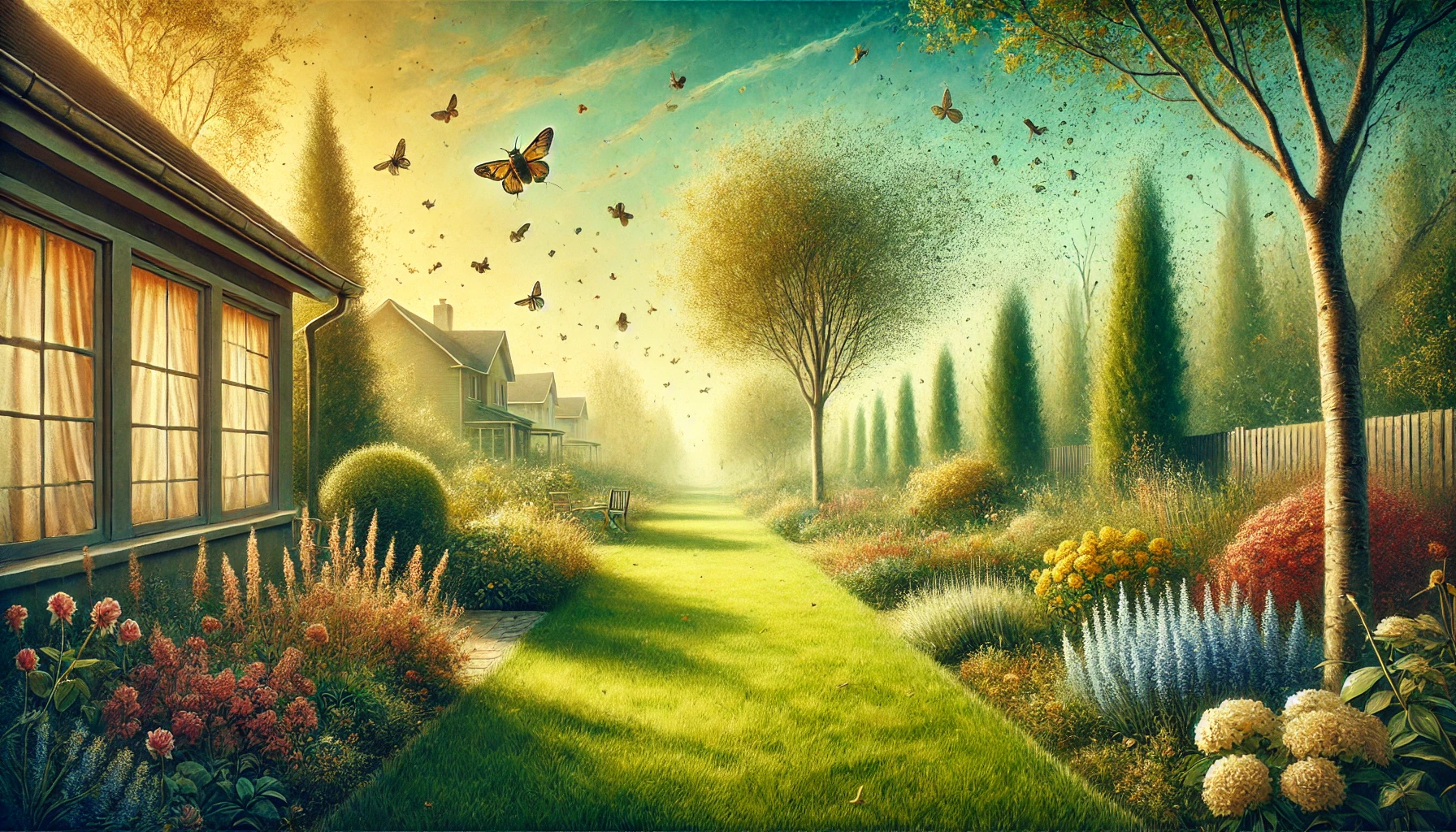
There’s a certain kind of silence that creeps in slowly.
You don’t notice it right away, especially when everything else looks just as it should. The flowers are blooming, the grass is green, the trees are full. But something feels off. The buzz is missing. The flutter is gone. And then you realize – there are almost no butterflies. No bumblebees. Just stillness.
This year, the silence feels louder than usual.
It started as a few offhand comments in local Ottawa gardening groups. People wondering out loud why they weren’t seeing bees in their backyards. Why their heavily flowering gardens felt strangely lifeless. Why the butterflies hadn’t returned like they used to. I didn’t need to look far for my own answer – I had been feeling it too.
And it didn’t feel like coincidence. It felt like consequence.
This isn’t just about pollinators.
It’s about the choices we make every day that seem small but carry weight. Choices that prioritize aesthetic over ecosystem. Convenience over continuity. Comfort over consciousness. Every fall, ecologists and advocates remind us to let the leaves lie. To let nature take care of itself. To remember that those scattered leaves are not mess – they are habitat. Shelter for insects, breeding ground for pollinators, insulation for tiny lives through the long winter. Every spring, they urge us to delay our rakes and lawnmowers just a few more weeks so the creatures underneath have a fighting chance to wake up.
But every year, the warnings get softer, and the mowers get louder. The moment the sun feels warm enough, we start cleaning. Clearing. Polishing. We don’t want to be that neighbor with a messy yard. We want curb appeal. We want tidy. But in doing so, we erase the very foundation that makes our gardens come alive.
And then we ask, genuinely confused, where the butterflies went.
The irony is that we often think of inaction as neutral. But in some cases, not acting – or not waiting – is the most harmful action of all. By not pausing, not listening to nature’s pace, we end up accelerating its decline. And once something disappears, bringing it back is not a matter of simply planting more flowers or buying a bee house from the garden center. The damage is cumulative, and recovery is slow. If it comes at all.
This isn’t just a local issue. This is the butterfly effect in motion. And not in the theoretical, metaphorical sense. The actual idea. That a small shift in one part of the world – a butterfly flapping its wings – can influence a chain of events elsewhere. Except here, it’s not the flutter of a butterfly setting off a hurricane. It’s the absence of one. And that absence is not neutral. It is charged with meaning.
There’s a larger framework at play here that many of us who work in systems and strategy understand well. It’s the compounding nature of unintended consequences. The idea that complex systems do not react linearly to inputs. That feedback loops amplify over time. That what looks harmless today becomes irreversible tomorrow. When we remove shelter for overwintering bees and butterflies, we don’t just reduce their chances of survival – we reduce the possibility of regeneration, of creation, or memory, of continuity.
It’s also a reminder that our relationship with nature is not one of dominion, but of dependence. We cannot outsource pollination. We cannot engineer fertilization. There’s no app for interspecies survival. At some point, our landscaping choices collide with our ecological responsibilities. And one will win.
This is not a guilt trip. It’s an invitation to pay attention.
Not everything needs to be overthought, but some things do need to be rethought. What if we saw our yards not as displays but as ecosystems? What if we shifted our idea of beauty from “clean” to “alive”? What if leaving leaves on the ground became a sign of wisdom, not laziness?
We’re not talking about massive structural shifts here. We’re talking about letting nature do what it does best – if we just get out of the way. A few leaves. A few extra weeks of waiting. A little mess. That’s all it might take to tip the scale back toward balance.
And if that sounds too small to matter, remember this: the silence you feel in your garden is not just the absence of bees. It is the echo of a choice. Many choices, over time, compounded into a system that now feels eerily quiet. But systems can shift. And choices can be reclaimed.
In my recent article, The Cost of Now Echoes Later (read here), I explored how the consequences of our inaction – or misdirected action – don’t just vanish. They linger, often landing hardest on those who come after us.
So the next time you step into your yard and wonder why it feels a little emptier than before, pause before picking up the rake. There is a world beneath your feet that you cannot see. And what you choose not to disturb might just be the reason the butterflies come back.
After all, the flutter of a butterfly might not cause a hurricane – but the absence of it? That just might.