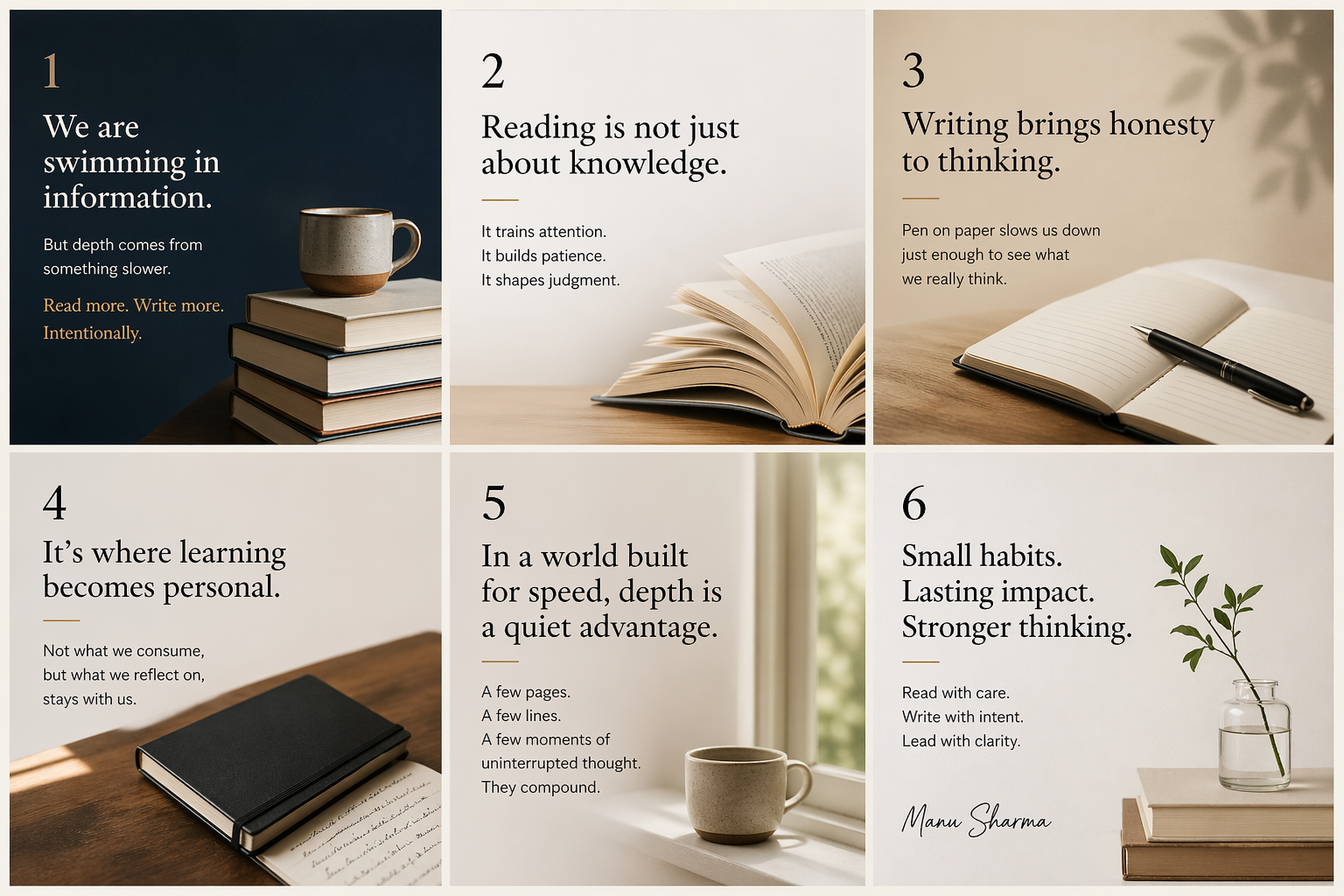
There is a strange irony in how much information we have access to and how little of it truly stays with us.
I notice it in myself at times. I can move through a dozen ideas in a single hour, watch, listen, absorb, react. It feels productive. It feels like learning. But if I pause and ask a simple question a few days later, what did I really take with me, the answer is often thinner than I would like.
I think this is where something older, quieter, and far less celebrated still holds its ground.
Reading slowly. Writing deliberately.
Not as an alternative to everything else, but as a counterbalance to the pace we have come to accept as normal.
I have spent much of my time working with students, early founders, and teams trying to make sense of complexity. There is always a moment, subtle but unmistakable, when the shift happens. It is not when they consume more information. It is when they begin to sit with it. When they start to write it out in their own words. When they stop chasing the next idea long enough to wrestle with the current one.
That is when clarity begins to form.
From what I see, the act of reading in a focused, uninterrupted way is not just about gathering knowledge. It is about training attention. It asks us to stay with something beyond the point of initial interest. It forces us to engage with ideas that do not immediately conform to our existing views. Over time, that does something deeper than learning. It shapes judgment.
And writing, especially by hand, brings a different kind of honesty into the process.
When you write with a keyboard, it is easy to keep moving, to edit as you go, to polish in real time. When you write with a pen, there is a certain friction. You cannot outrun your own thinking. You see the gaps. You feel the hesitation. You notice when a thought is not fully formed.
I would contend that this friction is not a limitation. It is the work.
Some of the most meaningful conversations I have had with students did not come from what they read. They came from what they wrote after reading. A half page of reflection. A question they could not answer. A connection they had not expected to make. That is where learning becomes personal. That is where it becomes durable.
There is also something grounding about the physicality of it. A notebook that travels with you. A page that carries your own handwriting. It may seem small, almost nostalgic, but I believe it creates a different relationship with ideas. They are no longer abstract. They are held, revisited, built upon.
I am not suggesting we step away from digital platforms. That would be unrealistic and, frankly, unnecessary. There is immense value in the access we now have. But I do think we need to be more intentional about how we balance consumption with reflection.
Without that balance, we risk becoming very good at recognizing ideas and not very good at developing them.
The truth is, thinking is not a passive activity. It requires effort. It requires time. It requires a willingness to stay with something even when it is not immediately clear.
Reading and writing, in their simplest forms, create the conditions for that to happen.
I often encourage my students to carry a notebook. Not because it is a technique or a productivity hack, but because it signals a different posture toward learning. It says, I am here to engage, not just to observe. I am here to form my own view, not just to borrow someone else’s.
Over time, that posture compounds.
It shows up in how they ask questions. It shows up in how they make decisions. It shows up in how they lead.
And perhaps that is the deeper point.
In a world that rewards speed and visibility, there is still immense value in practices that build depth and clarity, even if they are quiet and largely unseen.
A few pages read with care.
A few lines written with intent.
Not dramatic shifts. Not sweeping changes. Just small, consistent acts that slowly sharpen how we think and how we understand the world around us.
I believe those habits still matter. Maybe now more than ever.