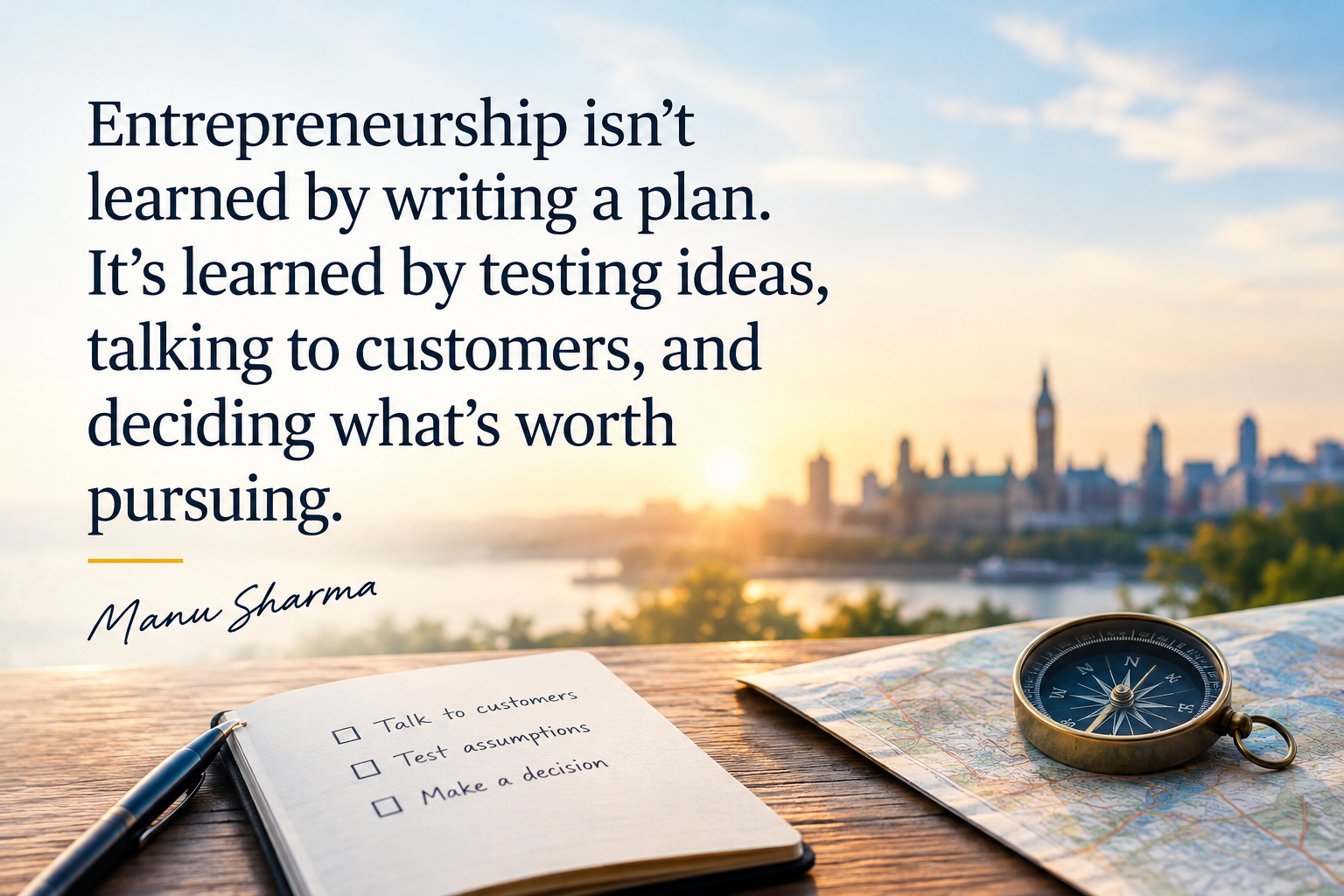
There is something curious about the way we teach entrepreneurship. We ask people to take a risk, challenge an assumption, find a customer, and build something that has never existed before. Then we put them in a classroom and ask them to spend a semester writing a business plan, often based on information they have gathered without ever speaking to the people they hope to serve.
I have always wondered whether we sometimes confuse the ability to explain a business with the ability to build one.
When I was in school in the late 1990s, the comprehensive business plan was already an established feature of entrepreneurship education. Years later, when I began working directly with aspiring entrepreneurs, first at OCRI, then Invest Ottawa, and subsequently at Carleton University, I found myself questioning the value of making that document the centre of the learning experience. We were encouraging people to become entrepreneurs, yet much of their time was spent doing the kind of work that would allow them to demonstrate their understanding of entrepreneurship to an instructor. I would contend that these are two quite different things.
The distinction mattered to me because I had spent enough time around entrepreneurs to appreciate what the work actually demands. An idea is only a starting point. The person who carries it forward has to discover whether anyone cares enough about it to change their behaviour, whether the proposed solution addresses a problem worth solving, and whether the economics make sense. These questions rarely yield to a well-written document. They require contact with the world, including the possibility that the world will disagree with you.
That became the basis for changing how we supported aspiring entrepreneurs. Instead of asking candidates to spend their time producing comprehensive business plans, we structured their work around feasibility analysis. They were introduced to business modelling and value proposition design, then expected to leave the classroom, speak with potential customers, learn from businesses already operating in the market, assess the quality of the information they gathered, and make a Go or No-Go decision.
The change sounds straightforward now, but it represented a meaningful shift in what we considered learning. The deliverable was no longer simply a document that demonstrated how much a candidate knew about a proposed business. It became a record of what they had discovered, what remained uncertain, and what they were prepared to do with that knowledge. Their job was to test an idea rather than become increasingly articulate in defending it.
Michael Lachapelle was an important influence in helping me think through this change, alongside the work of Steve Blank and Alexander Osterwalder. Michael challenged the usefulness of the business plan, particularly in the early stages of a venture. The question that stayed with me was deceptively simple: before investing considerable time and money in explaining how a business will work, have we established whether it should exist at all?
That is a different starting point. It also changes the kind of discipline we expect students to develop.
Consider a team of students asked to develop a technology product with relevance to Ottawa. The city has an established technology community, businesses with practical problems to solve, and potential customers who already spend money addressing those problems. Rather than beginning with a lengthy description of the proposed business, I would ask the team to state its value proposition in twenty-five words or fewer. Who exactly are they helping? What problem are they solving? What changes for the customer if the solution exists?
The exercise forces a useful kind of precision. An idea that requires several pages of explanation before anyone can understand its value may need more work before it deserves a business plan.
From there, the students would examine the industry, its size and growth, the number of existing competitors, and the economic conditions surrounding the opportunity. They would identify their first customer as narrowly as possible, describing the person’s characteristics, behaviours, and attitudes. They would estimate how many such customers might exist locally, across the province, and nationally. The purpose would not be to produce impressive market-size figures. It would be to understand where the first credible opportunity might actually be found.
Then the real work would begin.
Students would prepare questions in advance and interview potential customers, preferably in person. Where distance made that impractical, a video conversation would do. They would speak with people already using competing products or paying for alternative solutions, and record what those people actually said. Which parts of the proposed idea addressed a genuine need? Which assumptions did the conversations undermine? What would the team change as a result?
They would also study three principal competitors, examining their value propositions and comparing them on the factors that mattered to the intended customer. Finally, they would calculate the cost of one transaction: one unit produced, one sale completed, or one download delivered, depending on the business model. Every material cost would need a source.
None of this is particularly exotic. What makes the approach different is that it asks students to move from describing an opportunity to testing one. It gives them a reason to speak with people whose answers they cannot control, and to work with evidence that may not support the conclusion they hoped to reach.
Two aspects of the process mattered especially to me.
The first was the quality of the evidence. Students had to classify their findings as strong, moderate, or weak, explaining the basis for each assessment. A five-year-old industry statistic from a general website might offer useful background, but it could not be treated as equivalent to a recent conversation with a potential customer who was already paying to solve the problem. A supplier’s estimate, an expert’s opinion, a market report, and a customer’s stated intention each tell us something different. Their value depends on the question being asked, the source’s credibility, and how directly the evidence bears on the decision.
This was a lesson in critical thinking as much as entrepreneurship. Information does not become reliable simply because it appears in a spreadsheet or supports a persuasive argument. Students had to make their uncertainty visible rather than conceal it behind the appearance of precision. They learned that a conclusion is only as useful as the evidence and reasoning on which it rests.
The second aspect was the decision itself. At the end of the project, the team had to recommend Go or No-Go and explain why. A No-Go supported by credible evidence was a completed project. In fact, it could be the most valuable outcome available to the team.
This was harder for some candidates to accept than I had anticipated. Years of conventional coursework had taught them to associate a successful assignment with a positive conclusion. If they had chosen an idea, they felt they were supposed to prove that it would work. Abandoning it could feel like admitting failure, even when their research had given them every reason to stop.
I think this reveals something important about education more broadly. We can teach people to follow a process while inadvertently teaching them that the process must produce the answer they originally wanted. In entrepreneurship, that habit can be expensive. A founder who discovers early that customers will not pay for a product has learned something useful. A founder who spends personal savings building it because the original plan assumed success has paid a much higher price for the same lesson.
There is a reason experienced entrepreneurs talk about getting out of the building. The phrase, associated with Steve Blank’s approach to customer discovery, captures a practical truth: the world contains information that cannot be obtained by sitting at a desk, no matter how diligently one searches.
I would repeatedly remind candidates not to test their ideas primarily with friends. This was not because friends are unkind or incapable of offering useful perspectives. It was because the social relationship changes the quality of the evidence. A friend may praise an idea to spare your feelings, or offer a criticism so gently that you miss its significance. Even an enthusiastic response can be misleading when the person has no intention of becoming a customer.
The useful question is not whether someone likes your idea. It is whether the problem matters enough for them to change what they do, spend money, accept inconvenience, or take another meaningful step. There is a considerable difference between encouragement and evidence, and an aspiring entrepreneur needs to learn how to recognize it.
Talking with established businesses was equally valuable, particularly when the proposed product had a local application. Ottawa companies could describe the challenges they faced, the gaps they saw in existing offerings, and the relationships or capabilities they needed. Conversations with people already purchasing similar products revealed what customers valued, what frustrated them, and what they wished were available. These exchanges gave students a more grounded understanding of the opportunity than a collection of market statistics could provide on its own.
The same thinking was reinforced in my conversations with seasoned entrepreneurs, funders, and professionals through TiE Ottawa, where I have been involved for many years and now serve as a charter member. Business plans arrived regularly, I was told, but the documents themselves were rarely what generated the most interest. What people wanted was a concise explanation of the opportunity, the difference the venture offered, the reasons it might succeed, and the way it would make money.
Guy Kawasaki had made a similar argument in The Art of the Start, published in 2004. His emphasis on a concise pitch rather than an elaborate business plan resonated with the way I was approaching entrepreneurship education. An entrepreneur should be able to make a clear, evidence-based case for an idea without requiring an audience to work through fifty pages first. The pitch is not merely a presentation exercise. It tests whether the entrepreneur understands the opportunity well enough to explain it, including what makes the proposition distinctive and why anyone should care.
The tools available to us subsequently made this approach easier to teach. Osterwalder’s Business Model Canvas offered a way to represent the principal elements of a business model on a single page. Eric Ries’s The Lean Startup, published in 2011, popularized an approach built around testing assumptions, learning from customers, and refining a venture through repeated experiments. These ideas helped make visible what many experienced entrepreneurs had already learned through practice: early assumptions should be tested before they become expensive commitments.
I did not see these tools as replacements for feasibility analysis. They were ways of making it more practical and more iterative. The underlying principle remained the same. Before asking someone to commit substantial resources to a business, help them understand what they know, what they are assuming, and what they still need to discover.
None of this means that business plans are without value. A well-prepared plan can help an established business coordinate its activities, communicate with lenders, assess financial requirements, and explain its direction to potential investors. Some funding processes require detailed plans, and entrepreneurs need to know how to prepare them when the circumstances call for it. My concern has always been the timing and purpose. When a business is still an untested idea, a comprehensive plan can create an appearance of certainty long before the underlying assumptions deserve it.
There is also an opportunity cost. Every week spent refining a description of a hypothetical business is a week that could have been spent speaking with customers or testing a critical assumption. The problem becomes more pronounced when students rely on easily accessible online information without examining its age, relevance, or limitations. By the time a semester-long assignment is complete, some of the data may already be stale. The analysis can be internally consistent and the writing entirely competent, while the business itself remains largely unexamined.
I have seen this distinction matter in the work that follows the initial feasibility exercise. For entrepreneurship majors, the process was not intended to end with a recommendation. Their subsequent work took ventures to the edge of launch, requiring them to do much of the practical work involved in starting a business. Looking back at that experience, I recall roughly one in five of the entrepreneurship majors going on to start a business. Not every founder launched the idea developed during the programme, and a smaller number continued beyond the early years. Those who did, however, often regarded the feasibility work as an important part of their preparation. It had given them a way to examine an opportunity, question their own assumptions, and make decisions with greater discipline.
My work with Junior Achievement Ottawa over more than a decade reinforced another point: this approach is not limited to university students or people who have access to startup capital. A sixteen-year-old may not be in a position to launch a technology company, but she can identify a specific customer, interview five people who experience the problem, assess the quality of what she learns, and decide whether the idea deserves further attention. She can discover that the problem is less significant than she imagined, that an existing solution is better than she thought, or that a small adjustment would make the idea more useful. Each outcome develops her ability to think and act independently.
That is a worthwhile educational result, even if no company ever emerges from the exercise. The purpose of teaching entrepreneurship should include helping young people become more comfortable with uncertainty, more careful about evidence, and more willing to change their minds when circumstances warrant it. These capabilities extend well beyond starting a business. They are useful wherever people must make decisions without having all the answers in advance.
I believe the most important lesson is about the relationship between learning and action. We often assume that people should first acquire enough knowledge to feel ready, and only then begin doing the work. Yet some of the knowledge that matters most is available only after they begin. A conversation changes the question. A failed test exposes an assumption. A customer who declines to buy something teaches us more about the opportunity than another hour spent making the case for it. Action, when approached thoughtfully, is itself a way of learning.
For educators, the practical implication is quite modest. A course does not have to abandon business plans altogether. It can simply stop treating the plan as the natural first destination. Ask students to investigate an opportunity before they are asked to describe a business in detail. Require them to speak with people outside the classroom, distinguish strong evidence from weak evidence, and explain what they would do differently because of what they have learned. Then let them finish with a decision that the evidence supports, even if it means putting the idea aside.
A student who reaches a well-reasoned No-Go may have developed better entrepreneurial judgement than one who submits a polished plan for a business that nobody wants. The difference is not visible in the quality of the document. It is visible in the quality of the thinking.
Perhaps this is where entrepreneurship education needs to begin again. We should give students the opportunity to experience the uncertainty that defines the work, rather than protecting them from it through assignments that can be completed without confronting a real customer or a consequential decision. The goal is not to make every student a founder. It is to help them understand what it means to test an idea honestly, commit when the evidence warrants it, and walk away when it does not.
A business plan can describe a future. Feasibility work asks whether that future is worth pursuing. For someone learning to become an entrepreneur, knowing the difference may be the most valuable lesson of all.