Some of the most meaningful lessons I have gained about leadership did not come from leadership books.
They came from philanthropy.
To some, that may sound unexpected. After all, philanthropy is often primarily associated with fundraising, grantmaking, and charitable giving. Yet the longer I have worked in the space, the more convinced I have become that its greatest contribution is not just financial. It is also philosophical. It offers a different way of thinking about people, relationships, responsibility, and ultimately, human potential.
Over the past few years, I have made a conscious decision to deepen my understanding of trust-based philanthropy. Not because it was fashionable, but because I believed it asked questions that deserved serious attention. Questions about power. Questions about dignity. Questions about who gets to decide what communities need.
At the Ottawa Community Foundation, I have been fortunate to explore these ideas alongside my brilliant colleague, Tais McNeill. Many of our conversations have gone well beyond grantmaking processes or funding models. We have spent significant time thinking about what it truly means to design community funding around trust rather than transaction, around partnership rather than prescription. Those conversations have shaped my thinking in ways I continue to appreciate.
What has surprised me most is how often these same principles show up in my coaching and mentorship work.
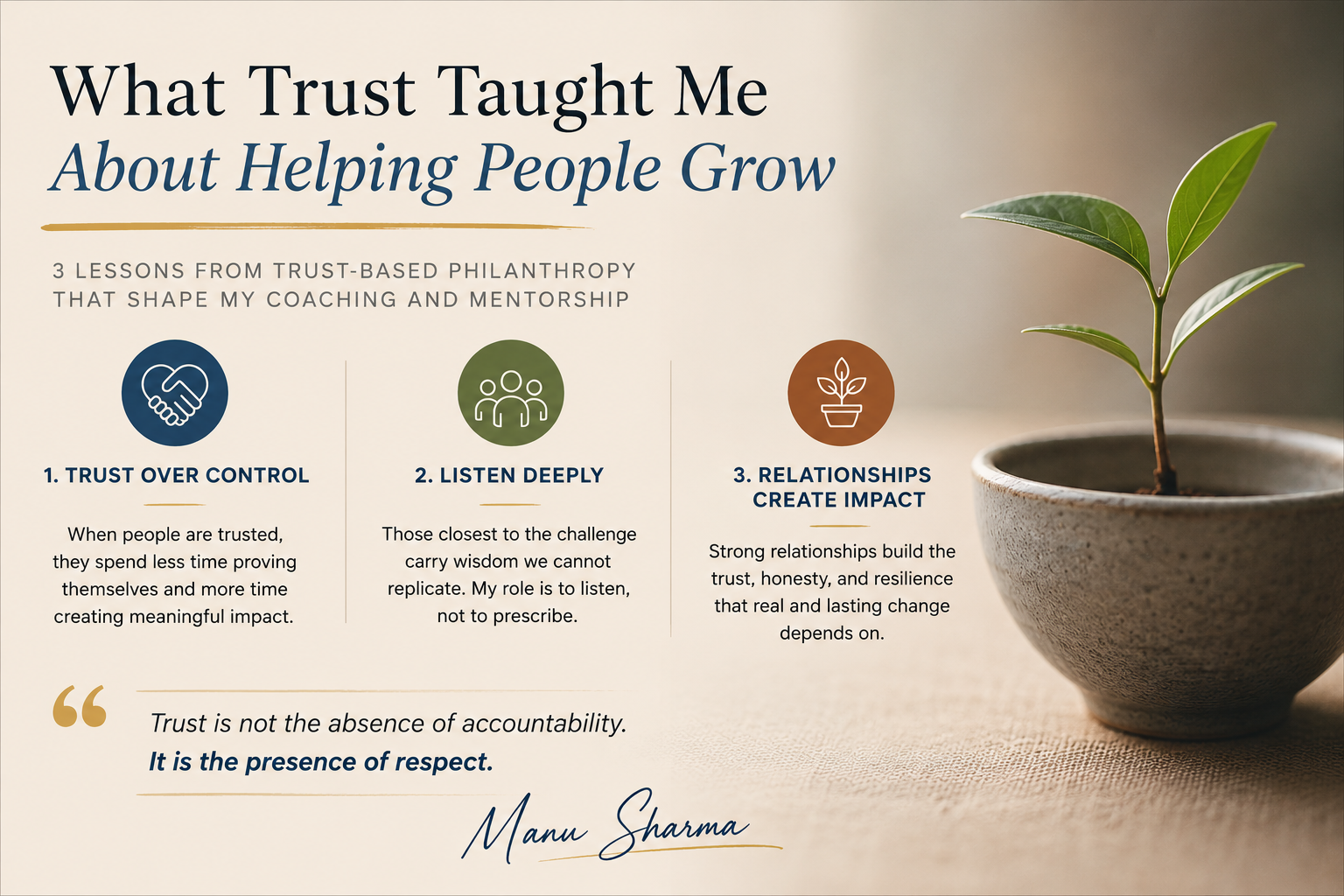
Whether I am working with a senior executive, a new entrepreneur, a nonprofit leader, or a student trying to find their footing, I keep coming back to three lessons that trust-based philanthropy has quietly reinforced for me.
The first is that trust is often more powerful than control.
I think many of us have been conditioned to believe that better outcomes come from tighter oversight. More checkpoints. More approvals. More reporting. More proof.
There are certainly moments when structure matters. Accountability matters. Stewardship matters.
But I have also learned that too much control has a hidden cost. It changes the nature of the relationship. People begin managing perceptions instead of making progress. They spend energy demonstrating competence instead of building it.
In coaching, I have found something remarkably similar.
When people feel they are constantly being evaluated, they become cautious. They say what they think they should say. They avoid uncertainty because uncertainty feels risky.
When they feel trusted, something shifts.
The conversations become more honest. Reflection becomes deeper. Curiosity replaces defensiveness. Growth accelerates because the need to protect one’s image slowly disappears.
I believe trust is not simply a leadership quality. It is a core element of the environment. And people almost always become more capable inside environments where they are trusted.
The second lesson is one I continue to relearn for myself and share with others.
The people closest to the challenge usually understand it better than anyone else.
Trust-based philanthropy reminds us that communities are not empty vessels waiting for solutions to arrive. They carry lived wisdom that cannot be replicated by expertise alone.
I have come to believe the same is true in coaching.
As coaches or mentors, it is tempting to think our value lies in having answers. Experience certainly matters. Perspective matters.
But in my experience, real breakthroughs rarely happen because I offered the perfect piece of advice.
They happen because someone was given enough space to discover something they already knew but had not yet trusted themselves to say out loud.
I will be honest. That has required conscious humility on my part.
Over time, I have learned to ask better questions instead of reaching for quicker answers. To become more interested in understanding than directing. To remember that my role is not to shape people into versions of myself. It is to help them become more fully themselves. To empower them to find answers and solutions that are already within them.
I believe this is one of the quiet disciplines of leadership that deserves far more attention from all of us.
The third lesson may be the one I carry with me most often, and the one that I am most committed to reinforcing.
Relationships create outcomes that transactions never can.
Much of modern life rewards efficiency. We measure activity, timelines, deliverables, and outputs.
Relationships are harder to quantify.
Yet, the way I see it, they determine almost everything that matters.
This philosophy recognizes that meaningful change rarely happens because funding moved from one organization to another. It happens because strong relationships create the conditions for honest conversations, shared learning, thoughtful risk-taking, and resilience when circumstances become difficult.
I see exactly the same pattern in coaching and mentorship.
People rarely remember the framework I shared or the model we worked through.
They remember how they felt during the conversation.
Did they feel heard? Did they feel respected? Did they leave believing they were more capable than when they arrived?
I regularly find that these questions stay with people far longer than any checklist.
I have spent much of my career building frameworks around leadership, decision-making, strategy, and organizational effectiveness. I enjoy creating models because they help bring clarity to complexity.
But if I am honest, I think every framework eventually points back to something much simpler.
People grow best when they are respected.
Not managed. Not fixed. Not controlled.
Respected.
Perhaps that is why my deep dive into trust-based philanthropy has resonated with me so deeply and inspired me in ways I did not expect. At its core, this philosophy is not only about trust; it is about recognizing the dignity, wisdom, and potential within every person.
Its principles reach far beyond philanthropy.
They can shape how we lead teams. How we raise children. How we mentor emerging leaders. How we build communities. How we show up for one another.
I sometimes wonder whether trust is one of the most underappreciated forms of generosity we can offer another human being.
Not because it guarantees success.
It does not.
But because trust quietly communicates something every person hopes to hear.
“I believe there is wisdom in you.”
“I believe you care.”
“I believe you are capable.”
In many ways, that may be the greatest gift we can give another person.
And perhaps, in the end, that is what my experience with trust-based philanthropy has been reminding me all along.