There is a quiet kind of exhaustion that does not come from effort, but from resisting what will not yield.
It shows up in subtle ways. A conversation replayed long after it has ended. A decision you wish had gone differently. A situation that refuses to bend despite your best thinking. The mind circles it, not because there is something left to do, but because it struggles to accept that there is nothing left to change.
I have come to believe that much of what drains us is not the weight of our responsibilities, but the misplacement of our agency.
We spend time, emotion, and attention in places where our influence is either gone or was never real to begin with. And in doing so, we quietly withdraw from the few places where our presence might have actually mattered.
That trade is rarely visible in the moment. It feels like care. It feels like diligence. Sometimes it even feels like accountability. But over time, it becomes something else. It becomes noise. It becomes fatigue. It becomes a slow erosion of clarity.
Let’s be honest about something that is uncomfortable to admit. Not everything is ours to fix. Not every outcome is ours to shape. Not every moment calls for our intervention.
And yet, doing nothing can feel like failure.
So we fill the gap. We overthink. We revisit. We replay. We pray for movement where none is coming. We hold on, not because it is useful, but because letting go feels like giving up.
I do not see it that way anymore.
Accepting what you cannot control is not surrender. It is discernment.
It is the discipline to step back and ask a harder question than “What went wrong?” It is asking, “Where, exactly, do I still have the ability to influence this?”
That question changes everything.
Because it forces a shift from emotion to clarity. From reaction to intention. From scattered effort to directed action.
In my experience, the difference between those who feel stuck and those who move forward is not intelligence, capability, or even resilience. It is their relationship with agency.
They know when to lean in and when to step away. They recognize when their involvement creates movement and when it simply creates more friction. They do not confuse presence with impact.
This is not about becoming detached or indifferent. If anything, it requires a deeper level of engagement. You have to pay closer attention. You have to be more honest with yourself. You have to care enough to choose your involvement carefully.
There are moments when your voice matters. When your action changes the direction of something. When your decision opens or closes a path. In those moments, hesitation carries a cost. That is where you show up fully.
But there are also moments when the outcome is no longer in your hands. When the variables extend beyond your reach. When continuing to push does not create progress, it only creates strain.
The difficulty is that both moments can feel the same from the inside.
That is where reflection becomes a discipline, not a luxury.
I think about times when I held on too long. Not because it was the right thing to do, but because I had convinced myself that persistence alone would change the outcome. It rarely did. What it did instead was narrow my field of vision. I became so focused on one immovable point that I missed other paths that were quietly opening.
I wonder how often we do this without realizing it.
We anchor ourselves to a single version of how something should unfold. And when it does not, we interpret that as a problem to solve rather than a signal to reassess.
But not every closed door is a puzzle. Some are simply closed.
The work, then, is not to force them open. It is to turn around and ask where else your effort might actually matter.
This is where the idea of responsibility needs to be reframed.
Responsibility is not about carrying everything. It is about carrying what is truly yours.
Your actions. Your choices. Your response to what unfolds. The way you show up in the next moment, not the one that has already passed.
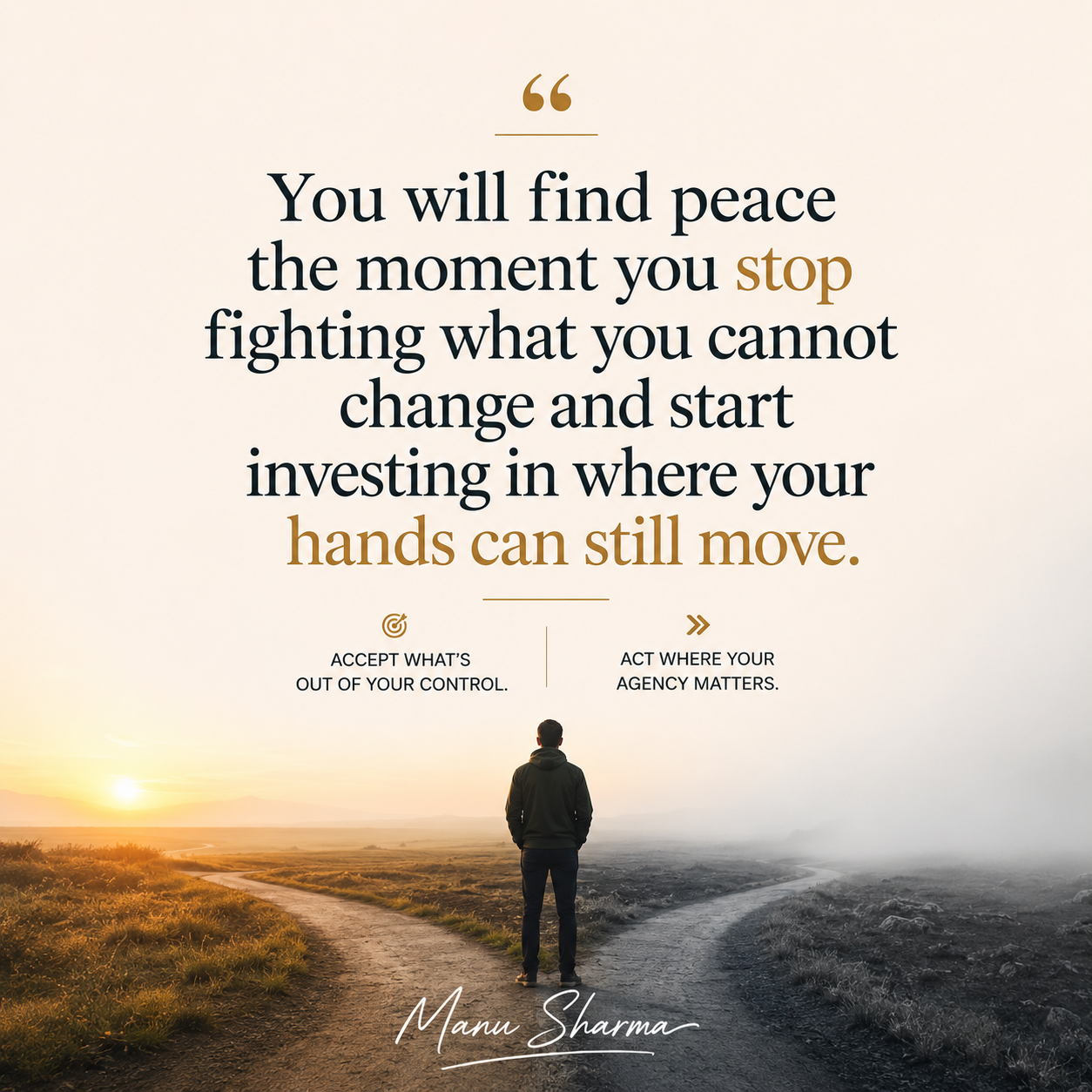
That is where your hands can still move.
And when you redirect your energy there, something shifts. The noise quiets. The regret softens. The sense of paralysis begins to lift, not because the situation has changed, but because your relationship to it has.
You stop negotiating with the past. You stop arguing with reality. You stop waiting for something external to give you permission to move forward.
You begin again, but this time with clarity.
I would contend that this is one of the most underdeveloped forms of discipline in leadership and in life. The ability to locate your agency with precision. To know where your effort will create movement and where it will only create exhaustion.
It is not a grand gesture. It is a series of small, quiet decisions made consistently.
Where do I step in?
Where do I step back?
Where do I let go?
Where do I commit fully?
These are not questions you answer once. They are questions you return to, especially when things feel uncertain.
Because uncertainty has a way of pulling us toward reaction. Toward urgency without direction. Toward doing something, anything, just to feel a sense of control.
But control is often the illusion. Agency is the reality.
And the sooner we learn to distinguish between the two, the more effective, and at peace, we become.
There is a certain calm that comes from this understanding. Not because life becomes easier, but because your energy is no longer scattered.
You are no longer sitting in your corner, replaying what cannot be changed, while the parts of your life that could move forward wait quietly for your attention.
You are present. You are intentional. You are engaged where it counts.
And that, I think, is where meaningful progress begins.