Distrust is often mistaken for intelligence.
We reward it in subtle ways. The quick skepticism, the raised eyebrow, the instinct to question motive before action. It feels sharp, even responsible. As if we are protecting ourselves from being misled, from being taken advantage of, from looking naive. And yet, I have come to believe that this reflex, when left unchecked, costs us more than it protects.
There is a quieter, less celebrated form of strength that sits on the other side of this instinct. It is the decision to assume good intention, not blindly, but deliberately. It is the choice to extend trust as an act of kindness, even when certainty is unavailable.
That choice is not about being right. It is about who we become in the presence of uncertainty.
I think about the many moments in life where people are not at their best. Not because they lack character, but because they are tired, unsure, or carrying something unseen. In those moments, what they are often asking for is not judgment. It is space. It is the chance to be seen without being immediately evaluated.
And this is where generosity shows up in a form that is rarely acknowledged. Not in what we give materially, but in how we interpret others.
To give someone the benefit of doubt is to momentarily suspend the need to be right about them. It is to say, “There may be more here than what I can see right now.” That simple shift can change the entire texture of an interaction.
In my experience, the most effective leaders and the most grounded individuals I have encountered carry this posture with intention. They are not blind to risk. They are not unaware of human complexity. They simply understand that default suspicion narrows possibility, while thoughtful trust expands it.
This does not mean accepting everything at face value. It means starting from a place that allows truth to emerge, rather than forcing it into a predetermined frame.
I have seen conversations soften because one person chose to believe first and question later. I have seen people regain confidence because someone refused to reduce them to a single moment or a single mistake. And I have seen teams move forward, not because everyone agreed, but because they felt respected enough to stay engaged.
Trust, in this sense, becomes a form of emotional infrastructure. It holds relationships steady when circumstances are unclear. It creates the conditions where honesty feels safer than performance.
I wonder sometimes how many opportunities we lose because we close the door too quickly on someone’s intent. How many relationships remain transactional because we hesitate to extend that first layer of belief. How many moments of growth are missed because we chose certainty over curiosity.
There is also a deeper layer to this. When we lead with trust, we are not only shaping how others feel, we are shaping our own internal state. Suspicion is heavy. It demands constant vigilance. It narrows our field of view. Trust, when applied with awareness, allows for a different kind of presence. One that is open, attentive, and less burdened by the need to control every outcome.
This is not a call for blind optimism. It is a call for disciplined generosity.
To assume good intention does not mean ignoring patterns or dismissing evidence. It means starting from a place that gives people the opportunity to show who they are, rather than deciding it for them too early. And when the evidence suggests otherwise, we adjust. Calmly. Clearly. Without resentment.
But we begin with belief.
Because in many cases, people rise or retreat based on how they are first received. When someone is met with trust, even a small amount, it often invites them to meet that trust with responsibility. Not always, but often enough that it matters.
From what I see, this is where leadership quietly differentiates itself. Not in the visible decisions alone, but in the invisible assumptions that precede them. The internal posture that shapes how we interpret behavior, how we respond under ambiguity, how we hold space for others when things are not fully clear.
Assuming good intention is not about others deserving it. It is about us choosing the kind of environment we want to create.
And perhaps more importantly, the kind of person we want to be within it.
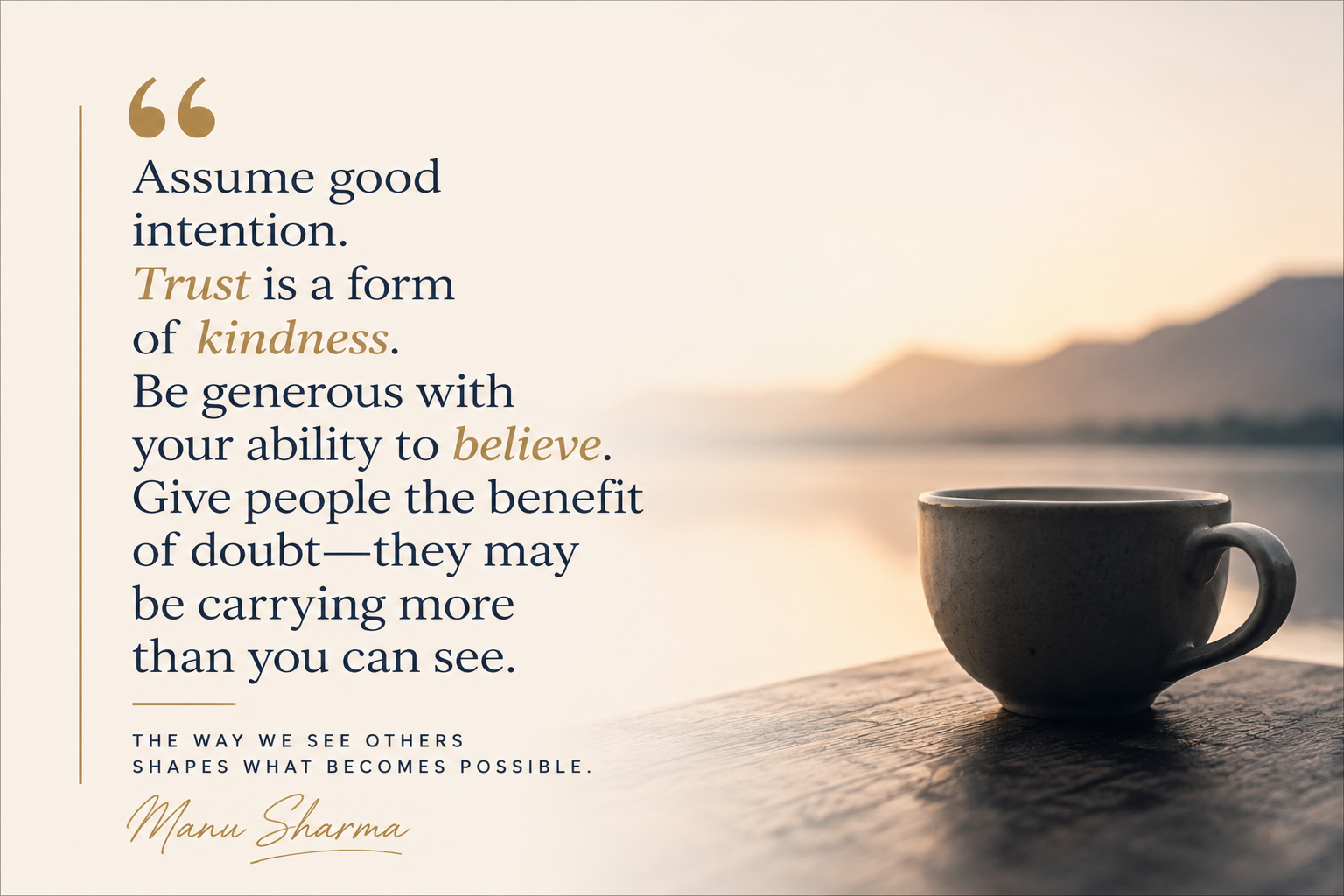
There is a line I keep returning to in my own reflections. Be generous with your ability to believe. Not because the world will always justify it, but because without it, we shrink the very space where trust, confidence, and growth are meant to live.
In a time where doubt travels faster than understanding, choosing to believe well might be one of the most understated forms of leadership we have left.