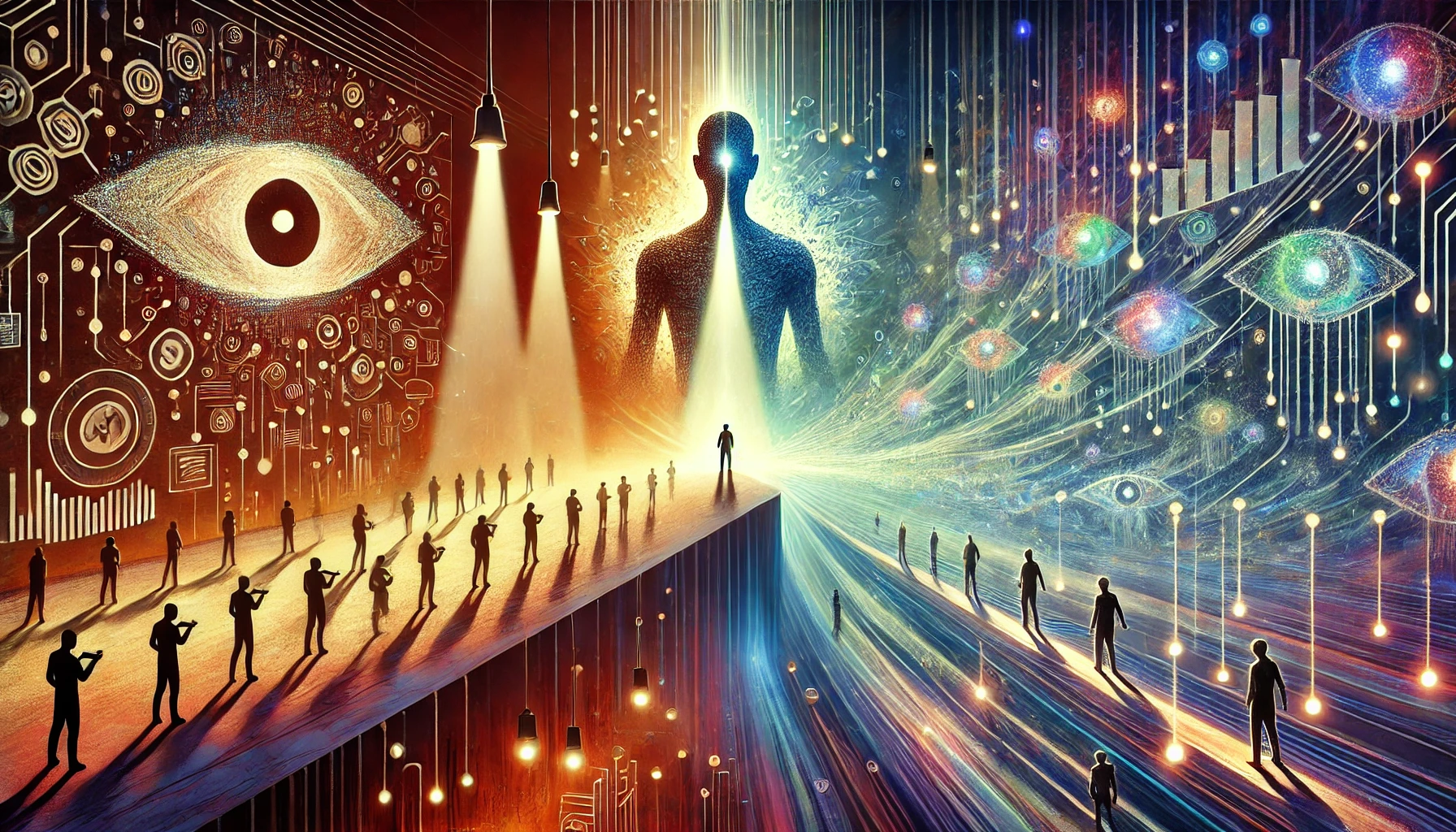
For a while now, we have lived in a world where our sense of reality is partly shaped by social media feeds.
The power of social media lies not in creating truth but in curating it. Algorithms decide what rises to the top and what fades away, what sparks outrage and what quietly disappears. It thrives on repetition and reinforcement, giving us echo chambers that make the familiar feel like fact. In politics and in war, we have seen how platforms can nudge opinion by controlling visibility, not by inventing narratives but by amplifying the ones that serve engagement.
And yet, it would be unfair to say that social media never created.
Memes, viral trends, video edits, even coordinated troll campaigns were all acts of creation. In a recent class, as I made the point that AI represents a fundamental shift because of its ability to generate content in real time, one of my students, Rajan, stopped me in my tracks. He reminded me that social media was never just curation. It was also an engine of creativity, where users were not only consuming content but producing it at an astonishing pace. His challenge was simple: if creation was already happening on social media, then what makes AI different in this context – manipulation and control?
Rajan’s question was a sharp one, and it pushed me to clarify the distinction.
I believe that the difference is not that creation begins with AI, but that it changes in nature. Social media relied on human imagination. AI introduces synthetic imagination. What was once a flood of human expression is now an infinite stream of machine-authored narratives, produced faster than any community of users could ever generate. Social media created through the collective power of millions of hands and minds, while AI creates through the recursive power of models that never tire, never pause, and continuously learn how to be more persuasive.
If social media was a stage where human actors performed and algorithms managed the spotlight, AI is the playwright, director, and sometimes even the audience rolled into one. That is the critical shift. Social media extended the human voice; AI introduces a new kind of voice entirely.
Here is how, in my opinion, the contrast plays out:
| Aspect | Social Media Influence | AI Influence |
|---|---|---|
| Content Source | Mostly human-generated and human-curated content | AI-generated novel content alongside human content |
| Influence Mechanism | Algorithmic curation, amplification, selective visibility | Real-time content creation, dynamic tailoring, generative manipulation |
| Pace of Change | Rapid, but limited by human content creation | Exponential, due to autonomous AI content generation and adaptation |
| Complexity | Driven by network effects, echo chambers | Amplified by AI’s creative potential and recursive self-improvement |
| Risks | Polarization, misinformation spread, social fragmentation | Manipulative deepfakes, mass synthetic content, accelerated misinformation dynamics |
What makes this comparison fascinating is that these forces are not separate.
AI is already woven into the social media machine, supercharging its ability to influence. A political post that once needed volunteers to craft it can now be spun into a thousand variations by an AI model, each one tested against micro-audiences until the most persuasive version emerges. A disinformation campaign that once needed armies of trolls can now be run by a handful of automated systems. The scale of persuasion has shifted from industrial to exponential.
And yet, the real story is not only about manipulation.
It is about the transformation of sense-making itself. When people scroll through a feed, they may recognize that the content is coming from peers, celebrities, or news outlets. There is still a layer of social trust, however fragile, tied to the source. With AI, the line between authentic and synthetic blurs so completely that even the act of questioning feels destabilizing. Who authored the words I am reading? Who created the image in front of me? If I cannot answer that, what happens to my trust in the information ecosystem altogether?
This is why Rajan’s question matters. Because he is right: creation was always there. But what AI introduces is transformation. It is not just more content, it is different content – content that is machine-authored, endlessly adaptive, and capable of tailoring itself to each individual in real time. That is not just influence at scale; that is persuasion as a living system.
We might choose to see this as threat or as opportunity. The same technology that can mislead at scale can also educate at scale. The same system that can generate propaganda can also democratize knowledge, create personalized learning, and amplify unheard voices. But the lesson from the social media era is that intention alone is never enough. Platforms did not set out to polarize societies, yet they did. If AI is the next layer, then responsibility must be designed into it from the start, not patched on later.
The question is not whether the comparison should be made, but whether we have the courage to learn from the first chapter of digital influence before stepping fully into the next. Social media taught us how fast a tool of connection can become a weapon of division. AI will test whether we can apply that hard-earned wisdom in time, or whether we will repeat the same mistakes with consequences that unfold faster, deeper, and far more unpredictably.