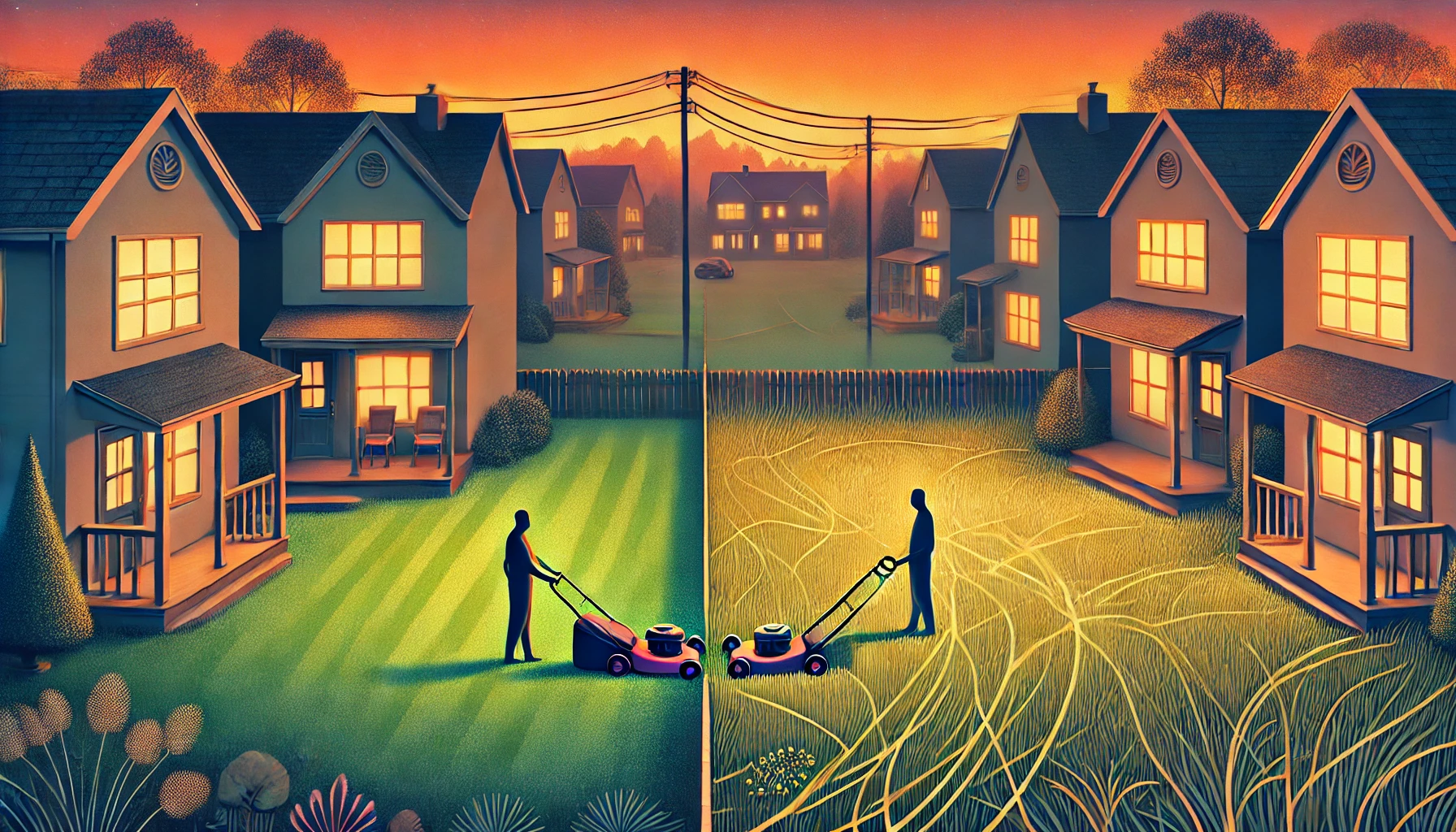
The other day, someone asked me why I had taken the time to mow my neighbour’s lawn while I was already mowing mine.
On the surface, it was a simple question. But it gave me pause. Not because I didn’t know the answer, but because the question revealed more than it intended. It wasn’t really about grass.
I took a moment. I didn’t want to rush into a casual explanation. I wanted to be precise, not defensive. Intentional, not performative. So I asked him, gently, “Why do you ask?”
He hesitated at first, then offered an honest observation: “Well, they have their own children. Why are you doing it when their kids can take care of it?” His tone wasn’t dismissive. If anything, he was genuinely puzzled. He assumed I was doing it out of kindness, which in his mind made it noble, but also unnecessary. It felt to him like I had taken on a burden that belonged elsewhere.
This, to me, is where it gets interesting. Because the logic behind that question – of who owes what to whom, and why – is not just about lawn care. It’s about the frameworks we use to assess value, effort, obligation, and belonging.
So I responded with three things, though not quite in bullet points at the time.
First, not everything in life needs to be transactional. We are surrounded by a quiet pressure to balance ledgers that no one asked us to keep. A favour received must be a favour returned. A kindness shown must be earned or reciprocated. Even relationships are often treated like running accounts, constantly audited for fairness. But the best parts of life – kindness, generosity, empathy – don’t fit on a balance sheet. They’re not supposed to. Not everything has to be scored, justified, or paid back. Sometimes you do something simply because it feels right in the moment. Because it costs you little and means something to someone else.
Second, it wasn’t just an act of kindness. It was a small gesture of civic presence. Of neighbourliness. We talk a lot about building community, but we often forget that community isn’t built with large declarations. It’s built with quiet, often invisible, acts of care. Picking up litter. Checking in. Shoveling snow. Mowing a lawn. These aren’t grand gestures. They’re habits of thought. Subtle signals that say, “You matter. I see you. We share this space.” And these neighbours have been kind to us in many small ways. So this wasn’t charity. It was symmetry.
And third, as for the part about their children – yes, they have them. But their kindness toward us has never been dependent on whether we have parents or siblings of our own. They treat us like neighbours, not like gaps to be filled or problems to be solved. So if we don’t hold them back from showing kindness to us, why should the existence of their children hold us back from doing the same?
What struck me most about that whole exchange wasn’t the question itself, but what it represented. It was a reminder of how deeply we’ve internalized the idea that things must be earned. That value flows only through obligation or utility. That people must justify their need, and others must justify their help. It’s a mindset that shows up everywhere – from how we manage workplace performance to how we treat aging parents, from who we vote for to who we let into our lives.
But I don’t believe in that kind of ledger. At least not all the time.
To me, mowing that lawn wasn’t a task. It was a choice. A way to remind myself that the boundaries we draw – mine and theirs, obligation and generosity, owed and earned – are often just habits of thought. They are movable lines. And every now and then, you get to push one a little further outward. You get to redraw the map just enough to remind yourself what kind of neighbour, friend, colleague, or human being you still want to be.
The truth is, it’s easy to forget how much influence we have in shaping the atmosphere around us. Culture, after all, is built one gesture at a time. One person decides not to gossip. Another gives without waiting to be asked. Someone else chooses not to keep score. These aren’t dramatic acts, but they create a ripple that shifts expectations.
And that’s really what this story is about. It’s not about lawns. It’s about the kind of world we want to live in. One where kindness is rationed and every act needs a justification? Or one where we allow ourselves to do small things that make life feel a little more human?
I don’t always mow their lawn. And they don’t expect me to. But every once in a while, when I’ve got the time and energy, I’ll keep going a few extra feet. Not because I have to. Not because it’s heroic. But because it’s one small way of saying: we’re in this together. And in a world where everyone’s busy measuring, weighing, and comparing, that feels like a quiet, rebellious thing to do.
Sometimes, the most radical thing you can do is something that doesn’t need to be done. Something that no one asked for. Something that isn’t earned. That’s how we stretch the boundaries of care – and how we remind ourselves what kind of neighbours we still have the capacity to become.