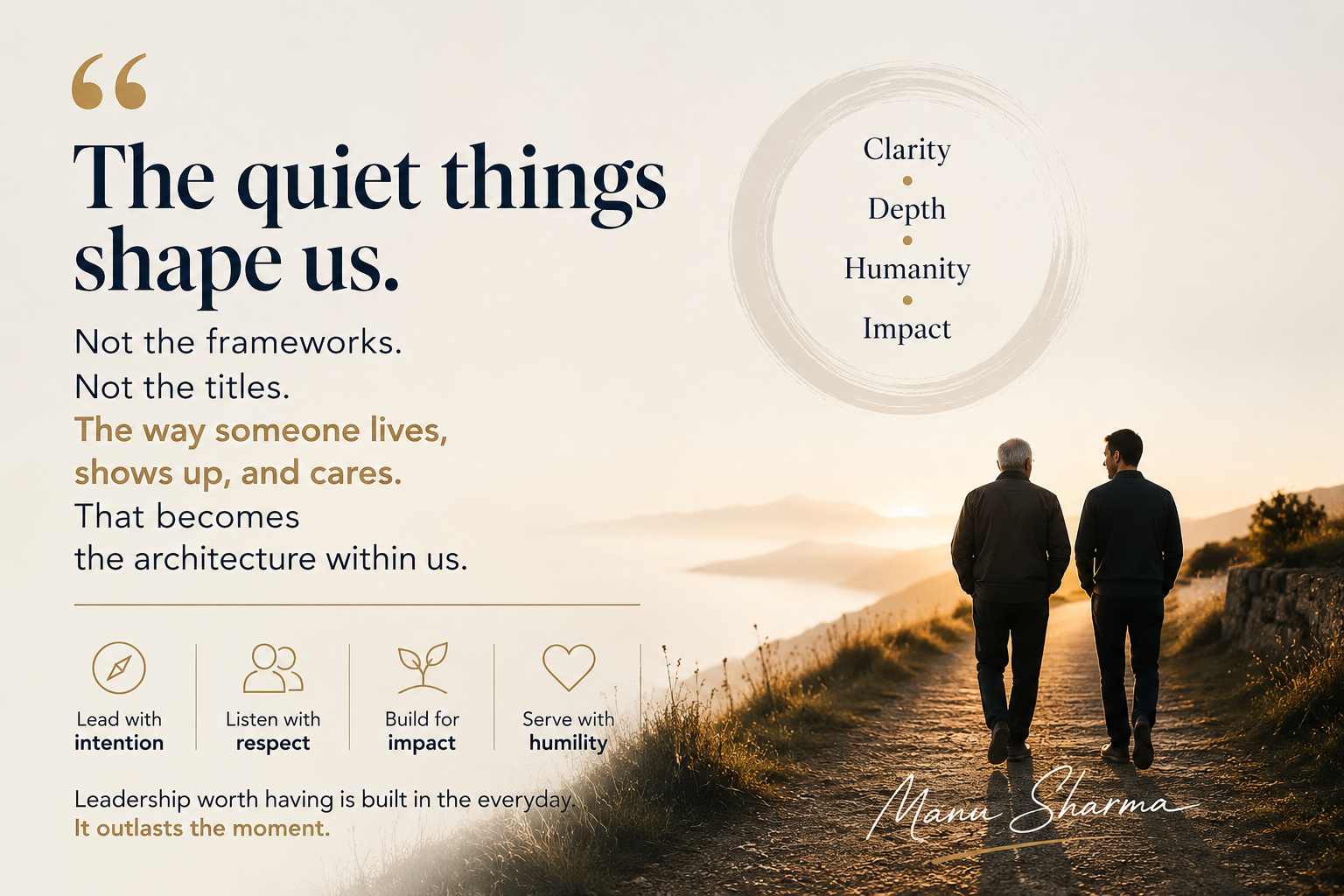
The people who shape us most rarely announce what they are doing while they are doing it.
They are not thinking in terms of influence or legacy or even teaching. They are simply living. Day after day. In ways that feel almost too ordinary to notice at the time. And yet, over years, those ordinary repetitions begin to form something in us that feels unmistakably like a spine.
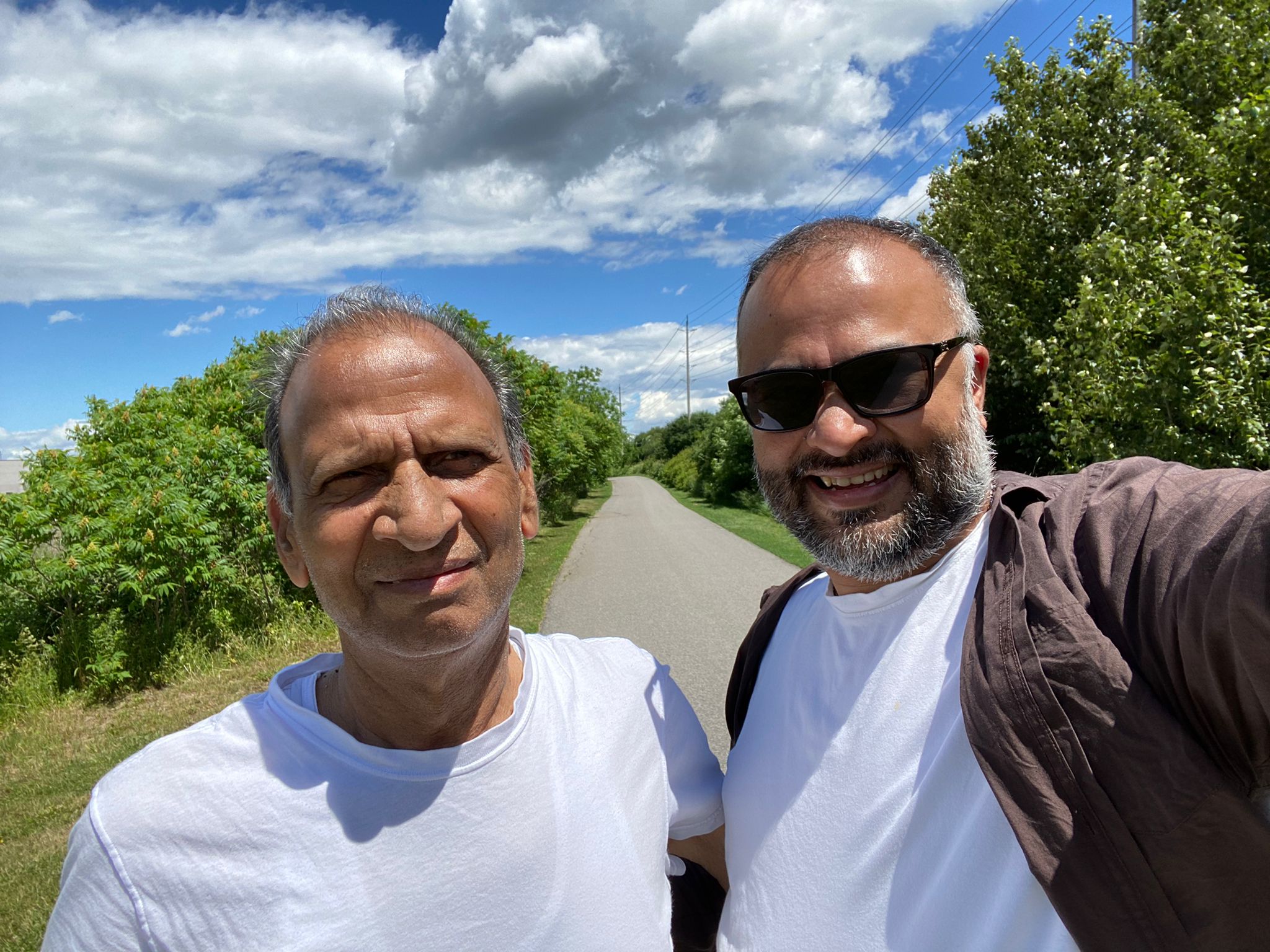
I think about this often when I think about my father.
He never offered me a framework for leadership. There were no structured lessons, no articulated philosophy, no language designed to be remembered. What he offered instead was something far more enduring. A way of being in the world where effort did not require an audience, where integrity was not conditional on recognition, and where responsibility was assumed rather than announced.
It is only much later in life that you realize how formative that kind of quiet becomes.
For me, it showed up first in how I understood education. Not as a credential or a pathway, but as a responsibility you carry toward yourself and toward the world you intend to engage with. It showed up in how I think about learning, not as something you complete, but something you return to again and again because it keeps you honest. And it shows up, still, in my ongoing negotiation with fear, ego, and expectation. The things that don’t disappear, but can be learned to sit with differently.
My father has always been steady in that way. Not loud, not performative, not interested in spectacle. Just consistent. Present. Reliable in the way that matters when life becomes unpredictable.
Over the last decade, we have had more time together than in all the years before it. And then came Covid, when time itself seemed to soften and slow down. Like many families, we were drawn into a smaller orbit. Fewer distractions. Fewer exits. More proximity, more care, more ordinary acts of looking after one another.
There is something about that period that I still return to in my mind.
The rhythm of shared days. The absence of urgency that usually crowds reflection out. The quiet recognition that presence is not a luxury, it is the foundation.
In those months, what became clear to me was not something new about him, but something I had not fully understood before. The values I associate with him were never abstract principles. They were lived habits. Repeated so often that they became invisible.
I think there is a deeper truth in that, especially in a time that often confuses expression with substance. We live in a world that rewards articulation, visibility, and performance of intent. But the more I observe leadership in different contexts, the more I find myself returning to something simpler. What endures is not what is said most clearly. It is what is done most consistently.
My father would never have framed it that way, but he lived it fully.
He placed value on showing up. On doing what needed to be done without turning it into a narrative. On carrying responsibility without asking for acknowledgement. There is a kind of dignity in that which is easy to overlook if you are only measuring what is visible.
He also taught my sister and me something that has stayed with me more deeply over time. That we are responsible for each other. Not in an abstract or sentimental sense, but in a practical, lived way. That family is not simply belonging. It is care in action. It is attention. It is the quiet decision to not let one another fall through the gaps of life.
And there is another dimension of him that I have come to appreciate more as the world around us has changed.
Long before equity became a widely spoken value in organizations and public discourse, he embodied it in the way he moved through the world. Especially in how he related to the women in his life. There was respect there, not as an idea, but as a default setting. He listened in ways that did not require correction later. He made space without being asked to. It was not something he performed. It was simply how he understood people should be treated.
As I reflect on this now, I realize how much of leadership is shaped not in formal settings, but in these early, intimate environments where you first learn what power looks like when it is exercised with or without care.
There is a kind of leadership I find myself returning to more often as I get older. It does not announce itself. It does not rely on visibility. It is not interested in being recognized in the moment it is happening. It is closer to stewardship than strategy. It is the kind that builds something slowly enough that it can hold weight beyond the person who built it.
From what I have seen in my own work and across the different systems I have had the privilege to engage with, the leaders who leave a lasting imprint are rarely the ones who are most visible. They are the ones who are most consistent. The ones who create trust not through persuasion, but through repetition of care. The ones who understand that credibility is accumulated quietly, over time, in moments that most people overlook.
I would contend that this is becoming even more important now, not less.
Because when everything moves faster, depth becomes a discipline. And when attention fragments, presence becomes a form of leadership in itself.
So on days like today, I find myself less interested in celebration as performance and more drawn to reflection as practice.
What does it mean to have been shaped by someone who never set out to shape you?
What does it mean to carry forward values that were never explicitly taught, only lived?
What does it mean to recognize that much of what we become is inherited through observation, not instruction?
I do not have perfect answers to those questions. But I do have a deep sense of gratitude for the quiet architecture that was built over time, without announcement or expectation.
My father has been that architecture for me. A steady reference point. A reminder of what matters when everything else becomes noisy.
And perhaps the most honest way to honor that is not to try to define it too tightly, but to continue to live it forward in my own imperfect way. In how I show up. In how I listen. In how I carry responsibility. In how I relate to the people who depend on me, even in small ways.
Because in the end, what we pass on is rarely what we intend to pass on.
It is what we consistently live.
Happy Father’s Day to all who are celebrating.